
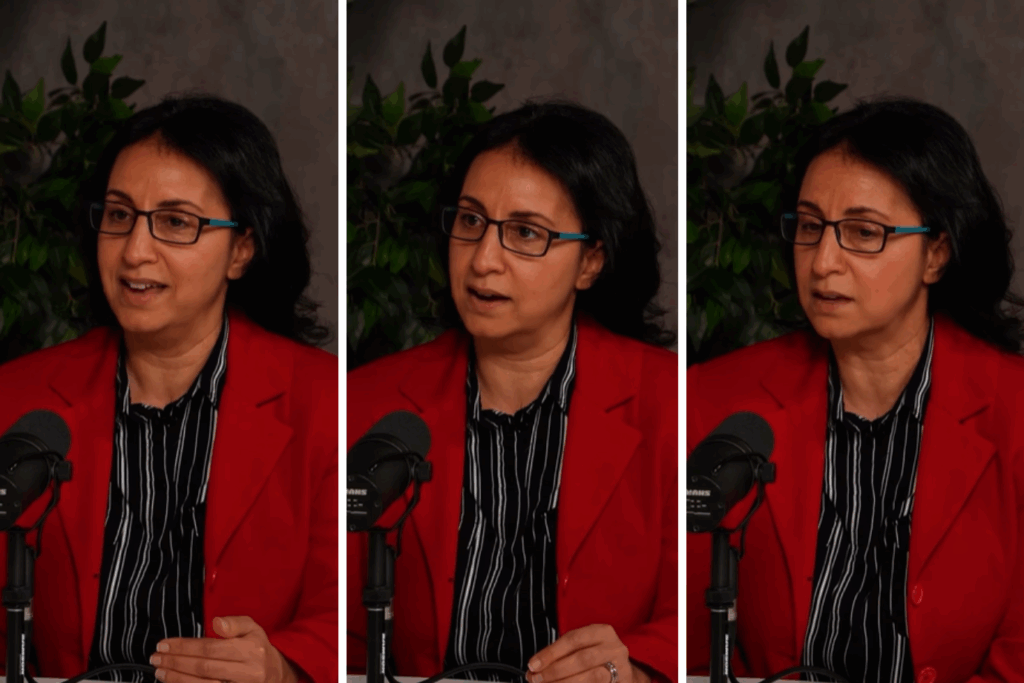
Survivor-turned-advocate, artist and legal trailblazer Jo Cooper is campaigning for nationwide adoption of Clare’s Law to prevent domestic violence and urging bystanders to become “warriors of change” against injustice.
Through her advocacy for Clare’s Law, Cooper is calling for proactive measures towards ending domestic violence. She says Australia’s legal framework is currently stuck in ‘crisis management’ mode.
“We are always reacting to domestic violence,” Cooper tells the Women’s Agenda podcast.
“As a survivor, you see these patterns and it’s been decades. We’re talking about the same thing. We see the same headlines. I look around and everyone’s doing the same thing. It’s crisis management.”
Aiming to get to the root cause of the issue, Cooper recently finalised a petition of 20,000 signatures for Clare’s Law in New South Wales. The new law, also known as the Domestic Violence Disclosure Scheme (DVDS), would essentially give people the right to know if their partner or potential partner has a history of violence or abuse.
The scheme is named after a woman in the UK, Clare Wood, who was murdered by her abusive ex-boyfriend in 2009. It was formally rolled out in England and Wales in 2014.
Here in Australia, Clare’s Law is already implemented in South Australia, and Cooper’s hope is that it becomes implemented nationwide.
“It’s an opportunity to look at where we’re failing and where things are falling through the cracks and get it right and have the conversation,” says Cooper, adding that one of the issues of not having Clare’s Law implemented nationally is that domestic abusers can cross borders.
A national register, she says, is what victim-survivors want. It would give people agency to access information that could keep them safe and potentially save their life.
Given that Australia already has police checks, criminal records and history checks for employment, Cooper says a national register of DV offences is “no different”.
“We all know there’s always going to be first time offenders.That’s just the nature of the beast, but to say that it’s not a repetitive behavior is to not understand domestic and family violence,” says Cooper.
“A lot of people are criticising it about privacy or false information. If we were to adopt that train of thought, we might as well do away with police checks and criminal histories and safety belts.”

The 20,000 signatures that Cooper’s petition received was monumental in that Clare’s Law must now be tabled in parliament.
For Cooper, any step in the right direction is vital, which is why she has been pushing hard for more support, including on social media, where she’s sending a clear message that victim-survivors want women to be able to access information on their partner’s history of violence.
“Nothing will ever be perfect enough,” she says, “but what we are guaranteed to not see is more tragedy. That is a guarantee.”
With the latest statistics showing 44 women have been killed already this year, Cooper says we cannot just leave the issue of domestic violence in crisis management.
“As far as I’m concerned, this is a national failure to date. There’s no other way to put it. We are not succeeding in this fight.”
Bystander culture
Already having made big impacts in other areas, Cooper once changed the law in her legal victory in Cooper v The Owners, a landmark court case ranked the #6 Most Influential Court Case of the 21st Century.
She’s also the Founder of The Good Warrior, where she leads a powerful movement to transform bystander culture and dismantle systemic abuse.
When it comes to defining what bystander culture entails, Cooper says this is the middle group of ‘silent’ people who hold all the power.
“You’ve got the people or the systems that abuse power. You’ve got the people that are harmed by that system or that or that person. Then, you’ve got this middle, who I call the power brokers of change, and they are the silent bystanders.They hold the power,” says Cooper.
“It’s somebody who watches injustice escalate. It’s somebody that watches harm and sits back and does nothing.”
In the workplace, a bystander could look like someone who doesn’t speak out for a co-worker being treated unfairly. On a more global scale, it could look like people who don’t speak out against wars or genocide.
“People will see and go, ‘oh my God, how did this happen?’ Well, it happened because people stayed quiet, because in all of those scenarios, people knew something was not right, but they stayed silent,” says Cooper.
“I love motivating people to basically be ‘warriors of change’ is what I call it,” she says, adding that she loves to help people understand they”have the power to change the course of injustice” through their actions and motivation to speak out.
“If you challenge something as soon as you see it, then it’s less likely that it will escalate into a crisis. That’s the message I’m trying to convey- the quicker we call things out, the earlier we call things out, then we don’t need somebody to come in at the 11th hour and take on the mountain, to take on the big ugly beast.”
As an artist, Cooper is bringing the power of music into the fight against injustice, saying that storytelling and emotion can bring people together in formidable ways.
“I do use my music now in the storytelling part, but I would love to see it as a global movement, a global brand where we’re really telling people stories,” Cooper says. “We’re invoking that emotion through music. I want it to be a place where people hear ‘the good warrior’, and they know it’s a safe place.”
“It’s a place that’s going to represent people who care about changing policies that are outdated, and care about defending those people that are considered victims.”