
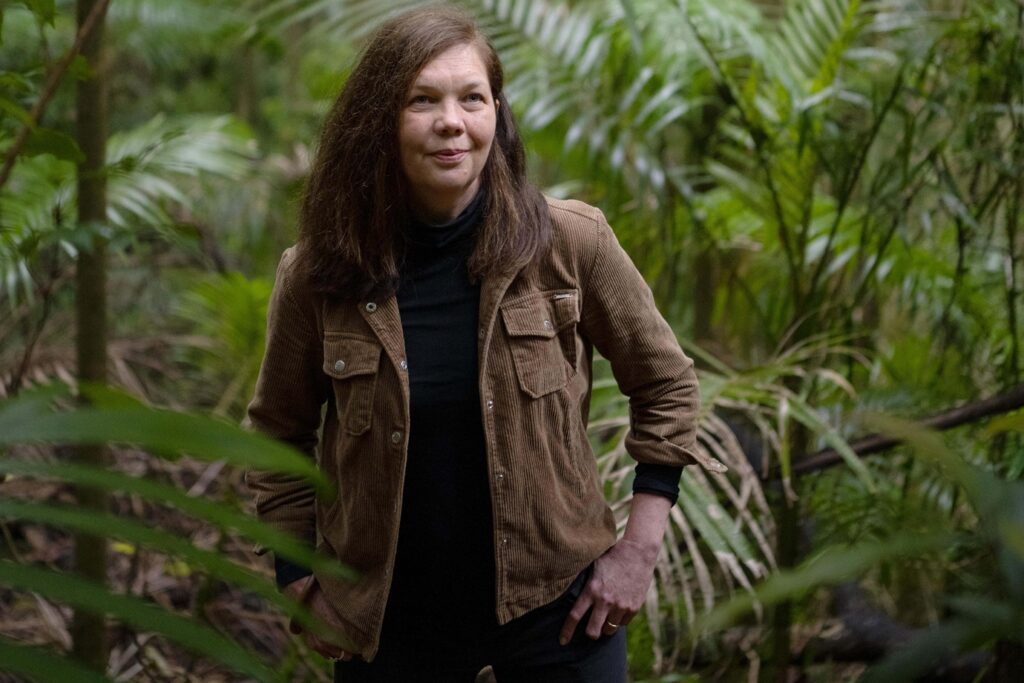
“Don’t sign anything you don’t understand.” It’s solid advice for any situation from accepting a work contract to signing a lease. Coming from Robyn James, it feels much more poignant.
She retells the story of a chief in the Solomon Islands who once broke down after realising what he had given away. “You should have come earlier,” he told her. “I have signed our land for a bag of rice.” It’s a moment she carries with her and one that clearly captures why her work matters.
Robyn is the former Global Director of Gender Equity at The Nature Conservancy, the world’s largest conservation organisation with over 6,000 global staff, and is now Adjunct Associate Professor at the University of Queensland. She joins the latest episode of There Will Be Dancing, a podcast produced by Women’s Environmental Leadership Australia (WELA) in partnership with Women’s Agenda, to explore what it means to share power in a movement that often assumes its own goodness.
Her first job was as the only female wildlife ranger at a remote station outside Mount Isa. The equipment wasn’t made for her. She shared accommodation with all men. The expectations of her were wildly different; that she wouldn’t be able to do fire management, drive a four-wheel drive confidently, handle the hard work. “That is really tiring after a while,” she says. From that moment on, she was always watching for who was finding it more difficult to be involved.
In the Solomon Islands, working on a climate resilience project, the women she was working with redirected her entirely. A mine was coming to their land. They weren’t being consulted. They didn’t even know what a mine was or what signing away their rights would mean. So James and her team built an information package from scratch. It included photographs of what a mine is, what your rights are, how long the process takes, a photo of a baby next to a photo of a grandparent to illustrate the lifecycle of a mine that communities assumed would last two weeks. They reached over 30,000 people. In 2020 those women, working with the Environmental Defenders Office and the Public Solicitors Office in the Solomon Islands, successfully stopped an illegal bauxite mine.
Robyn’s mangrove story isn’t quite as dramatic, but it’s no less revealing.
In coastal communities across the Pacific, women do most of their fishing in the mangroves because they can’t access the boats needed to fish offshore. Mangroves were long dismissed as wasteland, and as women’s spaces. Now, with carbon markets placing enormous financial value on the carbon stored in coastal ecosystems, those same mangroves have become contested ground. “Suddenly they’re valuable,” Robyn says, “and all these different people are interested in these spaces and women are being excluded.” The pattern is consistent: once something women have always managed becomes profitable, someone else arrives to claim it.
Her decision to leave The Nature Conservancy was shaped by that same analysis. When the US administration began rolling back DEI commitments in January 2025, the ripple effects were immediate and global. USAID lost $60 billion overnight. Global aid dropped 23 per cent. For someone working inside a large US-based organisation, speaking openly about gender justice, climate justice and conservation as interconnected became increasingly difficult.
But the global context was only part of it. “Sometimes the conservation movement gets a bit of a free pass,” she says, “because we’re green. And so automatically we’re really equitable. But that’s not necessarily how it works.”
Robyn still still hopeful. Australia now has 50 per cent women in Parliament for the first time in history. “We need to be taking more strategic advantage of things like that,” she says. She is buoyed by watching grassroots organisations get organised, find the cracks and move through them.
This episode also features an audio contribution from the women of Katupika, Wagina and Kia in the Solomon Islands, founders of the KAWAKI women’s group, whose traditional songs open the episode and prove that culture and conservation cannot be pulled apart.
Listen to the full conversation with Robyn James on There Will Be Dancing, available now on Spotify, Apple Podcasts and all major platforms.