
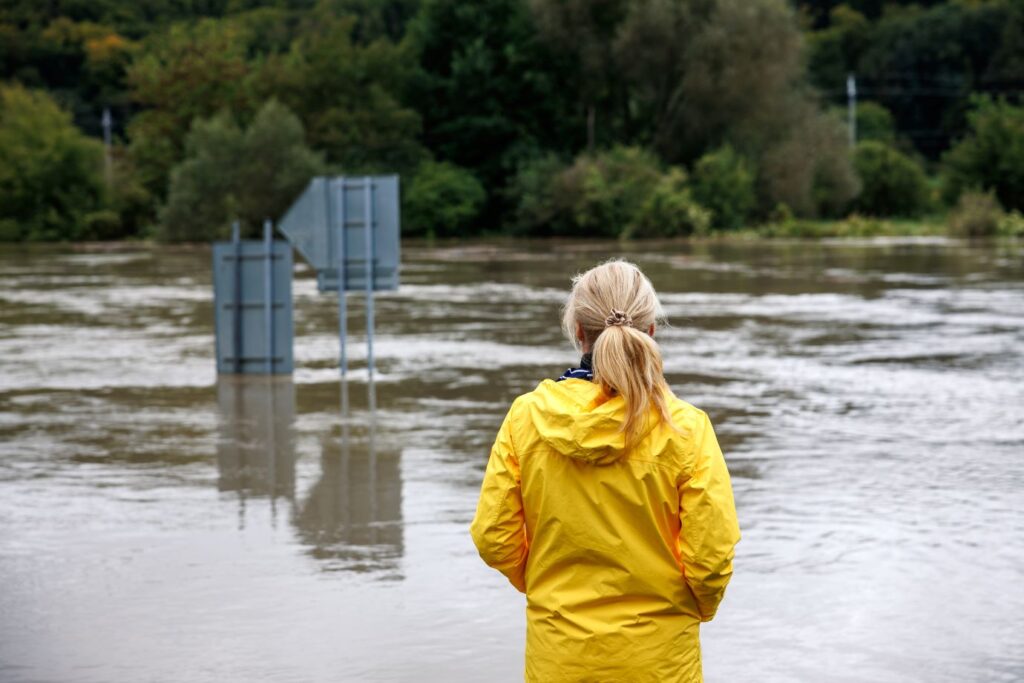
Environmental disasters can exacerbate existing inequalities in society which can worsen gender-based violence, disrupt reproductive healthcare and lead to a significant rise in unpaid emotional labour.
Late last year, the federal government released a long-awaited National Climate Risk Assessment report, spotlighting the “compounding, cascading and concurrent” threats to millions of Australians as environmental conditions worsen.
The report warned that heat-related deaths could increase by close to 450 per cent in cities like Sydney in coming decades if global warming surpasses 3 degrees.
But as Australia responds to increasingly severe weather events, researchers are also warning of the adverse effects disproportionately affecting women, girls and gender-diverse people.
Professor Jacqui True is the director of the ARC Centre of Excellence for the Elimination of Violence Against Women (CEVAW), which has been tracking women’s safety after natural disasters through the Women’s Safety Index.
“When a disaster occurs or an extreme weather event, often what’s reported and what we see are the most visible effects so the destruction of physical infrastructure or the impact on livelihoods,” True says.
“What we don’t see and what is less reported are the less visible impacts, the social impacts.”
The index and other research shows links between aggression and environmental disasters like floods and earthquakes.
True says high levels of stress and economic pressures are drivers of men’s violence against women and girls.
In communities with limited protective factors in place for gender equity, protection and resources, the index shows women and girls are more susceptible to violence in the aftermath of severe weather events.
According to the index, a number of key variables can determine this including: education, employment, parliamentary representation, maternal survival rates, non-violent attitudes and infrastructure such access to mobile phones, power and water sanitation.
In a recent example, the index tracked the aftermath of earthquakes in Japan and Venezuela.

“In Venezuela, we have really poor protective foundations for women’s safety,” says True.
“Venezuela has maternal mortality on par with Sudan, which is one of the poorest countries in the world and also conflict-affected.
“Japan by contrast has hardly any maternal mortality, very strong foundations for women’s health and in these other dimensions especially access to resources, which are impacted in disasters.
“Based on our previous research, which has shaped the Women’s Safety Index and our modelling of the impact of disasters, we would expect to see very high levels of gender-based violence in Venezuela and very limited preparation for that and far lower impacts in Japan.”
How the climate crisis impacts rates of violence against women
Severe weather events that disrupt communication and cut communities off can leave victims of gendered-violence at even greater risk of abuse.
In some cases, women find themselves further isolated with their perpetrators with limited access to support or resources.
During recovery and rebuilding efforts, pressures around finances and other stressors can lead to more acts of violence.
Family Planning NSW CEO Sue Shilbury says climate disasters like floods, bushfires and heatwaves present disproportionate risks to women and girls.
“Women and girls are 14 times more likely to die during disasters than the rest of the population,” says Shilbury.
“And they do face specific risks. There’s an increased risk of gender-based violence following any form of climate disaster.
“There’s a loss of livelihood, reduced access to education and health services, which is all compounded by any existing inequalities.”
A Monash University study exploring links between domestic violence and the aftermath of natural disaster found alarming rises in this type of abuse after major climate events.
After the Canterbury earthquake in New Zealand, local police reported a 53 per cent rise in domestic violence.
After Hurricane Katrina in the US, the study says there was a 98 per cent rise in physical victimisation of women.
Another study published in Jama Psychiatry found that with every 1 degree centigrade rise in the annual mean temperature in India, Nepal and Pakistan, there was a 4.5 per cent increase in intimate-partner violence against women in relationships aged 15 to 49.
Similarly in Australia, researchers have found gender-based violence increases in the aftermath of severe weather events.
A CEVAW study under peer review, led by Dr Rafat Mahmood, compares ABS crime data on gender-based violence with HILDA survey data.
She has found that police receive a relatively low amount of reports of family or domestic violence in the aftermath of disasters in rural areas of NSW but self-reported data in the HILDA survey shows the opposite – suggesting victims are experiencing high levels of violence but less likely to report to authorities.
“There already, when we look at our two data sets, we can see a real disconnect,” says True.
“It’s likely that people in a disaster, we expect them to be less able to report to police because there are so many things to deal with and they may not have access.
“So that has huge implications for how we respond and prepare for responding to disasters.”
True says another study led by Monash University and CEVAW analysed hospital data in Victoria which mandates reporting of injury presentations.
It found that assaults in homes where there is domestic or family violence increases by 6 per cent on hot days and 7 per cent when temperatures exceed 30 degrees.
She says it’s a worrying statistic given this only captures victims who disclose what happened in a hospital emergency department or the circumstances are discovered by discerning staff who record the injury cause.
“That is the tip of the iceberg,” she says.
Shilbury says higher rates of gender-based violence were also documented after the 2009 Black Saturday Bushfires in Victoria.
“For some victims, it was the first time their partner had used violence,” says Shilbury.
The invisible ‘mental load’ and caregiving burden
In disaster-prone regions, a significant amount of emotional and physical labor falls on the shoulders of women and caregivers.
Dr Bronwyn Gresham, the CEO of Psychology for a Safe Climate (PSC), says this work is often done quietly without much acknowledgement.
“They are monitoring warnings, planning for evacuation, making sure medications and documents are ready, soothing children, checking on neighbours and having the hard conversations about risk while still trying to keep things feeling ‘normal’,” she says.
“During crises like the COVID‑19 pandemic, unpaid care work increased for everyone but rose more sharply for women with higher unpaid care loads and unequal division within couples both associated with increased psychological distress.”
Despite this work being crucial to the fabric and resilience of society, it is often minimised and undervalued.
Dr Gresham says carers have the lowest collective wellbeing scores of any group in Australia with more than half living with moderate depression and other stressors.
“So when we add climate disasters on top, we have to be very intentional about how we support them,” she says.
What policymakers must take more seriously
True says communities that have systems in place to protect gender equity are less likely to leave women and girls exposed when disaster hits.
“If you have strong foundations for women’s safety in your society and your community, when a disaster occurs, you are able to buffer or mitigate some of those impacts of violence,” says True.
“That is what the Women’s Safety Index shows us.”
What makes a difference
Modelling and analysis by the Women’s Safety Index shows key societal systems and structures that can influence rates of violence and safety after major weather events. Together these provide a measure of the fairness and inclusiveness of a society.
Equity:
- Education
- Employment
- Representation in parliament
- Poverty levels
- Absence of legal discrimination
Protection
- Maternal mortality rates
- Attitudes towards violence
- Prevalence of child marriage
Resources:
- Safe water and sanitisation
- Electricity
- Mobile phone use
- Financial services
- Other essential resources that support security and autonomy
While the index ranks Australia relatively well at a national level, True says there are critical gaps when we zoom into particular communities.
Women and children are especially exposed in rural areas where access to resources and communication is lacking.
“Despite the evidence that we’re seeing here, we actually don’t build protection or preparation to prevent gender-based violence during disasters into our planning systems,” says True.
“In Australia, there are heat hospital plans.
“For example, Queensland has a heatwave management plan that recognises the risk of psychological stress that’s associated with increases in violent crime and domestic violence. They state it in the plan but they don’t actually operationalise it through hospital preparedness and response procedures.
“There isn’t adequate training of hospital staff to detect possible domestic and family violence presentations in the context of extreme weather. Heat health plans, which are available in many hospitals, don’t incorporate domestic and family violence preparedness checklists.
“So the screening and risk assessment is not reinforced there.
“On the crime prevention and mitigation side, we really don’t have any preparedness there. There’s potential for law enforcement, police patrolling in streets on hot days, camera surveillance, all of those sorts of things could be trialled.
“We can expect increasing heat in Australia but we are not prepared for the social impacts, particularly on women and girls.”
De-individualising climate distress and response efforts
A combination of tools and social factors contribute to the lasting wellbeing of a community affected by severe weather events.
PSC Programs Manager Beth Hill says improving mental health outcomes and building long-standing resilience in the face of climate change cannot happen with people doing therapy in isolation.
She says there needs to be a more ‘collective’ approach with more safe avenues for people to slow down, connect and open up about living with severe weather events.
One example of this is Climate Cafes led by PSC.
The program is designed to build emotional resilience and collective growth.
PSC facilitates circles online or in-person giving individuals a way to carry the weight of heavy global events like fires, floods or conflict.
“We train people from all over the country to become Climate Cafe facilitators so they can offer a cafe in their own community,” says Hill.
“So it’s a space usually of 12 to 15 people who come together to really speak about what’s on my heart today around the climate or poly crisis? How is it showing up in my life? What am I grappling with?
“So speaking from your own experience and then listening to other people.”
Hill says one of the most therapeutic aspects of the cafe is that there is no agenda or pressure to wrap action points and next steps.
The aim is to build resilience by allowing people to unwind and connect.
“There’s this real healing that happens as that sense of isolation kind of falls away,” she says.
“For those who have been through disasters, it can often be difficult to talk about climate in the same sentence as talking about the disaster for other people in the community who just don’t want to hear that other layer on top of the trauma that they’re already managing.”
PSC CEO Dr Bronwyn Gresham says spaces like climate-focused groups can help reduce isolation for women and gender-diverse people while allowing them to name their experiences and ‘collectively imagine safer and more just responses’.
“Climate disasters don’t hit a blank canvas,” says Dr Gresham.
“They land on top of numerous systems of disadvantage including those already holding
unequal loads of care and women are often the ones carrying that invisible emotional and cognitive load.
“In our groups, it’s often women who turn up, not because they’re more fragile – in fact they bring vast strengths and resilience – but it’s because they’re holding everyone else’s fear as well as their own.
“When we listen to First Nations knowledge, and even our own personal ancestral heritages, we’re reminded that everything is interconnected.
“If our environment is sick, we are sick; that relationship is reciprocal.
“This is all a lot to navigate and why at PSC we created spaces for tending to our emotions and growing our psychosocial strengths so that we can resource ourselves to both respond and engage in transformation.”
This series on Care, Connection, Kindness and Climate Change is editorially independent but made possible thanks to the support of Wendy McCarthy AC. You can learn more about this support here.