

Last week I wrote about Victoria’s new portfolio a Minister for Men and Boys. My argument was straightforward that we actually need a Minister for Gender Equality and the Prevention of Family Violence, because until governments commit to dismantling the patriarchal structures that continue to disadvantage women, nothing changes. The response on social media was swift and predictable. I was accused, along with Women’s Agenda, of not caring about men’s physical and mental health.
Then this weekend, I fell down two rabbit holes that left me red hot angry, and perfectly illustrated why that criticism to my article is not just wrong, but dangerous.
The first rabbit hole was an article by Rowan Pelling, published in The Telegraph. It was titled “Forget the manosphere. It’s angry leftie women we need to worry about.” The byline read: “Radicalised by the likes of Greta Thunberg, young females are spurning marriage and capitalism — society as we know it is at risk.” When The Telegraph shared it on social media, they posed the question: “Greta Thunberg or the manosphere — which influence should we be worrying about more?”
I searched Rowan Pelling. She is a woman. I won’t pretend that didn’t make me angrier.
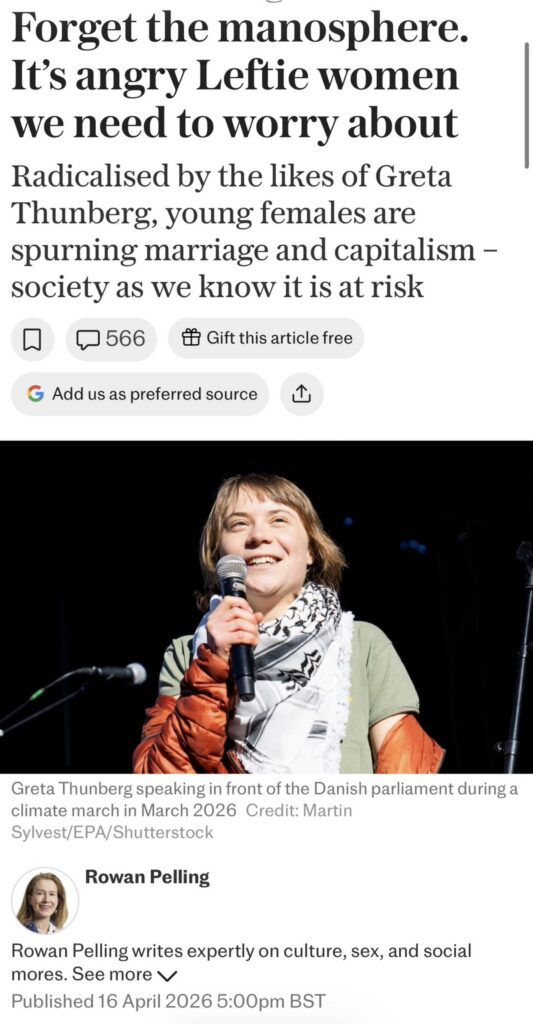
Pelling’s argument is that for every boy radicalised by Andrew Tate or Charlie Kirk, there is a young woman radicalised by Greta Thunberg or Alexandria Ocasio-Cortez. She coins this the “femosphere”, where young women are being turned off marriage, motherhood, and capitalism.
Let us sit with that framing for a moment. Andrew Tate, who has faced and continues to face charges of human trafficking, rape, and forming a criminal gang to exploit women, is the moral equivalent of a young climate activist. A man who built an empire on teaching other men to control, demean, and profit from women is being weighed against a woman who wants a liveable planet and economic fairness. And according to Pelling, the latter is the greater cause for alarm.
I am sorry. What?
Tate is described as a “mentor.” Thunberg is described as someone who “radicalises.” The language alone tells you everything about whose power this article is designed to protect.
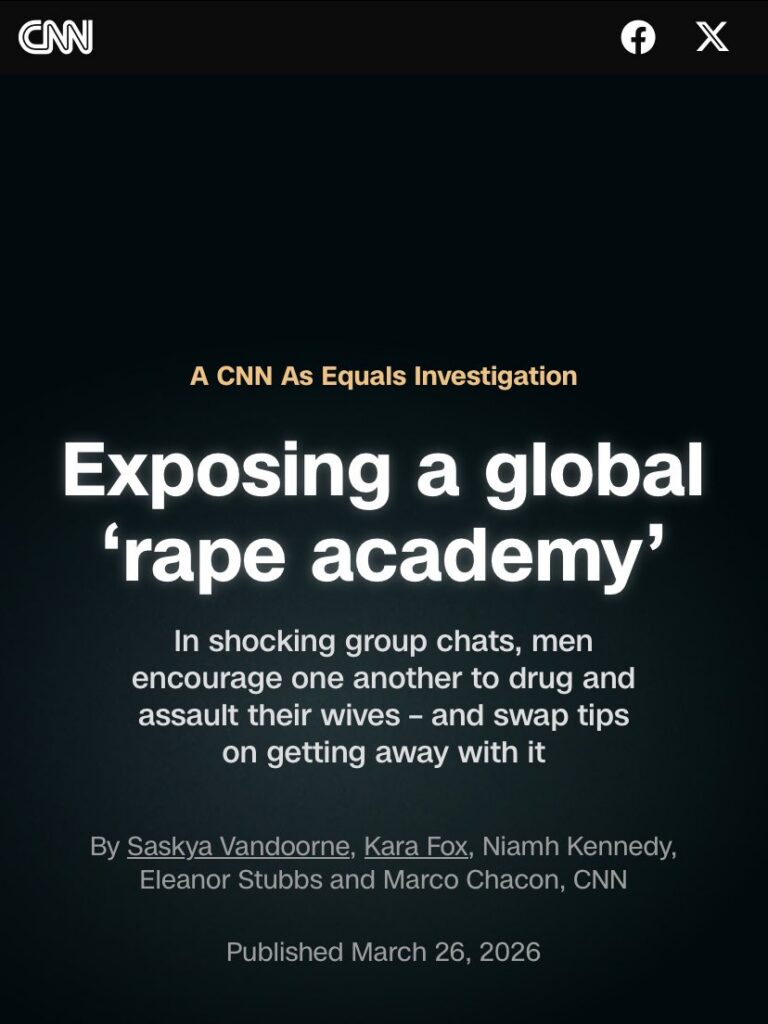
The second rabbit hole was darker. Days before Pelling’s piece was published, CNN released the findings of a months-long investigation into what experts and lawmakers are now calling a global “online rape academy.” What they uncovered is not a fringe forum. It is a decentralised, cross-platform, and thriving eco-system.
One pornographic website, Motherless.com, recorded approximately 62 million visits in a single month. Within that platform, investigators found more than 20,000 videos in a category known as “sleep” content: videos uploaded by users of women they claim are sedated or unconscious, including their own wives and partners. Some of those videos had hundreds of thousands of views. Some users advertised live-streamed assaults for $20 per viewer.
On Telegram, a group called “Zzz”, since taken down following CNN’s investigation, had nearly 1,000 members sharing tips on how to drug partners, carry out assaults, film them, and evade detection. The investigation spoke with survivors, including one woman whose former partner filmed her assault while she was unconscious. When she went to police with the video as evidence, she was met with disbelief.
This is not a dark corner of the internet. This is an industry. It is global, monetised, and growing.

Now hold both of these things in your mind at once.
A global network teaching men how to drug and rape their partners that is profitable, high-traffic and largely unpunished. And a newspaper columnist, published in one of Britain’s most widely read mastheads, arguing that this is less of a threat to society than young women who want climate action and gender equality.
These two stories didn’t land together by coincidence. Pelling’s article tells us women who resist are the problem. The CNN investigation shows us what happens to women in a world that believes that.
This is precisely the argument I was making last week, the one that was met with accusations that ‘we don’t care about men’. Structural inequality is not abstract. It does not live only in policy documents and parliamentary portfolios. It lives in the online spaces where sexual violence is commodified. It lives in the editorials that equate a rape apologist with a teenage environmentalist. And it lives in the responses to journalism that names these things, responses that immediately reframe the conversation around male victimhood.
I have a daughter. I hope she becomes an ‘angry leftie woman’. I hope she believes in a healthy world, in fairness, in equality for all. I hope she is protected from violence and sexual assault. I hope she gets an education, has access to sexual and reproductive healthcare, builds a career, votes, and pushes every boundary placed in front of her.
I hope that if she chooses marriage, she chooses it freely. I hope that if she chooses motherhood, she chooses it because she wants it not because society told her that her value is located there. And I hope she is never, ever filmed while she sleeps.
This is what feminist “radicalisation” looks like. This is what Greta Thunberg and Alexandria Ocasio-Cortez represent to young women, not destruction but the audacity to want better. The audacity to refuse the terms patriarchal structures offer them. That a female journalist at a major newspaper finds this more threatening than a global rape infrastructure is just astonishing.
We don’t need a government that validates the feelings of men in a cultural moment defined by the abuse of women. We need one that looks at the evidence — 20,000 videos, 62 million visits, conviction rates that remain unconscionably low — and acts accordingly.
The rape academy has 62 million visitors a month. The manosphere has a Minister. And apparently, we are the problem.