
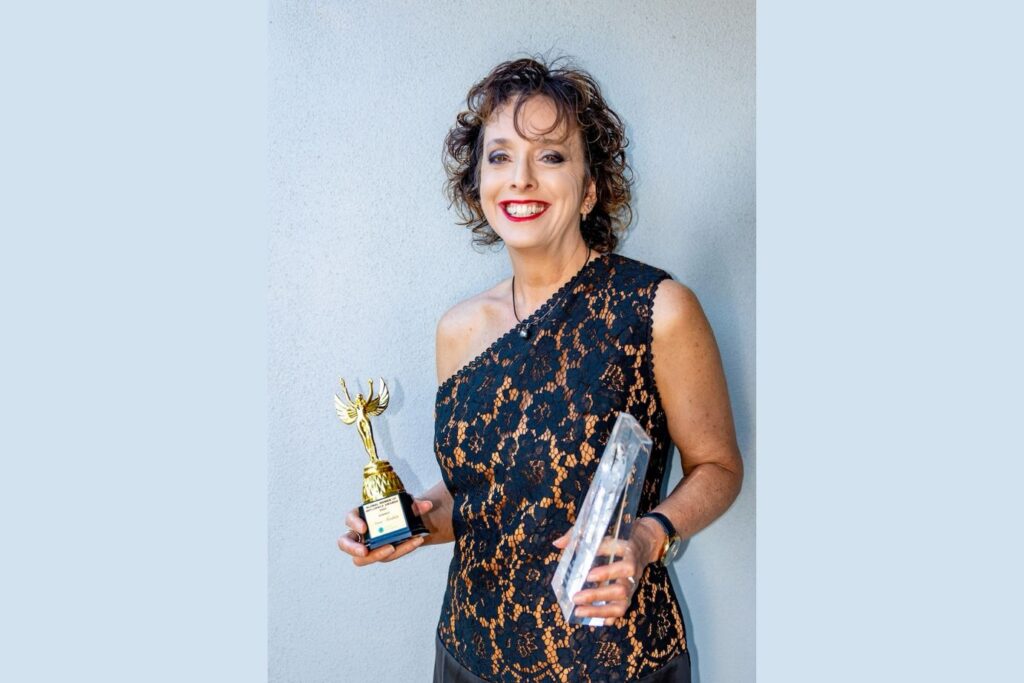
Lecturer, disability advocate and author of Tonkin 10/10 Bill, Anne Tonkin, is the 2026 SA Award recipient of the Australian Awards for Excellence in Women’s Leadership. Here, she shares more on her push to create the world’s first community inclusion metrics for the disability sector.
I can still see my little red tartan suitcase.
I was eight years old when it was crushed under the wheel of our family car. I remember carefully packing each item inside, closing the zipper tightly and announcing proudly, “Dad, I’m packed.” He looked at me in his calm, practical way and said, “Put it somewhere so we don’t forget it.” Challenge accepted! I thought carefully about the best place, somewhere that would guarantee we wouldn’t leave it behind. With great confidence, I carried my little red tartan suitcase outside and placed it under the front wheel of the car.
When the car moved forward, the tyre rolled straight over the suitcase. The sides collapsed instantly. The frame bent, the edges crushed, and the zipper stretched tightly under the weight. What had once been a neat little suitcase was now misshapen and damaged.
But when we opened it, something remarkable had happened. Everything inside was still intact.
This little suitcase became the metaphor for my life. We get crushed, life can impact us. Life changes form. Bodies change and the insides remain the same; the heart, the soul, the love.
Years later, another quiet moment shifted the direction of my life. I was sitting in a marketing lecture at the Adelaide City Campus – where I now teach – eating M&Ms after a long day working in marketing with Weber barbecues. I was young, ambitious and completely absorbed in the content when a thought struck me so clearly it felt as though it had been waiting for me. “This is the most amazing topic you could ever teach… I think I could teach this with much more excitement.”
It wasn’t a criticism of the lecturer. It was clarity about myself. That moment planted something in me. I wanted to inspire others. I wanted to teach people to challenge assumptions, think critically and design solutions for tomorrow rather than repeat the thinking of yesterday. Marketing, at its core, is about understanding people – their needs, behaviours and experiences – and creating strategies that genuinely serve them.
When I eventually stepped into lecturing, the start was far from glamorous. I began with just three hours of teaching each week. At the time, I had a two-year-old and a twelve-week-old baby. I missed a feed and my breasts inflated under my clothes in class. I was conscious of this whilst lecturing. I marked assignments with a baby monitor beside me. I prepared lectures during nap times or after dark. I took papers camping and marked them by torchlight once the children were asleep. I was exhausted, but energised through my teaching and learning. I wanted more knowledge. I craved it. I wanted to challenge concepts when they didn’t add up.
Life was a constant balancing act between roles: mother, daughter, wife, academic and now a carer. None of these roles existed separately; they shaped my perspective and strengthened my determination.
My husband was ill, his body was changing shape, his muscles declining as he was diagnosed with myotonic dystrophy. Everything was changing, I had no control over anything. He was losing his strength and now I had to add into the equation his health, his needs, his caring. His heart, soul and love for his family remained the same. We used to play sport together, and now we watched sport together – but why were there not enough disability carparks, toilets, transport or access seats in venues? Why are access seats only allocated to be assigned to one carer? Why can’t we sit with my children? Why was a reasonable allowance across the disability sector unreasonable? Why were there no metrics added to these spaces when 21% of the Australian population have a disability? The equation of equality and accessibility did not add up.
My needs mattered too, that was all I could control. Over the next two decades, I continued to study relentlessly, late into the night, the children were asleep, unaware of my passion to build my academic knowledge, qualification after qualification. Eventually I completed my Master’s degree, deepening the academic rigour that underpinned my thinking. Like many academics, I developed a healthy respect for research, critical analysis, and evidence-based thinking, even though referencing stubbornly remained my academic nemesis.

But something unexpected began to happen through the combination of lecturing, research and lived experience of caring for David for 17 years. There was a shift in global thinking. At my computer working, my brain whirring away in the background. A new equation was forming.
As a lecturer in marketing, I constantly taught students to ask, Who is the target audience? Are we meeting their needs? These questions, when combined with my lived experience navigating the disability sector, began to reveal something profound. Around the world, governments and organisations spoke about inclusion, accessibility and equity. Policies were written, strategies were announced and commitments were made.
Yet something critical was missing across the global disability sector.
Measurement.
Without clear metrics, community inclusion remained largely aspirational. If inclusion is not measured, it is not done. Organisations cannot manage what they cannot measure. Policies are vague so implementation remains as a tokenistic gesture. The UN does not measure community inclusion.
This was the equation where everything came together.
Seventeen years of lived experience as a carer to my now late husband. Two decades of lecturing. Academic rigour developed through advanced study.
It crashed together in my brain, urgently and it was like a powerful force of nature. I need a Bill. I need to change this. The combinations together created the foundation for the Tonkin 10/10 Bill. The Bill introduces the world’s first Community Inclusion Metrics – a global, scalable, measurable framework based on national disability data, designed to assess and improve accessibility and inclusion across communities, organisations and governments.
Rather than treating accessibility as an afterthought, the model reframes it as strategic governance, risk management and measurable social impact. 10/10 added together equals 20, representing the 21% of Australians with a disability. This is how it is globally scalable. 10/10 also represents one, a whole number where everyone is included, like society everyone deserves equal access to the community, this is a basic human right. 10/10 means split the sector to better meet the needs of the target audience. Allocate 10% for wheelchairs, 10% for mobile disabilities (with a new symbol – a simple blue D, representing differentiation, diversity, determination, and disability), for these categories to be numerically measuring for carparks, toilets, transport and venue seating. Without metrics, inclusion is an afterthought, a tokenistic gesture but it’s unreasonable. Accessing the community is a basic human right for everyone.
Community inclusion is not simply a social ideal. It is a basic human right. Accessing the community improves mental health, but this is denied to many by outdated systems, policies and vague plans that attempt to be inclusive.
The Tonkin 10/10 Bill provides a practical pathway forward. By linking inclusion metrics to global frameworks such as the UN Sustainable Development Goals, it creates the accountability that has long been missing from accessibility initiatives around the world.
Like my little red tartan suitcase, I have been crushed, I have changed, but I am still full of passion, love, heart and soul for my family, and broader humanity. What started as a passion for teaching marketing evolved into something much larger: a framework for global accessibility and measurable inclusion.
My equation to life, full inclusion for all, be one whole community together. And the time to start measuring community inclusion – properly, globally and transparently – is now. The world is watching this space. The equation adds up and community inclusion metrics are coming soon.