
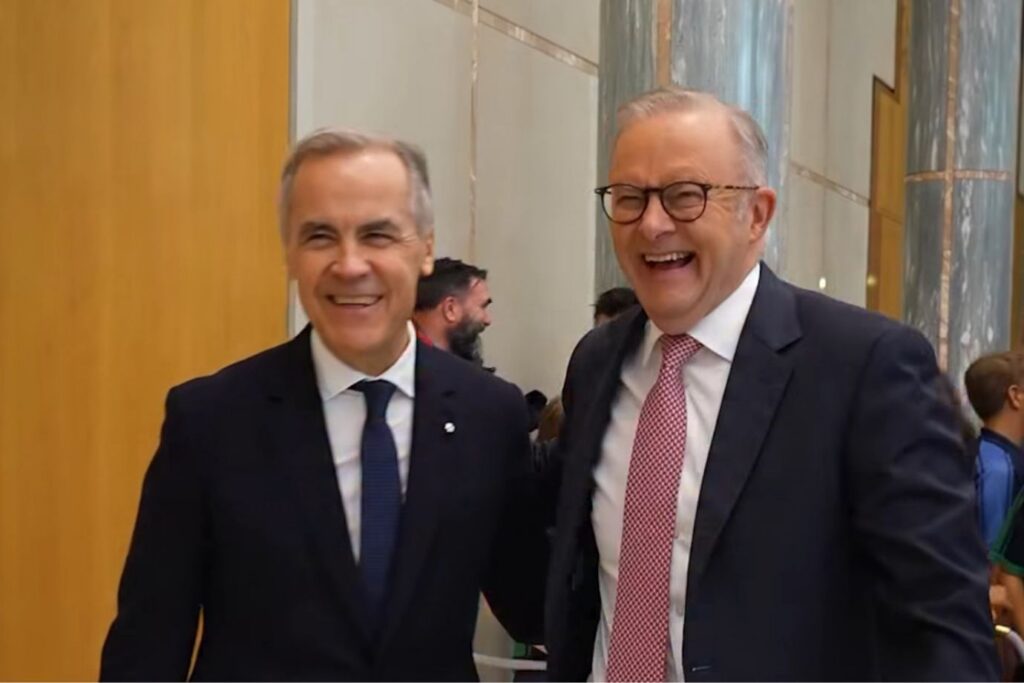
Canadian Prime Minister Mark Carney may have woken up this morning to a few headlines that made his heart skip a beat.
During a visit to Canberra, Mr Carney addressed federal parliament calling for unity and optimism.
And then he said this.
“Let us remember that Australia was the first nation in the world to give women the right to vote and to stand for Parliament,” Mr Carney says.
The parliament responds with “hear, hear”.
Then came the headlines – some which have now suspiciously disappeared – calling out the ‘embarrassing’ moment.
How could the Canadian Prime Minister snub New Zealand like that?
New Zealand, in fact, was the first country in the world to give women voting rights.
Years and years of fighting and petitioning by New Zealand’s leading suffragists and feminists led to the creation of the Electoral Act 1893, giving all adult women the right to vote.
Less than two months later, more than 100,000 women in New Zealand were enrolled to vote.
Even Mr Carney’s own colleague – Deputy Prime Minister David Seymour – decided to add some salt to the stinging headlines.
But here’s the thing.

Mr Carney may actually have nothing to be embarrassed about.

And there is a reason the parliament floor just nodded along when he made the statement.
In 1894, one year after New Zealand’s historic move, a bill was passed giving women in South Australia the right to vote but this is the interesting bit.
The 1894 Bill requiring a change to the Constitution to give women the right to vote also included a clause that prevented them from becoming members of parliament.
According to parliament records, an outspoken critic of women’s suffrage “almost accidentally” got this clause removed.
“Ebenezer Ward, an outspoken opponent of women’s suffrage successfully moved for this to be removed during the Second Reading, hoping that it would seem so ridiculous for women to be members of Parliament that the whole Bill would be voted out,” records state.
“But the change was accepted so the women of South Australia gained complete parliamentary equality with men.”
In 1895, women in South Australia were legally allowed to vote and run for parliament – making Australia the first nation in the world to do both.
As much as this should be celebrated, it took until 1962 for Indigenous women to be granted voting rights.
Mr Carney’s comment is correct – Australia was in many ways a pioneer in this space but it has also made grave mistakes.
And as we saw with Mr Ward’s staunch opposition to women’s participation in politics, there are still many today pushing back against the incredible gains women have made in recent decades.
Many of us today vote and lead in spaces where women were once told they have no right being in.
And it’s thanks to the fierce women and girls – of all backgrounds, cultures, faiths – who chose to be difficult, who chose to believe in a better future and who chose to confront the systems that were holding them back.
It’s their dedication to this day that is transforming societies not just in Australia but around the world.
And it’s up to every one of us to keep building on that.