

When Georgie returned to Australia at age 35, after more than a decade living and working in Europe, she couldn’t have imagined how profoundly her life would change.
Within a few years, she would become a carer for her dad, a dementia advocate, and one of the many women quietly balancing caring for family and full-time work.
Georgie’s father, Chris, was diagnosed with Alzheimer’s disease in 2017 at age 76.
At first, the signs were easy to explain away. Small shifts in routine, moments of confusion that felt like “just ageing” or adjusting to life after retiring from his fast-paced career as a sales representative.
“There were things that didn’t make sense,” Georgie said.
“He’d ring my mum, my sister or me in a panic because he couldn’t turn the oven on or off. Driving became stressful for him. Looking back, the signs were there, we just didn’t know what we were seeing.”
Like with many, diagnosis took time. Chris resisted being assessed, shaped by memories of his mother’s own Alzheimer’s disease diagnosis decades earlier.
“He was very resistant to talking about it and being diagnosed,” Georgie said.
“He knew the path that diagnosis could lead to. He didn’t want anyone to know.”
This kind of silence and stigma is sadly not uncommon.
In 2026, an estimated 446,500 Australians are living with dementia, now the leading cause of death in the country. Around 1.7 million people are involved in dementia care – and Australian research shows women make up approximately 75 per cent of unpaid care partners.
Georgie’s mother, Fay, took on the role as carer for her husband Chris.
By 2020, when Georgie moved in with her parents to help during COVID lockdown, the progression of Chris’ dementia and the scale of her mother’s caregiving became impossible to ignore.
“She was doing everything, she was exhausted,” Georgie said.
As Chris became increasingly dependent, Fay was responsible for everything; meals, supervision and daily care – rarely able to leave the house alone. Over time, the physical and emotional toll on her health became unavoidable.
When Georgie’s mother was hospitalised in 2022, things escalated. Their father’s needs were too complex, respite care was hard to find, and the family faced a decision.
“It was the hardest decision we’ve ever made,” Georgie said.
“But Mum said, ‘I’m not able to do this anymore.’”
Chris moved into residential aged care soon after. The transition came with grief and ongoing adjustment.
Throughout it all, Georgie continued working fulltime at the Sydney-based firm, where she has worked for many years. She openly credits workplace flexibility and trust for making her caregiving role manageable.
“I’m super lucky to have the job I have,” she said.
“My team knew what was happening. When mum was in hospital, I took two weeks off to look after Dad. I could continue to work from home so Mum could have a break. That support made all the difference.”
It also shaped Georgie’s belief in the role workplaces can play in supporting people navigating dementia, not just through workplace flexibility, but through culture, education and giving.
Through her caring journey, Georgie and both her parents accessed Dementia Australia’s resources and online education sessions, including practical guidance on understanding a dementia diagnosis.
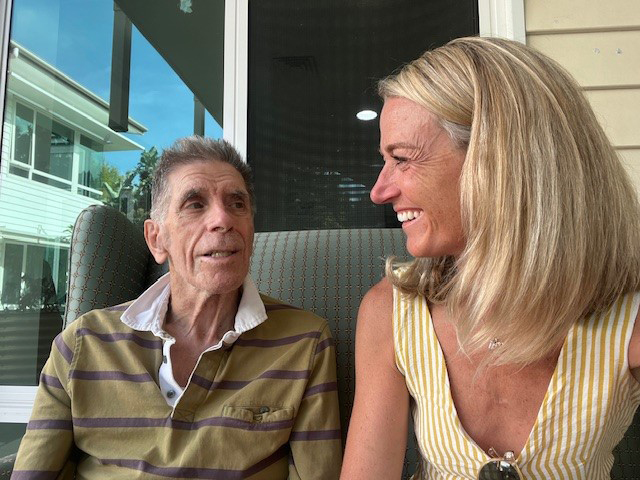
“Those sessions really helped,” Georgie said
“They allowed me to understand what Dad was going through – especially the things that aren’t just memory loss, like changes to vision through reduced depth perception.
“It made sense why Dad saw things different to me, like when we would cross the road cars may seem closer to him.”
For Georgie, supporting Dementia Australia through donations was a natural extension of that support.
“I want there to be a cure,” Georgie said.
“No family should have to go through this.”
Through her firm, Georgie’s donations are matched, doubling her impact each payday.
“It absolutely makes a difference,” Georgie said.
“And it makes you feel that your employer genuinely supports what matters to you.”
She believes more workplaces can and should take action, exploring meaningful ways to support employees impacted by dementia.
Today, Georgie’s father lives in fulltime dementia care. Her mother, after years of caring for others, is living at home and focusing on her health.
Both Georgie and her mum continue to share their journey openly, hoping their experiences might help and encourage others navigating dementia and educating those who may not have been so closely impacted by dementia before.
“The most important thing is asking for help,” Georgie said.
“People want to help, they just don’t know how.”
Dementia affects millions of Australian families and countless working women. Workplaces have a powerful opportunity to lead with empathy, understanding and action.
Dementia is the leading cause of death in Australia, the time to act is now.
Show your commitment by choosing Dementia Australia as your organisation’s workplace giving charity.
If dementia has impacted your life, your story matters. Ask your employer to add Dementia Australia to their workplace giving program and help make a difference every payday.
For more information visit our Workplace Giving Program website or contact [email protected].
Dementia Australia is here 24 hours a day, seven days a week, 365 days a year. If you or someone you know have a diagnosis of dementia, or mild cognitive impairment, or you’re concerned about changes to your cognition or that of a loved one, contact the National Dementia Helpline on 1800 100 500 or visit dementia.org.au.