
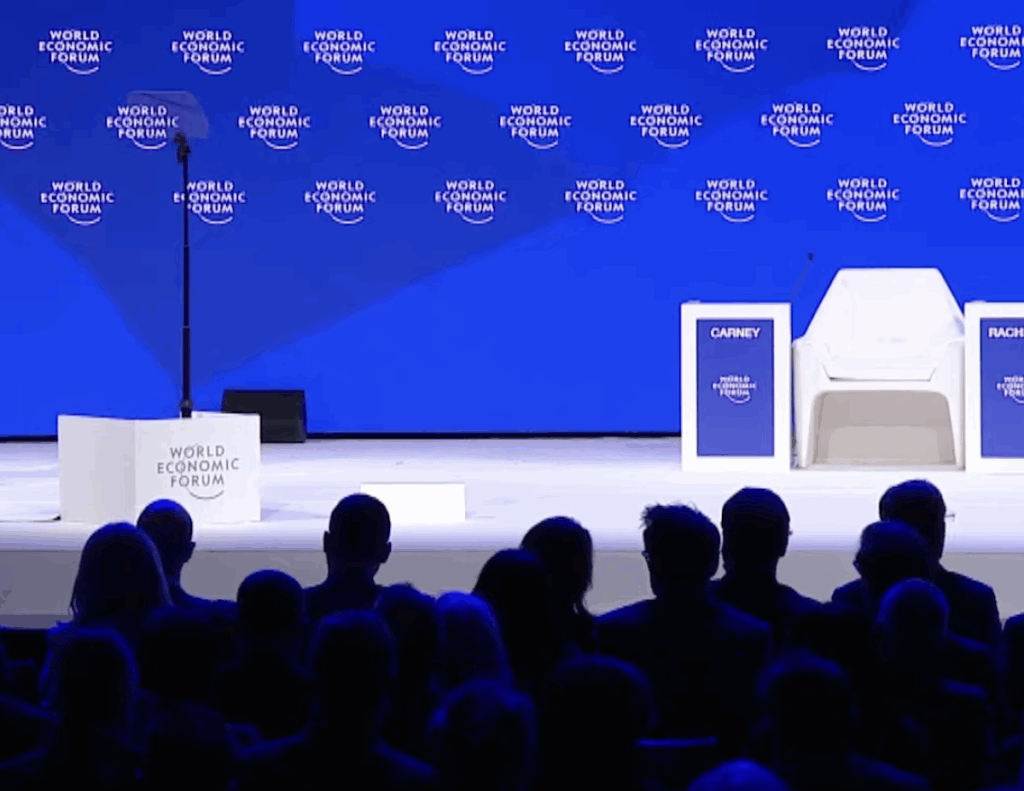
Every year, the wealthy and influential descend on Davos in the Swiss Alps for the annual meeting of the World Economic Forum. Around 1500 private jets are expected to land at or near the Alpine town this week, delivering business and political leaders.
In public, they will share concerns about inequality, geopolitical risks, climate change and AI ethics. In private, they will make deals and broaden their personal networks.
Some such leaders may even publicly criticise US President Donald Trump, with Canadian Prime Mininster Mark Carney making an early start in declaring during his speech today that “the old world order is not coming back” and that middle powers like Canada should respond with honesty, ambition and confidence.
But in 2026, as in previous years, around 80 per cent of those attending Davos are will be men. While efforts are made to include soe diversity into panel discussions, bringing together hundreds of top “CEOs and chairpersons,” titans of industry, and “top political leaders” inevitably means that women and other minority groups are significantly underrepresented.
Almost 3000 cross-sector leaders from 130 countries are attending this year, according to the WEF. There are 400 “top political leaders”, including 65 heads of state– almost all of them are men. The WEF expects 850 of the world’s top CEOs and chairpersons to be present, and almost 100 leading “unicorns” (tech companies worth $1 billion or more). Again, the overwhelming majority of are men, and they’re typically from North America and Europe.
Still, the WEF notes that the program is enriched by contributions from youth leaders, social entrepreneurs, cultural luminaries, academics, and various experts. Here, we get much better global representation and more input from women. And while the CEOs, chairpersons, political leaders, and riders of unicorns are hopefully reserving some listening time to these contributions, such leaders are also there to act in the interest of their companies and shareholders, their own investments and their own hold on power.
For his part, US President Donald Trump will lead the largest-ever US delegation at the event. He shared with reporters on Tuesday that his “primary message” will be to share “how well the United States is doing”.
“A year and a half ago, we were a dead country, and now we have the hottest country in the world,” he said.
How inspiring!
Last week, the WEF released its 2026 Global Risks list, an annual report aimed at supporting decision-makers in “balancing current crises and longer-term priorities”. It describes “uncertainty” as the defining theme of its 2026 outlook and says global risks will continue to “spiral in scale, interconnectivity and velocity”.
The WEF’s risk report calls 2026 the “age of competition” and notes the cooperative mechanisms are crumbling, and stability is under siege, especially in the multipolar landscape that is emerging “where confrontation is replacing collaboration.”
In short, the outlook is not looking good, for any of us.

Over the next two years, the WEF lists the top ten events (in order) as:
- Geoeconomic confrontation
- Misinformation and disinformation
- Social polarization
- Extreme weather events
- State-based armed conflict
- Cyber insecurity
- Inequality
- Erosion of human rights and/or civic freedoms
- Pollution
- Involuntary migration or displacement.
Over a ten-year period, the risk of extreme weather events takes the number one spot, followed by biodiversity loss and ecosystem collapse, and critical change to Earth’s systems in the third spot.
The data is based on a survey of around 1300 people across the WEF’s network of academics, business and government leaders, civil society and other thought leaders. Men made up 59.9 per cent of survey respondents, with business leaders (at 38 per cent) the largest group, and the majority overall being from North America and Europe.
The WEF’s two-year outlook includes risks with the potential to be devastating not just for businesses and economies, but for the health, well-being, and survival of all of us. They’re risks that carry additional consequences for women and girls globally.
And yet, Davos remains a men’s fest.
The question this week will be how many such men will participate with the courage and integrity to support entire populations, rather than their personal business interests.