
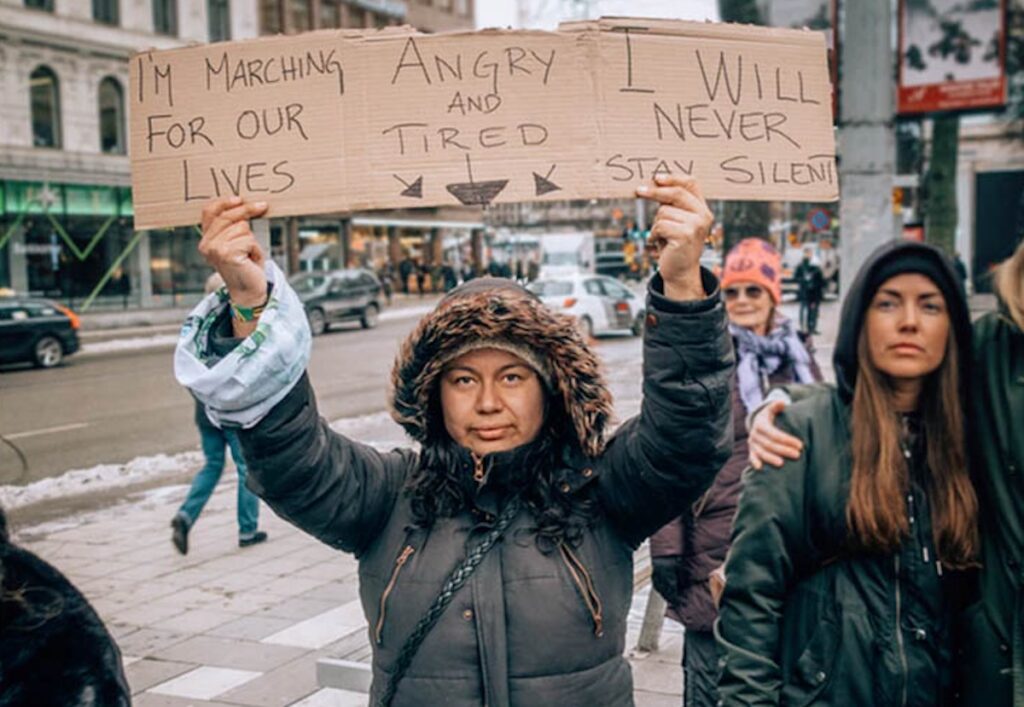
Here we are: March 8, International Women’s Day.
Employers across the country have sprung into action with various events.
Messages of support and appreciation for women’s work have been sent.
Press releases noting “as we approach International Women’s Day” have been issued, promoting stories about women, as if they can’t be shared at any other time of the year.
In previous years, I’ve highlighted how every day should be International Women’s Day.
But this year, I’m removing the “should” from that statement to declare instead that every day must be International Women’s Day.
The situation for women and girls is desperate and has been rapidly deteriorating. And that makes it a rapidly deteriorating situation globally.
We’ve been witnessing a global rollback of rights for women and girls globally.
The fallout from Trump’s sudden cuts to USAID has seen once established programs supporting women and girls cancelled, with 94 per cent of funding for sexual and reproductive health funding cut, as well as 80 per cent of gender-based violence prevention response funding.
And here in Australia, there has been little to no change in the rates of violence against women.
Some of us see and report on these stories every day. Some of us work in the space supporting the basic rights and safety of women and girls. And some of us are living these experiences.
But on IWD at least, more of us take a moment to look up and consider the current state of things for women and girls.

And in 2026, it feels like such awareness has never been more important. Not just for one day, but every day. And not merely for the sake of the health, safety and economic opportunity for women and girls, but also for the health, safety and economic opportunity for the entire planet given escalating conflicts, a continued lack of action on climate change and the fast rise of artificial intelligence that’s set to have significant consequences across the global workforce.
IWD sees UN Women urging the world to take note of a current and timely issue. This year, it’s justice, with UN Women issuing an urgent alert around the fact that women hold just 64 per cent of the legal rights of men globally, exposing women and girls to discrimination, violence and exclusion.
Indeed, the latest United Nations Secretary-General’s report on ‘Ensuring and Strengthening Access to Justice for All Women and Girls’ finds that in over half of the world’s countries (54 per cent), rape is still not defined on the basis of consent. Meanwhile, national laws can still force a girl to marry in almost three out of four countries, and there is no law mandating equal remuneration for work of equal value in 44 per cent of countries.
As UN Women Executive Director Sima Bahous says on these findings, When women and girls are denied justice, the damage goes far beyond any single case. Public trust erodes, institutions lose legitimacy, and the rule of law itself is weakened. A justice system that fails half the population cannot claim to uphold justice at all.”
But that’s not all. It’s not a matter of progress to be made; in 2026, the issue is the progress being rolled back.
Globally, laws are being rewritten in response to the backlash against gender equality, seeing more restrictions on the freedoms of women and girls, a silencing of voice, as well as the enabling of abuse without consequences.
We cannot divert focus from the issues. Not even on the day after International Women’s Day.
Meanwhile, escalating conflict also has catastrophic consequences on the rights and safety of women and girls, something we were so heartbreakingly reminded of in the past week. Not since the end of the Cold War has a greater proportion of the female population globally lived within 50 kilometres of a deadly armed conflict, according to the Peace Research Institute Oslo.
There has been an 87 per cent rise in reported cases of sexual violence in just the past two years, according to the UN report.
We need to know them and fight to change them every day.
IWD is also an opportunity to remind politicians of what voters want, and to issue warnings of shifts in rhetoric and social norms and attitudes that could be quietly leading to future harms.
Indeed, this year CARE Australia highlighted the fact that one in two Australian women believes the world is less safe for women now than it was five years ago, and that three in four Australians believe women’s safety should be prioritised above other global issues.
IWD is also a calendar point used to celebrate the achievements of women. And sharing and elevating data on the current state of things for women and girls shouldn’t take away from such celebrations.
Rather, it should highlight the need for more celebrations. Every day. We have a long way to go before we are ever closer to acknowledgeing, celebrating and elevating the difficult, underpaid and undervalued work that women do — ordinary women who’ll never be on a stage, or winning leadership trophies or getting the job titles deemed ‘successful’ but who are holding families and communities together and/or working tireless across industries, especially in care, that simply don’t get the pay and recognition and recognition around ust how hard and relentless the work is.
As journalist Kristine Ziwica said at our International Women’s Day dinner with CARE Australia on Thursday night, we are currently in a “break glass in case of emergency” situation. One day isn’t going to cut it. The fight to retain the progress achieved, to bring back what’s been lost, and to fight for more needs to happen every day. And so must the celebrations for the hard, relentless, and so often underappreciated work that women do.
But the emergency is bigger than protecting the rights of women and girls. The challenges facing the future of the planet grow by the day: conflict, climate change, unregulated AI, deteriorating democracy and the rise of populism. Elevating women’s stories and the current plight of women and girls globally for one day isn’t going to cut it. Every day MUST be International Women’s Day.
See a full wrap of International Women’s Day from Women’s Agenda here.
Remember, it’s business as usual on Women’s Agenda. Every day MUST be International Women’s Day, and Women’s Agenda is here every day. We place a vital gender lens on the news every day. Subscribe to our free daily update here.