
How can we better support boys to thrive in an increasingly digital world? Take our short survey, in partnership with The Man Cave, Movember and the Foundation for Positive Masculinity, and help shape the conversation. Take the survey here.
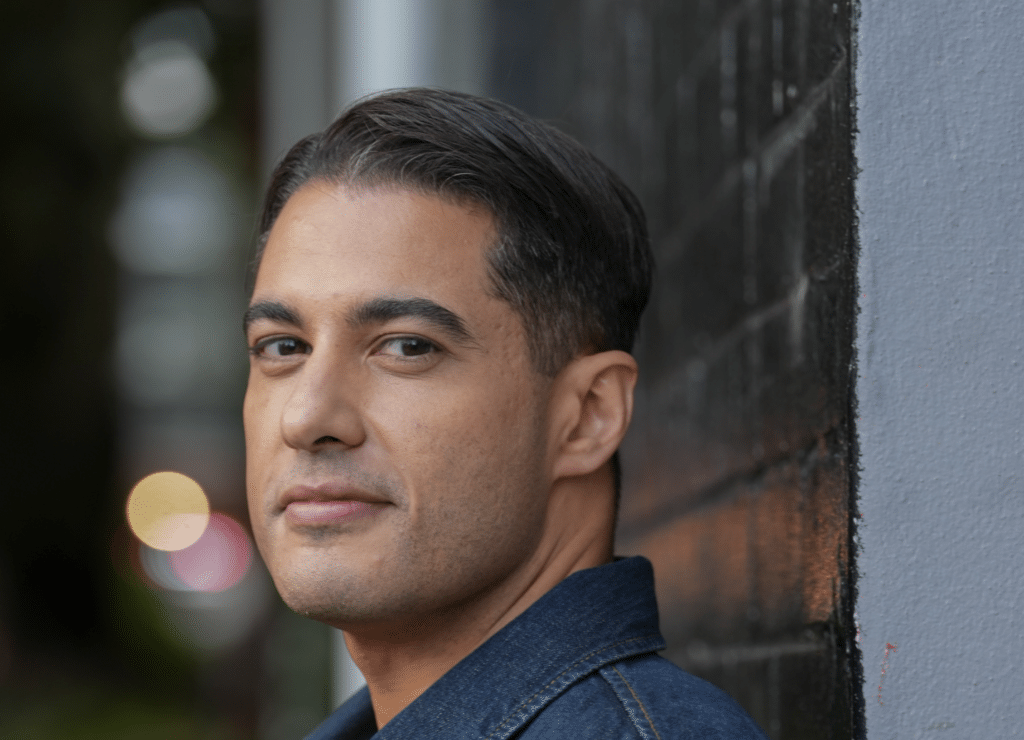
When Marc Fennell’s kids were watching Pokémon videos on YouTube, he thought he’d found a relatively safe way to let them use the internet while he cooked dinner.
“When I came back, I heard this voice, and it was like, ‘Weak men lead to hard times.’ And I was like, ‘I know that voice.’” It was Joe Rogan, appearing in a YouTube Short, despite nobody in the household having searched for him.
Fennell checked the viewing history and questioned the kids (and the dog). No one had pressed any buttons. YouTube had taken them from Pokémon to Rogan all by itself.
The incident crystallised a concern Fennell had been mulling over since around 2024, when he was first approached about a project examining the manosphere. Familiar with the term and some of the more notorious online influencers, he’d begun to see how it was playing out in real time.
At the gym, for example, he had noticed changes in the types of conversations young men were having. Intense discussions about bodies, steroids, testosterone and peptides, alongside the pressure to make a first million by 25 or risk being considered a failure.
There was also the way some young men talked about women and dating, as though women were “a thing to be outsmarted and won”.
“It was the compound effect of it,” he tells me.
It was why the YouTube incident started to bring things home and confirmed a fear that plagues so many parents: How much control do we really have over what our kids see online? Are they doomed?
“I’m very wary about the handful of responses that come back, and it almost always comes back on parents and teachers to solve,” he says. “That is not a fair fight.”
Fennell doesn’t suggest parents and teachers stop playing a part, but the notion that they control the internet is grossly unfair.
“Working parents have enough stuff to deal with, and we cannot also be policing the entirety of the internet all the time”, he says.
It’s a central theme of The State of Man, Fennell’s three-part ABC documentary examining masculinity, the manosphere and the forces shaping boys’ lives. Rather than simply condemning controversial influencers, the series explores why their messages resonate, how they spread and what might be done about them.
One of its key observations is the role COVID played in accelerating the problem.
For many of the young men featured in the documentary, the pandemic arrived when they were in Years 10, 11 or 12, cutting them off from friends and normal social interactions. Their phones became a window to the world at a time when social media platforms increasingly rewarded content designed to provoke an emotional response.
“I think sometimes when we all got done with COVID, a lot of us were a bit like, ‘And let’s never fucking talk about it again,’” he says. “There were some lasting consequences, and I think this might be one of them.”
The isolation of the pandemic coincided with other significant cultural shifts, including #MeToo and growing public conversations about toxic masculinity. Fennell believes it’s possible to recognise the importance of #MeToo while also examining how some of the language used at that time was absorbed by young men.
While the term toxic masculinity was intended to describe harmful behaviours and attitudes, not masculinity itself, that’s not what many young men take from it.
“Millions of young guys and men hear that term and they hear the mere fact that I am masculine is toxic,” he says. “What is said and what is heard, I suspect, are two completely different things.”
It’s a position that’s supported by former Prime Minister Julia Gillard who Fennell interviews in the series. She sees the manosphere’s rise as both a symptom and a cause of young men feeling left behind by progress in gender equality.
That’s why there’s a growing need to talk about sexism and gender equality in a way that shows boys they’re also victims of the current system and social conditioning.
Fennell describes the current moment as a “perfect storm” of social, cultural and technological change, in which some young men are struggling to work out what their role in society should be.
The manosphere offers a cookie-cutter answer.
Its appeal often rests on a sense of misplaced injustice and the idea that the world is working against men. Women are cast as the antagonists who have stolen opportunities that were never theirs.
The way to fix this imbalance, according to influencers like Andrew Tate, is to take control through money, physical strength and relentless self-improvement, while treating relationships as a competition to be won. The content promises certainty in uncertain times.
Fennell sees why these messages might appeal to young men without accepting the conclusions they promote. It’s also why he resists the idea that there is a single culprit or simple fix.
“There is no singular smoking gun,” he says. “It’s not just on parents, and not just on teachers, and not just on the government, it’s not just on tech companies. There’s actually a bit of this we all need to address.”
The consequences extend beyond what boys watch on their phones..
“If you accept the premise that 50% of the population is in some form of crisis, then the other half is in danger,” he says.
But while The State of Man examines the insidiousness of the manosphere and its influence on boys today, it didn’t land on the idea that everything’s irreversibly broken and nothing can be done.
Fennell and director Mel Maclean were determined to dedicate the final third of the series to possible solutions.
For Fennell, the most encouraging part of making the series was spending time with teenagers themselves. He came away feeling more hopeful about the future, not less.
“I feel incredibly hopeful because I spent time with teenagers, and I genuinely think teenagers are the best,” he says. “I think they have much better bullshit meters than any adult I know does. They can identify anything dodgy a mile away.”
Rather than assuming adults must provide all the answers, Fennell believes we need to listen more carefully to young people, who are often coming into contact and interpreting cultural shifts way before the rest of us catch up.
“They are at the forefront of culture,” he says. “I think we owe them our respect and ears.”
So where is Fennell left in the aftermath of the show and his assessment of what it means to be a “good man”?
“We’re really messy human beings, and that’s okay. We make mistakes. We’re not perfect,” he says. “I think it’s up to us to decide what kind of good people we’re going to be.”
For him, the more useful question is how people feel in our presence. Do they feel safe, afraid or inspired? It is a question he applies to himself as a parent, a journalist and a person still working out what masculinity means.