
Just last year, the health startup Harrison.ai received $32 million from the National Reconstruction Fund, in part to help “continue to base its operations in Australia”.
On Tuesday, the ABC reported that Harrison.ai made a number of staff in its Australian team redundant while launching a US venture hiring American clinicians. Harrison.ai has previously come under fire for using millions of medical scans of Australians to train their AI without consent.
Meanwhile, Oli CEO Tara Croft has (on paper) raised most of the all-female-founded Oli’s next round offshore, and hasn’t yet touched it. Taking the money would mean Oli is no longer an Australian company. So she’s giving it a few months to try and raise the same capital here.
Keeping any kind of startup here locally is important, especially when Australian jobs are involved.
But it’s even more so when it involves health and AI, and even more so when it concerns women’s health innovation—as Oli does.
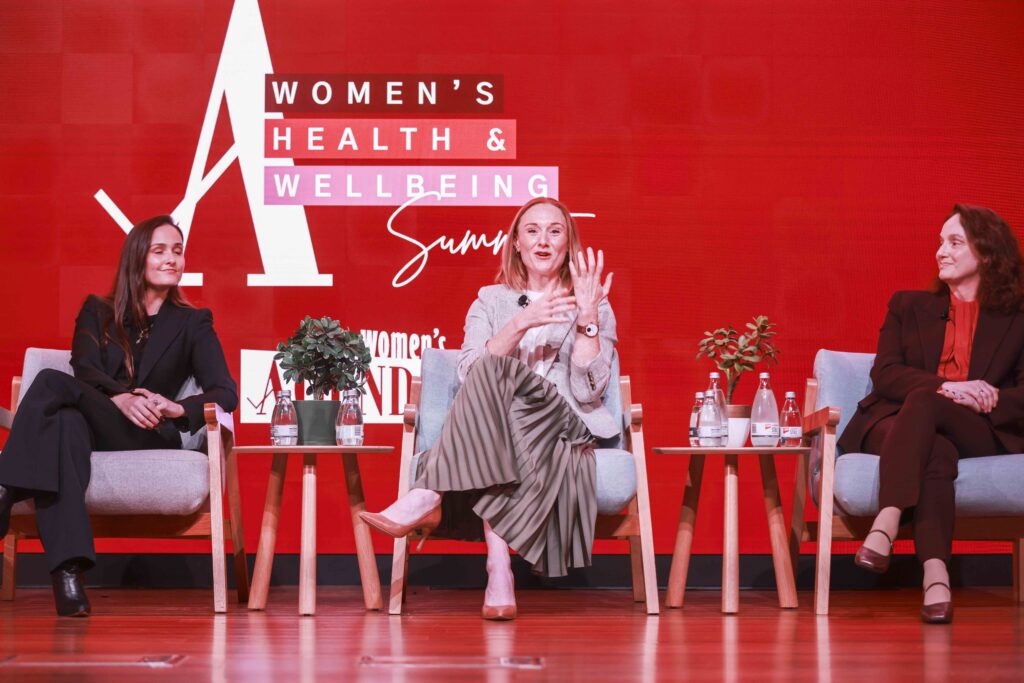
Tara Croft shared the comments at our Women’s Health and Wellbeing Summit last week, on our women’s health innovation panel that also featured Ovum founder Dr Ariella Heffernan-Marks and Associate Professor Helen Frazer, who is leading trials around AI detection in breast cancer screening.
While all three have had varying levels of success in grant funding and raising capital, all three noted the challenge of raising capital in Australia and, therefore, scaling and pursuing their work.
All three also agreed Australia has the potential to be a world leader in women’s health innovation.
Oli has raised more than $25 million to further develop their wearable tech to monitor maternal and fetal signals during childbirth. As an all-female-founded company, they are a bright spot in the Australian startup ecosystem, where just two per cent of private capital went to all-female-founded startups in 2025.
“I’m so grateful for the support from both private and government investors, because we wouldn’t be here today without it,” Croft said on the panel.
“That said, with stronger investor support, we literally would have been in market 2 or 3 years ago. I’ve had to pull the handbrake on so many times because we didn’t have the capital to do what we needed to do.”
Oli has just completed one of the largest clinical trials in maternal health ever run on the globe, and they’ve done it from Sydney, Australia, with a team of 16 across hospitals around the world.

As for the funding they can find offshore? Croft also cited the catch.
“I haven’t taken it. The catch with that money is that we are no longer an Australian company and we become a US company. And I haven’t taken that. We’re quite literally giving it a few months to try and raise that capital here,” she said.
“There’s a point in time where you’ve just got to say, you know what? My mission today isn’t to solve gender bias in investment capital. My mission today is to make sure that mums are safe and healthy, and we get this great tech onto every mum’s belly around the world, because we’re going to save lives. I’ll solve the gender bias in investing another day…
“Sadly, that’s the decision you have to make, and I really, genuinely hope we don’t have to, because it moves us offshore.
“We have so much great research in women’s health here in Australia, and that builds great innovation. That vision for Australia to truly own women’s health globally, I think we can do that.”
As the chief investigator developing algorithms for breast cancer detection and risk prediction, Associate Professor Helen Frazer is leading Australia’s first randomised controlled trials of AI for high-consequence medical decision-making.
She believes Australia has the ingredients for incredible femtech solutions, and has a deep personal mission to support Australia’s sovereign AI data capabilities.
“It’s important to develop algorithms on our Australian population, which is incredibly unique. If we do purchase international platforms, we do risk hollowing out our excellent clinical and technical capabilities as a country,” she said.
Losing these things and then trying to retrofit solutions created elsewhere will also be difficult.
“If we buy an algorithm that was trained on a different population and a cancer is diagnosed,” said Frazer.
Frazer’s work has been supported through the MRFF and philanthropy, including Mecca M-Power, but she says overall funding has been challenging.
“I’ve spent a lot of time over the past ten years actually writing grants; most of them have been unsuccessful.”
Meanwhile, Dr Ariella Heffernan-Marks, CEO of Ovum, has had recent funding success but also noted the challenges.
“It’s been a challenge, but there has been support, and I’m very grateful for that because now we can execute to not only take it to Australia but to global markets and get some more diversity in our data sets, which is really important from the AI perspective.
As Tara Croft said, Australia is on the edge of a huge opportunity, with the potential to become a great breeding ground for women’s health innovation that serves the globe.
“Imagine if we could build a women’s health innovation stack all here. Right. Biology, data, sensors, AI, clinical evidence and commercialisation. We could teach the world what good looks like in women’s health. And domestically, we are big enough and sophisticated enough to do great research and great innovation. Quite literally the best in the world.
“And we’re small enough to be focused, if we are to invest across that entire stack, if we are to invest, you know, across that whole ecosystem and across that whole stack, and I quite genuinely believe we’ve chosen to invest in all of those pillars of mining.
“Why wouldn’t we invest in all those pillars of the ecosystem for women’s health and lead the world?”
When just two per cent of private capital goes to all female founding teams across the country, and $32 million in government funding goes to one male-founded AI startup — that ends up leaving the country anyway — we need to ask more questions about what it actually costs to keep jobs and AI sovereign capabilities here. And we also need to consider how much we’re prepared to invest in the opportunity that exists to not only transform women’s health, but also to lead the world.