
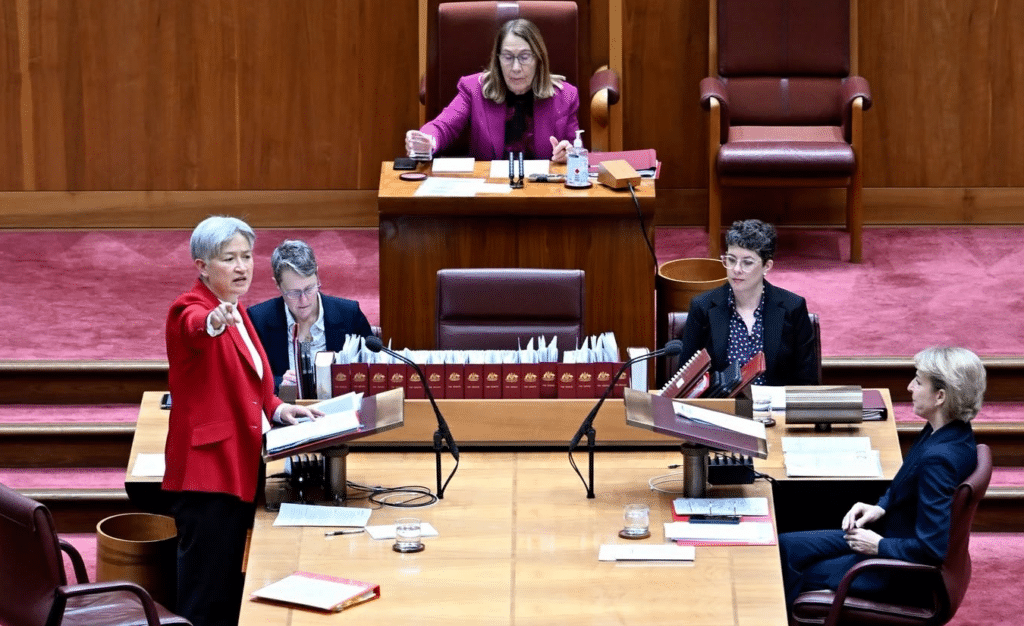
When Senator Sue Lines shared a picture of the women now running the Senate, the replies were so predictable that she has since limited them. Rita Nasr asks the key question: why doesn’t anyone ask if he deserves it?
Men have always held the power. If you believe in a God, he’s a man. The Roman emperors were men. So are the presidents, the prime ministers and the dictators. Men sit at the head of the dinner table and the boardroom table. They read the news, fill the seats in parliament, lead our armed forces in and out of conflict, run the disaster response and walked on the moon. Even Santa is a bloke.
In every picture, on every screen, at every decision-making table, from the highest office in the land to a manufacturing plant somewhere, almost nobody stopped to ask whether “he” deserved to be there. In all my years, I’ve rarely heard anyone wonder about a male leader, “Is he actually the best person for this job?”
Remember Scott Morrison, who at one point held five ministerial positions? He secretly appointed himself to each of them. We ridiculed the absurdity, and we questioned the validity of the appointments. But I didn’t see many people asking whether he was up to the job. Not once, let alone five times over.

Women get a different test. Somehow, we’re perceived to have less merit than men, especially when it comes to leadership. The question of merit isn’t neutral, and is wide open to bias. One Yale study sent identical applications for a lab manager job to scientists, changing only the name. “John” was rated more competent and offered a higher salary than “Jennifer”. Another study found that in organisations that explicitly prized meritocracy, managers were more likely to give men bigger bonuses than equally rated women. Believing you’re fair, it turns out, can make you less fair.
And the playing field isn’t level. Women do most of the unpaid care. We’re offered fewer formal development opportunities, and less coaching and mentoring. If you’re a woman of colour, those barriers get sharper again.
Which brings me to this week. Senator Sue Lines, Senator for Western Australia and President of the Australian Senate, shared a historic photo on her social media. It showed five women from across the political spectrum, with the caption: “This isn’t a sight you would have seen a decade ago. The Leader of the Government in the Senate, the Leader of the Opposition in the Senate, the President and Senate staff all women. This photo truly highlights the strength of women’s leadership across our Parliament and how far we have come. Although the work definitely isn’t finished.”
She’s completely right. It is historic. It took a long time, plenty of blood, sweat and tears, and pure fight to get here, and we should celebrate it, especially in politics, where the road to equality has been brutal. Women now make up more than 50 per cent of the governing party.
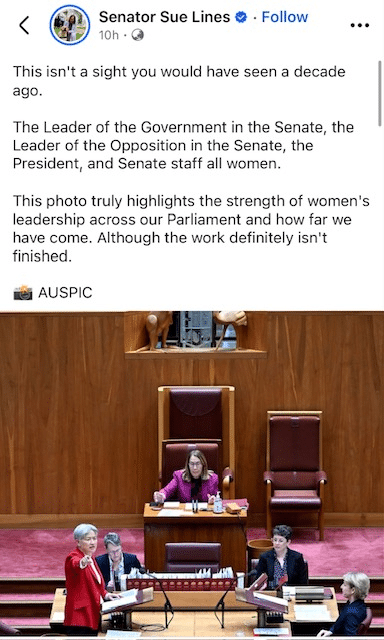
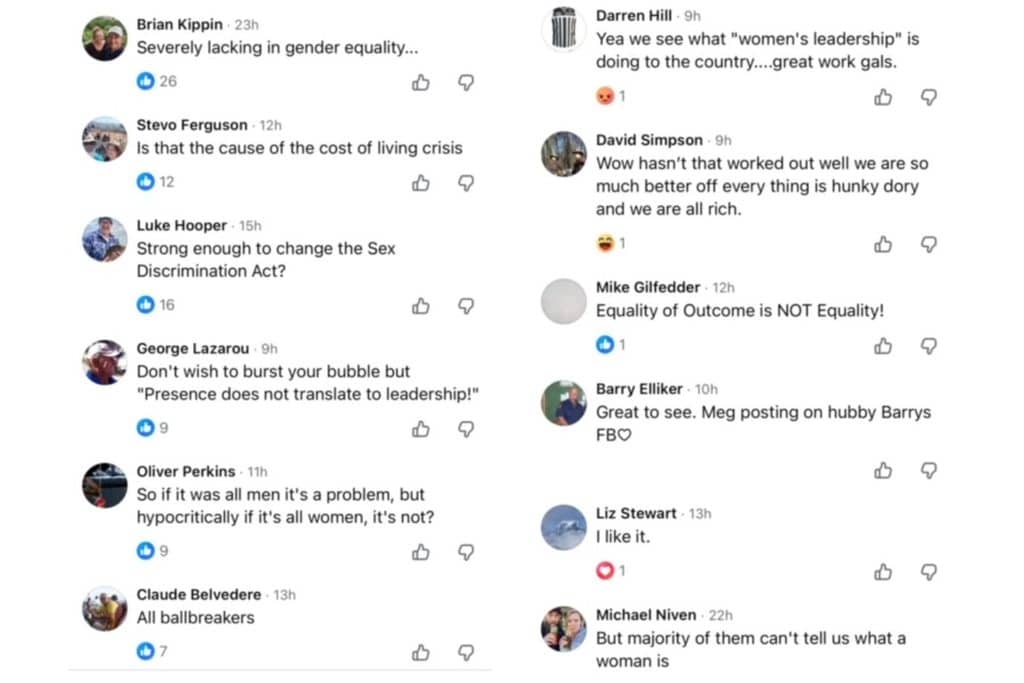
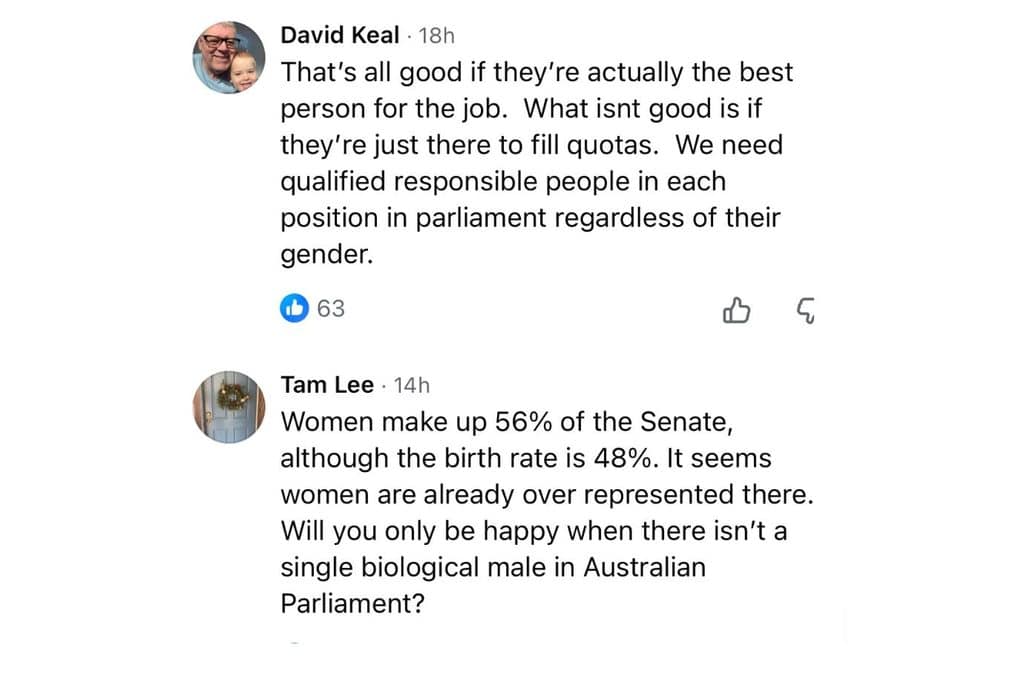
And then came the comments. Honestly, the comments. They were so spectacular, and so disappointingly unsurprising, that the Senator has now limited them.
David offered, “that’s all good if they’re actually the best person for the job. What isn’t good is if they’re just there to fill quotas. We need qualified responsible people..regardless of their gender.” Thanks, David. Nobody had ever thought of that. Tam added his two cents with “will you only be happy when there isn’t a single biological male in Australian parliament”. Yes, Tam, we’re coming for every last one of you, starting with the photo of five women in a room. George went one step further with the gem “presence does not translate to leadership”. And the lovely Alastair brought it home with “between them all they couldn’t bake a cake, let alone run this country”. Baking a cake, of course, being the core competency of the Senate.
That’s four names out of roughly 400 comments, most of them along the same lines.
Here’s the thing about quotas. They don’t lower the bar, they expose it. Economists studying Sweden’s gender quotas found that they pushed out mediocre male leaders and lifted the average competence of the men who stayed. When only one group gets automatic passage, plenty of the people waved through are average. Nobody calls them quota hires, though. They’re just called the leader.
In a society that praises in men the very same traits it penalises in women, it’s a mistake to think we all get judged on the same criteria. There are so many incompetent men who have led countries, corporations, workplaces and industries, and we never questioned whether they were there on “merit”. Jane Caro put it best: “Gender equality will be achieved when we have as many incompetent women in senior leadership roles as we do incompetent men.” So why is it always assumed that a woman in leadership is incompetent and only there to fill a quota or tick a DEI box?
I was recently asked in a guest seminar on intersectional gender equality and leveraging employee diversity: if we focus on increasing the representation of one group, say women or women of colour, don’t we risk alienating another existing group in the workplace? I keep thinking about that question. We’ve had overrepresentation of men in leadership forever, and nobody ever asked whether that risked alienating the women in the room.
I don’t care if I’m there to fill a quota or be a DEI hire. If it gives me a seat at a table where I’d never have had one simply because I’m a woman, and a culturally diverse one at that, it doesn’t mean I lack the skills, knowledge or intelligence to do a good job. It means workplaces and social structures have been built, since the start of time, to disadvantage women, and those with intersecting identities even more.
Going by the comments, we have a long way to go. Those attitudes don’t belong in any boardroom or community.
And just to be clear, Alistair, I can bake.