
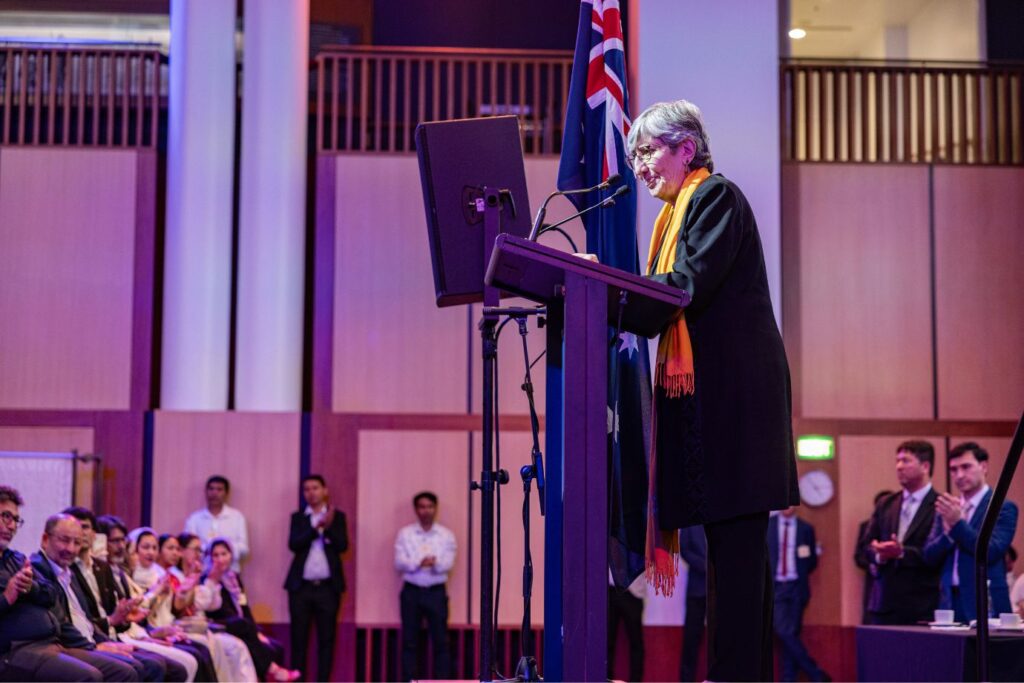
When I accepted the post of Minister for the newly created Ministry of Women’s Affairs in December 2001, Afghanistan was emerging from the ashes of the Taliban’s first rule. The country was broken, but the air was filled with hope. For the first time, women were again seen in public, and long persecuted groups like the Hazaras could breathe freely again.
I returned to Afghanistan after spending two decades in exile from where I built schools and clinics both inside Afghanistan and in Pakistan for refugees. I saw there was an opportunity to help rebuild a nation based on equality.
In the same year I also served as one of the vice-chairs of the Afghanistan Interim Administration (for 6 months), effectively the first vice president of Afghanistan. The task before all of us in the new Afghanistan was immense. We had to start from scratch: draft a new constitution, create ministries, and rebuild institutions. I remember walking through Kabul’s shattered streets thinking that if we could keep girls in school and women in the workplace, Afghanistan would never again fall to darkness.
Over the next twenty years, we tried.
Through my foundation, the Shuhada Organisation, we opened schools and hospitals across remote areas. We trained midwives, teachers, and administrators. Later as the chair of the Afghanistan Independent Human Rights Commission, I spent nearly two decades documenting abuses and urging successive governments and the world to remember that justice must never be sacrificed for convenience. I served as the United Nations Special Rapporteur for Sudan to ensure that human rights and women’s voices were not forgotten in conflict zones.
There were moments of genuine progress. Millions of girls returned to school. Women sat in parliament, ran ministries, and held prominent positions in civil society. At the time there were some indications that these were fragile gains, but still made a real difference to the lives of women and girls across the country. Every classroom full of girls was a quiet revolution.
And yet, two decades later, we are again speaking of Afghanistan in the language of absence and erasure. Erasure of women from public. Absence of protection for persecuted groups. And absence of justice.
Today, girls in Afghanistan are banned from secondary school. Universities are closed to women. Women cannot work for NGOs, visit parks, or travel without a male guardian. Women cannot even be heard in public. The word “apartheid” is not an exaggeration; it is the lived reality for women and girls in Afghanistan.
That’s half the population of Afghanistan, approximately 15 million women and girls.
The cruelty is deliberate: to erase women from public life, to silence them, to make them invisible. This is not about culture or religion; it is about power and control. And it thrives in silence, including the silence of the international community, the fatigue of donors, and the complacency of governments who speak of human rights in press releases or places like Geneva and New York but whisper them away in negotiations.
Amid that silence, Australia has stood out as one of the few nations taking principled action.
By joining international legal efforts under the Convention on the Elimination of All Forms of Discrimination Against Women (CEDAW), Australia is playing a critical role in attempting to hold the Taliban accountable.
Australia’s decision to maintain diplomatic recognition of the Afghanistan embassy in Canberra, rather than handing it to representatives of the Taliban, has also sent a powerful message: that legitimacy cannot be granted to those who take power through violence and force, and erase women from public life.
During its 20 years of engagement in Afghanistan, Australia supported education, minority rights and women’s participation, and those values have left a lasting impression among people from Afghanistan who still dream of a free and equal society. The strong diaspora community from Afghanistan, mostly from the long persecuted Hazara group here in Australia, is the product of Australia’s support of people from Afghanistan.

Australia can do more, and can remind the world that solidarity does not end when troops withdraw; it endures through our shared humanity.
I come to Australia not only to speak about the suffering of women in Afghanistan, but to recognise the courage of those who still care. The world may have turned its attention elsewhere, but moral leadership is measured in quiet persistence, not headlines.

Women in Afghanistan have not given up; they continue to teach in secret, to gather in underground schools, to speak online at risk to their lives. They remind us that human rights are not a Western export; they are a universal demand for dignity.
To the international community, and to Australia in particular, I say this: keep the pressure alive. Continue to lead on international accountability. Support Afghan women’s networks inside and outside the country. Keep Afghanistan’s story visible in your media, your diplomacy, and your classrooms.
For those of us who once sat in the cabinet room imagining a different future, the pain is personal. We built what we could and we believed that education would be Afghanistan’s armour against ignorance. It still can be but only if the world refuses to normalise a regime that bars half its population from learning, and basic human rights. Afghanistan’s story is unfinished. The next chapter must not be one written entirely by powerful men with guns. It must include the voices of the women, and all of Afghanistan’s ethnic groups.
Photo credit: Mozafar Ali.