
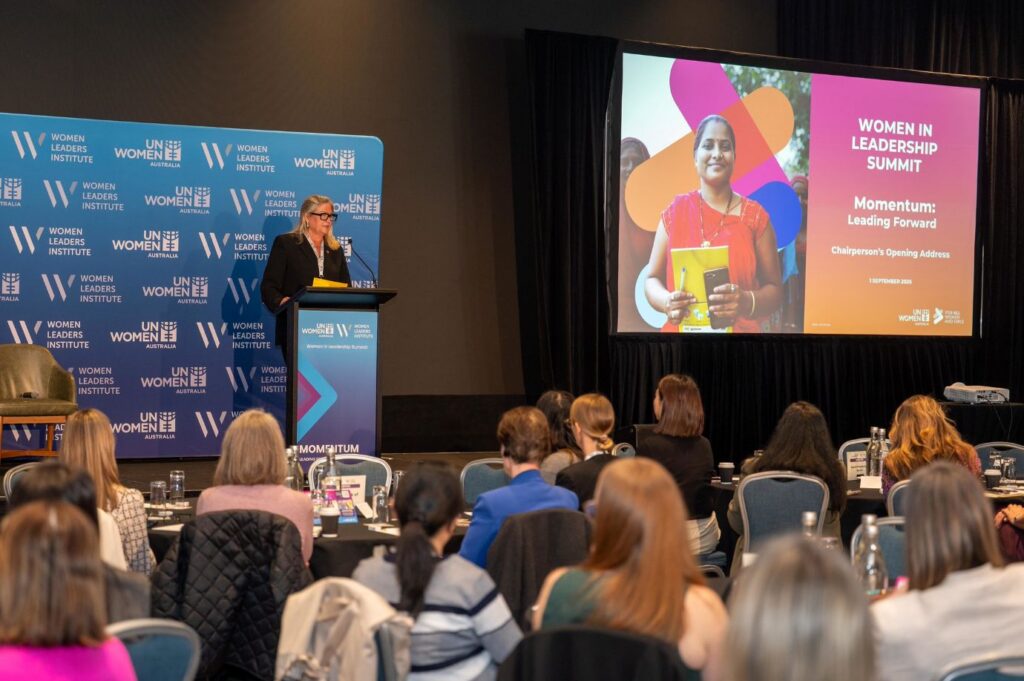
There is a particular kind of energy in a room full of women leaders. It showed up this week at the Women in Leadership Summit, delivered in partnership with UN Women Australia, where almost two hundred women from the public, private and not for profit sectors gathered under the theme “Leading Momentum” across industries and communities.
Two days of candid conversations, panels and structured networking left me feeling genuinely optimistic, inspired by the calibre, passion and determination of the women leaders in that room.
The tone was set on the morning of day one, when Annie Konieczny from UN Women Australia asked the room a deceptively simple question: “What will it take, from this room, to get more women into leadership faster?” It landed differently depending on where you sat. For many of us, the barrier has never been ambition. It has been the structural weight of workplaces and a society still not built with us in mind.
But Annie reframed that weight into momentum, pointing out that one appointment, one promotion, one board seat is progress, and each one moves the gender equality dial forward. Women hold just 22.3 per cent of CEO roles in Australia and 34 per cent of board positions, so every single appointment is genuinely structural change, not a token gesture.
Michelle O’Byrne, Australia’s Ambassador for Gender Equality and a former Federal Member for Bass, opened the summit by talking about leading without certainty, including the uncertainty that creeps into how we question our own abilities and skills.
She spoke candidly about the current political climate, where women in politics face escalating sexism and vitriol online, much of it designed to push women’s voices out of public life altogether. It is a sobering backdrop given women now hold almost fifty percent of seats across Australia’s federal parliament, the highest representation in the country’s history. That progress is real, and it is also precisely why the backlash has intensified. Michelle’s point was that women need a seat at the political table because representation leads to better policy outcomes, and that seat must be defended, not just won.
The panels that followed ranged widely, from the ongoing debate over working from home to what it means to lead with intention, and the room’s energy shifted noticeably during the conversation on unpaid care.
Micaela Driberg, CEO of Gender Equity Victoria, spoke about women carrying around 70 per cent of caring responsibilities, a figure that lines up almost exactly with national data showing women make up roughly seven in ten primary carers in Australia. You could watch heads nod across the room in recognition. Micaela’s point was not just about the statistic but about leadership itself. Leaders need to talk about and acknowledge that women are often trying to lead while carrying the bulk of caring work at home, and empathetic leadership starts with naming that reality rather than pretending it does not exist.
Dr Leanne Griffin, Vice President of Change at Toll Group, offered advice that has stayed with me since, “be broad in how you define success.” Women are so often trained to judge ourselves harshly against a narrow, singular idea of what success looks like. Leanne’s reminder that success can be tangible in many different forms felt like permission many people in that room needed.
The moment that stopped the room entirely came from Dr Naba Alfayadh, founder of Rahma Health, who spoke about her lived experience of war, racism and displacement as a refugee, and the intersecting identities and cultural expectations she has navigated throughout her leadership journey. Watching her resilience and her ability to turn adversity into power, then pay it forward to her community, was genuinely one of the most inspiring things I have witnessed at a professional event.
A powerful moment on day two came during a question to keynote speaker Antoinette Braybrook, CEO of Djirra, about how to bring men into conversations and spaces designed to advance women without making them feel alienated. Her response cut straight to the point – she is always asked this question, and women leaders need to stop being asked it. That conversation belongs with male leaders. It is their job to talk to other men and answer it themselves.
A clear thread ran through both days: the importance of surrounding yourself with the right people, building coalitions of genuine allies, and investing in sustainable peer networks.

Louise Weine, CEO of the National Association of Women in Operations, put it plainly, “gender balance doesn’t happen by accident, it happens by design.” Dr Niki Vincent, Commissioner for Gender Equality in the Public Sector, reinforced that idea, noting the workforce “was designed in a different era for a male with a wife at home looking after the kids.”
The closing panel pushed that design thinking further still, with women from culturally diverse communities unpacking intersectionality for the room. Malini Raj, Executive Director of the Australian Multicultural Women’s Alliance, argued that organisations need to co-design away from Western constructs of leadership and consult with women who hold lived experience of intersecting identities when building workplace structures.
Two days is a short window, but the summit did something a keynote alone never could. It built a room. It created the connection and networking that underpin the alliances every woman leader eventually needs to keep going. You cannot be what you cannot see, and rooms like this one are quietly, deliberately building that visibility, one appointment, one relationship, one seat at the table at a time.
Image: UN Women Australia CEO Simone Clarke speaking at the Women in Leadership Summit in Sydney, 2026.