
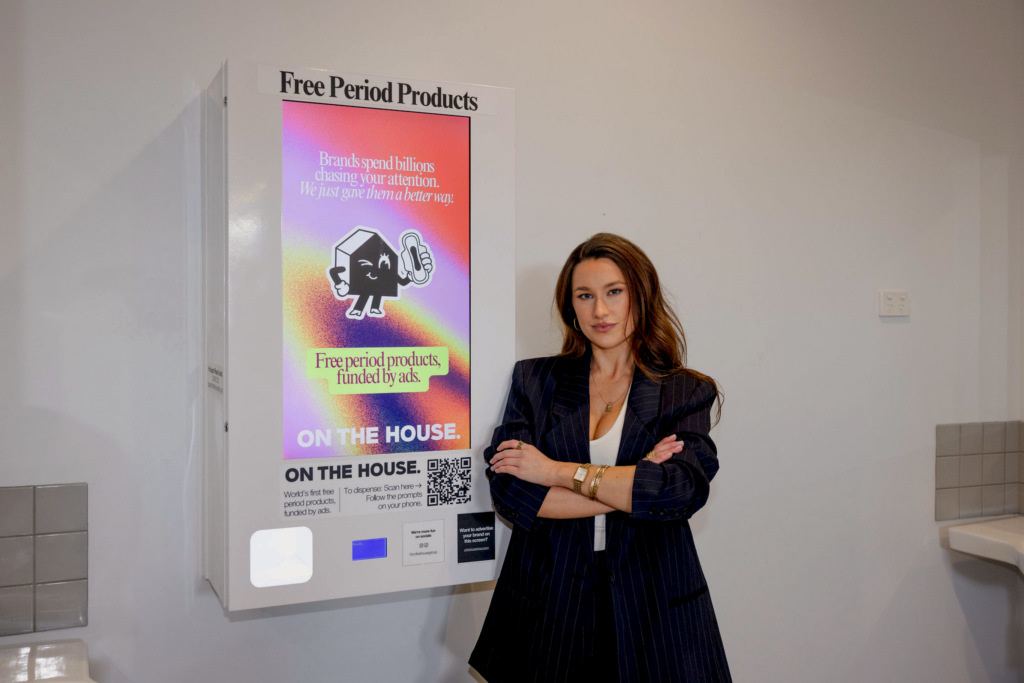
Remy Tucker likes to think of period products in the language of infrastructure. They’re more like water systems or transport networks than something a charity or social initiative needs to support in order to enable more people to access.
The Sydney-based founder of ON THE HOUSE, a seed-funded startup that has just raised $1.7 million, sits behind a concept that has quickly moved from idea to expanding rollout across public venues.
ON THE HOUSE operates on an unusual model for the sector: advertising revenue funds the provision of free period products across public venues including stadiums, universities and large precincts. The company redirects existing marketing expenditure into a system designed to sustain access.
“Brands already spent billions globally on advertising,” Tucker said. “We were redirecting an existing, stable budget rather than relying on funding streams that could disappear when conditions changed.”
The result is a triangular structure of incentives: brands receive visibility and engagement, venues improve their public amenities, and users gain free access to essential products.
“The strongest models are the ones where everyone wins,” she said. “That alignment was what made it sustainable.”
Tucker adds that period inequity is anything but a niche issue, noting the scalability of what she’s building.
“Before I even built the business, scalability was the starting point,” she told Women’s Agenda. “If it could not scale, it would not have solved the problem in a meaningful way.”
Rather than developing a pilot program or a donation-dependent model, relying on grants, donations or government funding (which can fluctuate with political and economic cycles), Tucker built the company as infrastructure from day one—designed to expand into any high-footfall public space where access to period products remains inconsistent or absent.
It reflects a broader shift in how some founders are approaching entrenched social problems: not as gaps to be filled at the margins, but as markets that have never been properly constructed.
“No one questioned the provision of toilet paper, soap, or running water in public spaces,” she said. “They were considered baseline infrastructure. Period products should be viewed in exactly the same way.”
That shift changes the entire logic of provision, she says. What begins as a question of whether period products should be supplied becomes a question of how they are embedded reliably and at scale. In that transition, the issue moves from welfare to standard practice.

“Once you adopted that mindset, it stopped being a nice-to-have or a welfare issue and became a standard of care.”
Like many founders building at the intersection of commercial and social impact, Tucker said early conversations with investors often began with misunderstanding.
She says it was initially difficult to convince investors of the opportunity. “Because on the surface it could have sounded like a social initiative or a charity.”
But once the mechanics of the business were clear, the perception shifted quickly.
“What it highlighted was that framing mattered,” she said. “If you clearly articulated the size of the opportunity and the mechanics, the conversation moved from impact to inevitability.”
Tucker positions ON THE HOUSE not as a cause with commercial upside, but as a large-scale market opportunity with embedded social outcomes. “We were building a multi-billion dollar business that also happened to solve a critical problem,” she said.
The company’s growth sits against a backdrop of persistent gender imbalance in venture capital, particularly for women-led startups in Australia and globally.
Tucker is careful not to reduce that imbalance to individual bias alone.
“The stat was true, but it was a symptom, not the disease,” she said. “The real problem was that the system was built by men, for men, and it self-replicated.”
She points to entrenched networks, homogeneity among decision-makers, and differences in how founders are assessed in pitch rooms.
“Anecdotally, I have heard that investors literally asked women different questions—focused on what could go wrong rather than how big they could win,” she said. “That framing alone led to dramatically lower funding offers.”
She also points to research often cited by advocates for greater diversity in venture capital.
“Women-led startups delivered roughly twice the return per dollar invested,” she said, “and when venture-backed, generated 12 per cent higher revenue.”
For Tucker, the solution lies not in quotas but in structure: more diverse decision-makers, broader networks, and greater visibility for women building companies at scale.
“What I wanted to see change was not preferential treatment,” she said. “It was fixing the entry points.”
Demand for ON THE HOUSE has come from a different direction entirely. Now, the company is expanding into stadiums, universities and major public precincts, and interest from organisations has been immediate.
“We had been inundated with inbound requests,” she said. “The sheer volume signalled just how widespread and under-addressed this need had been.”
According to Tucker, the barrier for many venues is not willingness, but infrastructure. The expectation that period products should be available in public spaces is increasingly accepted; what has been missing is a scalable system to deliver it.
“Once that solution existed, adoption accelerated quickly,” she said.
Asked about advice for other founders building from lived experience, Tucker rejects the idea that these issues belong to any one group.
“I actually did not think of it as a deeply gendered issue,” she said. “These were human issues. Women’s problems were people’s problems, and vice versa.”
Tucker believes that proximity to a problem is an advantage rather than a constraint.
“Lived experience was a competitive advantage,” she said. “When you deeply understand your customer, you build better, faster, and more intuitively.”
Her advice is direct: focus relentlessly on the problem, and be prepared to educate as you scale.
“The more clearly you articulated the problem, the easier it was to bring others along.”
Looking ahead, ON THE HOUSE is targeting the deployment of 20,000 machines globally over the next five years, a milestone Tucker links directly to impact.
“For us, success meant building a business that was deeply commercially viable,” she said. “Because that was what enabled us to create real, lasting impact at scale.”
In her view, profit and purpose are not competing forces but mutually reinforcing ones.
“The two were completely interdependent.”
It is a view that extends beyond her own company, into how she sees the next wave of Australian startups.
“There had never been a better time to build,” she said. “The companies that balanced profit and purpose effectively would be the ones that endured.”