
Let me take you back to 1990. George Michael is gyrating in a leather jacket, and five of the most genetically blessed women on the planet are pouting at the camera for Freedom! ’90. Cindy. Naomi. Linda. Christy. Claudia. The Big Five. So iconic they only needed first names, like royalty.
We were told these women were the beauty standard. Runway-stomping, magazine-cover-dominating, “I won’t get out of bed for less than $10,000 a day” goddesses. Impossible? Absolutely. But at least they had the decency to be obviously, cartoonishly unattainable. They existed on glossy pages you physically had to purchase.
Fast forward to 2026, and we being bombarded algorithmically, relentlessly, intimately by a beauty standard that makes the supermodel era look like a wholesome government health campaign.
The awards season red carpets. Cannes. The Met Gala. Hollywood’s most glamorous stages have become a parade of the disturbingly thin, and every red-carpet moment lands directly in my Instagram feed whether I invited it or not. Something has happened to women in Hollywood, and that something has a brand name, a prescription pad, and a very aggressive marketing budget.
Let’s call it what it is: the ’90s thin ideal never actually left — it just got a wellness rebrand, a new prescription, and the audacity to call itself empowerment. Vogue Business said it plainly in their 2025 size inclusivity report, “progress has stalled and we are facing a worrying return to using extremely thin models, amid the Ozempic boom.” The presence of plus-size models on runways dropped from 2.8 per cent in 2020 to just 0.8 per cent in 2025. We didn’t just stall, we reversed, at speed, in heels.
At the 2026 Oscars, multiple A-listers appeared noticeably, startlingly thin triggering widespread concern and the now familiar guessing game of who’s disclosing, who’s denying, and who is attempting to convince us that their new frame is the result of pilates and mindfulness. Some celebrities, to their credit, have been honest. Kathy Bates openly credited Ozempic for her 100-pound weight loss. Others remain silent, which is their right, but that silence has a cost when millions of women and girls are watching, absorbing, internalising.
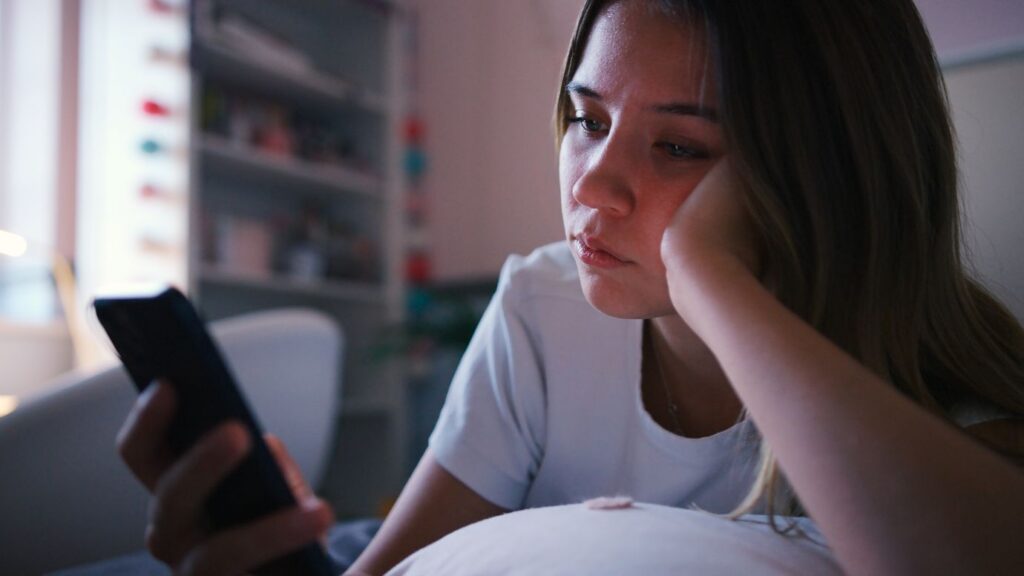
Because here is what’s different from the ’90s, and it matters enormously: this is not a magazine you can close. This is your phone. It is in your pocket, your bed, your bathroom. The algorithm does not sleep. And it has decided that your body is a problem requiring an urgent, monetisable solution.
I am now routinely informed, via my feed, that I need to take Ozempic (or “microdose” it, for the more aspirational version), stack it with peptides, lift weights but not too many, we don’t want to look bulky, do lymphatic drainage massage, get laser facials, and blend my grey hair, because apparently silver streaks are a character flaw requiring correction.
The fitness influencers who spent years screaming at us to simply move our bodies and stop being lazy are now hawking GLP-1 microdosing protocols and “doing their own research” on peptides. The same women who sold us transformation via discipline are now selling transformation via injection. The product changed. The message — your body is wrong — did not.
And ageing? Women in their sixties are expected to look forty. When a woman dares to appear on a red carpet with actual grey hair, or God forbid, visible wrinkles, she is described as brave. Brave. As though existing in your own unmodified face is an act of political resistance requiring courage. Which, apparently, in 2026, it is.
We had a window. A genuinely hopeful, culturally shifting window, where body positivity moved from fringe activism into mainstream advertising. Where we saw diverse bodies, different sizes, different ages, different stories reflected back at us. Where “normal” stopped being a euphemism for thin, white, and 25. That window is closing.
The tragedy is not just aesthetic, it’s medical. Eating disorder rates among adolescent girls have surged since the pandemic. Social media use and thin-ideal internalisation are now so well-documented in research they barely constitute a controversial finding. We know what these images do to women and girls. We have the data. We just keep posting anyway.

There is nothing wrong with weight-loss medication for people who medically need it. There is everything wrong with a culture that has repackaged an injectable appetite suppressant as the new black, filtered it through celebrity endorsement and wellness branding, and pointed it directly at women who were, until very recently, being told that their bodies were finally, actually, enough.
In 2026, we’re expected to get out of bed, hit the gym, book the laser, order the peptides, and do our own research all before breakfast. And we are supposed to feel empowered about it. Empowered to make our own choices, just as long as every choice leads us to looking exactly like everyone else.