
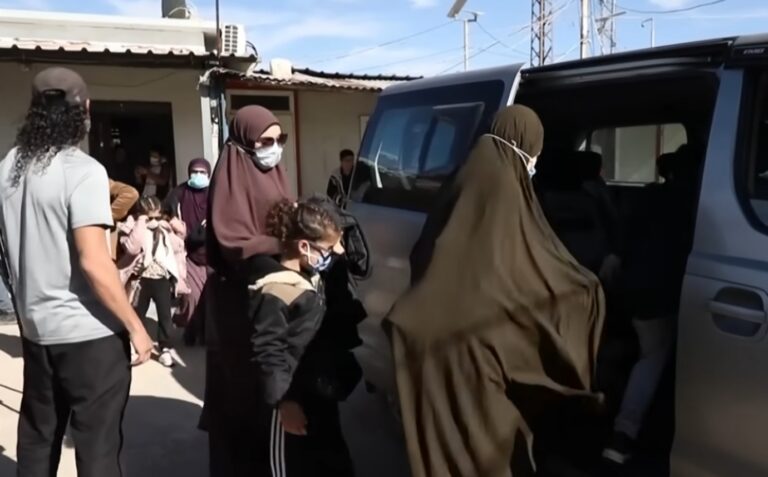
The return of Australian ISIS-associated women and children has been the subject of contentious debate since the defeat of the ISIS territorial caliphate in Syria. Concerns about their threat to national security have been at the forefront. At the same time, Australian organisations such as Save the Children have advocated for the women and children’s humanitarian needs and right of return as Australian citizens. Other commentators have raised the challenge of their reintegration and its impact on Australia’s social cohesion.
The recent return of four ISIS-associated women and nine children from Al-Roj camp in northeast Syria has resurfaced these debates.
Just this week, six additional women, along with their children and grandchildren, are expected to leave the Al Roj camp in Syria for Damascus before returning to Australia.
Unprecedented Prosecution
One woman was arrested on arrival in Sydney for her alleged membership of a terrorist group. Two women were arrested at Melbourne airport for slavery offences and crimes against humanity committed in Syria. They are alleged to have enslaved, possessed and used a Yazidi woman in Syrian territories. The slavery charges fall under Division 270 of the Australian Commonwealth Criminal Code, which criminalises slavery as a standalone offence. The crimes against humanity charges fall under Division 268, which implements Australia’s obligations under the Rome Statute of the International Criminal Court (ICC) and criminalises enslavement committed as part of a widespread or systematic attack against a civilian population. The two women’s bail hearings are delayed until June.
Australia has acted swiftly to prosecute these alleged international crimes, which are the first of their kind seen in Australia. Cases of ISIS-affiliated returnees have been prosecuted in several European states, including Germany, where courts have now delivered multiple convictions of ISIS members for crimes against humanity and genocide committed against the Yazidi community. While Australia is not obligated under the ICC to prosecute the crimes, it is an important signal of the country’s commitment to the international rule of law in the context of crimes against humanity being perpetrated in other countries.
Victim survivors and perpetrators: the gendered complexity of return
The highest priority of the Australian Government is to keep Australians safe. But security cannot be reduced to prosecution alone. Reintegration of ISIS-linked women and children is more complex than public debate suggests because many of these women may have been victim survivors as well as perpetrators of gendered violence, and the children most definitely have been exposed to and witnessed violence and deprivation. Although the Australian and international media often refers to women who entered ISIS territory between 2014 and 2019 as ‘ISIS brides’, this label implies singular, passive roles. In reality, these women are not a homogenous group. Some travelled voluntarily for ideological reasons, others were taken to Syria by spouses or family members. They took on various roles in the caliphate: fighter, recruiter, fundraiser (terrorist financing), slave owner and/or wife/mother. As well as alleged perpetrators, some women may have themselves been victims of crimes of sexual and gender-based violence including forced marriage, forced pregnancy and sexual violence.
ISIS’s gender ideology has been well documented: Men were recruited as fighters, while women were recruited primarily for domestic and reproductive roles. ISIS also enslaved Yazidi men for forced labour and Yazidi women for domestic and sexual servitude. This gender order was integral to ISIS’s quest to create a Caliphate. Yet this context has rarely featured in public discussions of the return and reintegration of ISIS-linked Australian women and children.
Stigma and community impact
How Australia manages the reintegration of this group of ISIS-linked women and children through its legal, health and social institutions has implications for the broader community. It will likely have the greatest impact on the Australian Muslim community, which may face stigmatisation through Islamophobic assumptions linking these alleged crimes to Islam itself, a dynamic that has been documented for years.
Public understanding of ISIS returnees in other non-Muslim majority countries has been shaped by Islamophobia. Returning to a society that discriminates against women for wearing a hijab, for instance, can undermine the sense of belonging that reintegration requires. ISIS reintegration programmes in Germany and other countries have revealed the challenge of working with ISIS returnees in a context of Islamophobia. Moreover, women returnees often face a “double stigma”. They are penalised for their association with a violent extremist group, and for transgressing conventional gender norms by joining the group. Women and children from ethnic and religious minority groups face the greatest stigma.

This matters because states’ narratives and practices can fuel the very same grievances that attracted citizens to join terrorist organisations in the first place. Research on ISIS recruitment has shown that the experience of being treated as foreign in one’s own country can be instrumentalised. A reintegration process that deepens marginalisation risks fuelling the grievances it seeks to resolve.
Confronting all extremisms by enhancing social cohesion
The return of the ISIS-linked women and children has occurred at a time of heightened social tension. The Bondi attacks revealed Australia’s serious problem of antisemitism and the aftermath has led to sharp increases in Islamophobia. Both antisemitism and Islamophobia are instrumentalised by far-right extremist groups. Research shows that different extremisms fuel each other and exploit the same underlying conditions. Confronting any of these extremisms requires confronting all of them. Australia cannot challenge violent extremism or promote social cohesion through the rule of law only. The reintegration of returning citizens, especially children, must be informed by values of human rights, gender equality and dignity.