
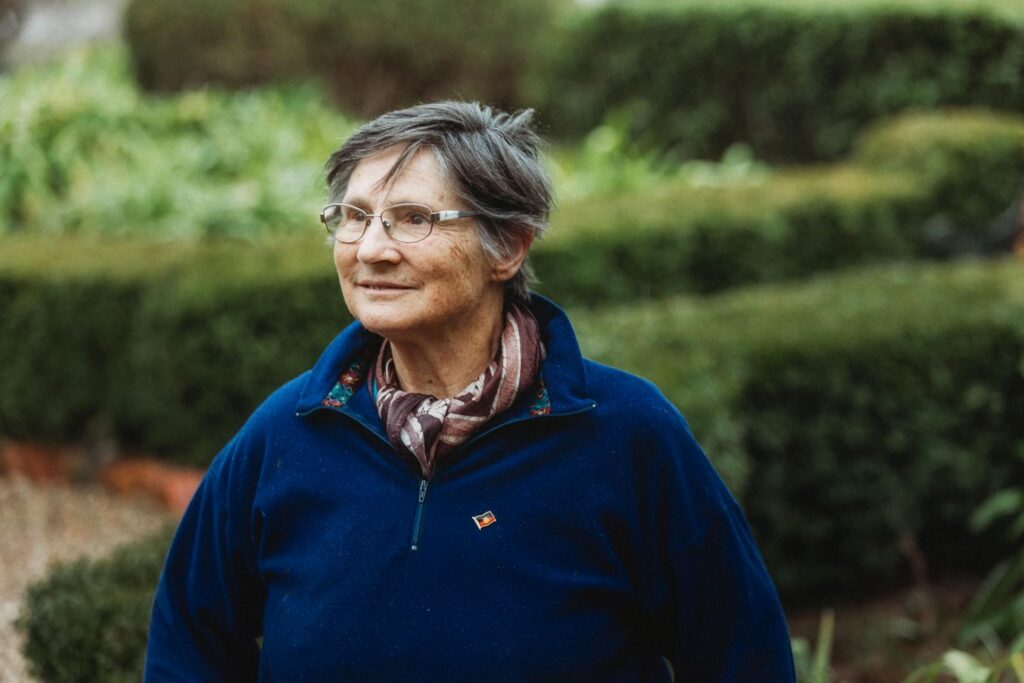
When Karen Alexander was around seven years old, her father gave her one piece of advice for navigating the bush: if you get lost, don’t follow the track, follow a creek. It will always bring you out somewhere. “Follow nature and you will then be renewed,” she says.
In the final episode of the season of There Will Be Dancing, a podcast produced by Women’s Environmental Leadership Australia (WELA) in partnership with Women’s Agenda, Karen, a WELA co-founder, reflects on a career that also included founding the Wilderness Society and Bush Heritage, helping build the Greens in Victoria and securing World Heritage listing for the Daintree.
Karen grew up in the Dandenong Ranges outside Melbourne, five acres backing onto Sherbrooke Forest, and was crawling for the front door by nine months old. Her mother, a musician and music educator working in the city in the 1950s, was juggling career and motherhood in a way that was unheard of at the time. As a result, her parents let her loose in the bush. That early freedom to explore set her on a path that has now spanned more than four decades of environmental leadership.
Lake Pedder in Tasmania’s southwest was the first place that broke her heart. She fell for its wild country on a university bushwalking trip, and when the lake was flooded to build a dam, something in her hardened.
“A bit later on when they wanted to do the Franklin,” she says. “I thought: you bastards, you’re not getting this one.”
That anger became the Franklin campaign, widely credited as the birthplace of modern Australian environmentalism. Karen helped lead it to victory, stopping a dam that would have flooded the wild river forever.
The Franklin win wasn’t purely a triumph of conviction. A couple of advertising volunteers walked into the campaign office one day and asked a question that stopped her short: not which arguments felt right, but which ones actually worked with the public. The campaign ran focus groups to find out and the answer was surprising. It wasn’t the loss of jobs or the destruction of wilderness that cut through, but the sheer waste of it all: a World Heritage area destroyed for just 180 megawatts of power, about two weeks’ worth of what Australia now installs in rooftop solar. Armed with that intel, the campaign got surgical, mapping exactly which marginal seats would decide the outcome nationally and building a grassroots game there ahead of the 1983 election. “We were very, very strategic,” she says. “We knew where it was possible to get a change.”
The Franklin blockade worked because it was timed for maximum publicity ahead of an election and carried out by people embedded in the campaign. Years later, a blockade in East Gippsland played out very differently. Outsiders arrived, disrupted careful local negotiations with loggers and blew the whole thing apart. “It was terrible,” she says. “People’s motivations were fine but a blockade divorced from an overall strategy can do more harm than good with the very people a campaign is trying to reach.”
Looking back, Karen wishes she’d raised the gender issue within the movement much sooner.
Not long after the Franklin win, she remembers telling fellow campaigner Bob Brown that the environmental movement wouldn’t solve its bigger problems until it reckoned with gender. She didn’t push the insight further at the time. “I couldn’t quite see where to take it,” she says. Decades later, that unfinished thought became part of the impetus for WELA, born out of a research project interviewing women environmental leaders and a friend’s dying instruction not to let the findings sit on a shelf.
Karen now sits with the role of elder, a title she’s leaned into deliberately. She’s inspired by First Nations approaches to eldership, where decades of lived experience are actively sought out rather than sidelined. “We do not honour the experience, expertise or stories of older generations,” she says of mainstream Australian culture. She believes the answer is practical: create simple, regular spaces where younger people can ask anything. And bring cake.
Listen to the full conversation with Karen Alexander on There Will Be Dancing, available now on Spotify, Apple Podcasts and all major platforms.

____________________________________________________________________________________________
Karen Alexander’s advice for younger leaders
- Ask, and ask again. I’m very good at saying: who can help me do this? You lose nothing by asking.
- Follow the creek. When you’re lost or uncertain, return to what grounds you rather than searching for a marked path.
- Take your insights seriously. If you notice something others haven’t named yet, don’t let it sit. “Talk about it, go to a mentor, find someone to sit down with.”
- Test what actually works. Passionate arguments aren’t always persuasive ones. Be willing to find out which messages land with the audience you’re trying to reach.
- Turn anger into strategy, not despair. Strong emotion is a legitimate starting point for action, provided it’s channelled into a plan rather than left to sit.
- Seek out your elders. Whatever stage of life you’re at, cross-generational relationships offer wisdom that professional structures rarely provide on their own.
____________________________________________________________________________________________