
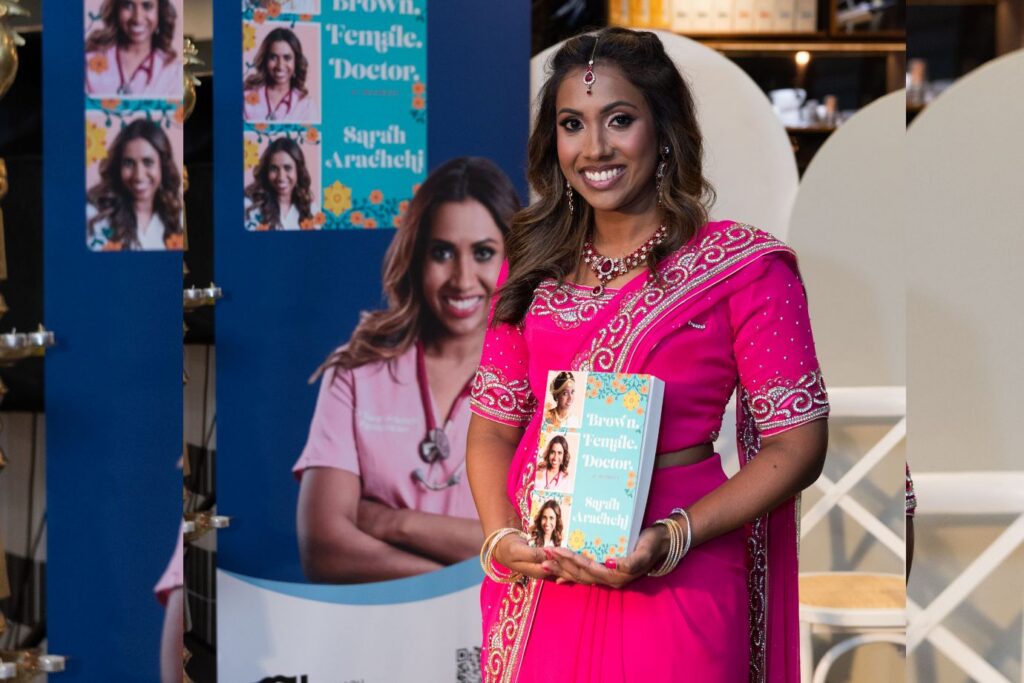
There is a growing conversation in Australia about what it means to be Australian and the importance of identifying as Australian. Yet we cannot ignore the fact that we are a nation built on multiculturalism.
The Australian Bureau of Statistics reported that 32 per cent of Australia’s population was born overseas, as of June 2025, with India, England, China and New Zealand representing the largest overseas-born populations.
Interestingly, if we look back to 1891, the earliest population records show that 32% of Australia’s population was also born overseas.
As a child who arrived in Australia from Sri Lanka in 1990 at the age of four, I have always seen migration as an important part of my story. Migration often involves a search for belonging in new places and spaces. Yet acceptance is not always granted, no matter how hard one tries to fit in.
Australia was always the “lucky country”, a place of opportunity and education, a place that valued difference, or so I had been taught.
From the moment I entered kindergarten in 1990, I tried to blend in. I worked hard to perfect my Australian accent. I developed a love for the beach in summer, enjoying fish and chips while walking in thongs along sandy shores, watching the spindrift gather at my feet. I embraced barbecues on long weekends with family and friends and fell in love with one of Australia’s great sporting passions: cricket. In high school, I helped establish the first girls’ cricket team because I loved the game so much. I love Aussie banter, the idea of giving everyone a “fair go”, and words like “mate” are part of my everyday vocabulary.
I am one of the first people to be patriotic about Australia. It is a nation that gave me opportunities for which I remain deeply grateful. I identify strongly as Australian, yet there are times when it feels as though that identity is reserved for those who look a particular way. Even with my unmistakably Australian accent, 36 years later I am still asked, here in Victoria:
“Where are you from?”
“I’m from here,” I reply. “I’m Australian.”
“No, where are you really from?”
Does it really matter?
One of the most beautiful aspects of Australia is that we are a diverse nation. Shouldn’t that diversity strengthen us and help foster stronger international relationships?

I still remember singing “I Am Australian” by Bruce Woodley at the top of my lungs as a nine-year-old in primary school. The lyric, “And from all the lands on earth we come,” resonated deeply with me. I can never let go of my cultural roots, nor would I want to. They have helped me see the world through a different lens. I love my Sri Lankan culture—its food, its people, its language, its music and its rich heritage. I am proud to speak both Sinhalese and English and to perform traditional Kandyan dancing.
The question of “Where do I belong?” has always created an internal tug-of-war. It is easy for politicians to debate concepts such as monoculturalism when they have no lived experience of navigating multiple cultural identities. I was often “not Sri Lankan enough” or “not Australian enough”. There was never a sweet spot for people who walked a tightrope between two worlds, constantly trying to maintain the perfect balance to fit into both.
In 1996, many of my friends and I, particularly those of South Asian and Asian backgrounds, endured comments such as “Go back to your own country” in the school playground. It was a common refrain directed at children who looked different.
What happened to those children?
Many grew up to become doctors, lawyers, engineers, journalists, accountants and business owners. They became community leaders, volunteers, parents and mentors.
They continue to contribute to the growth of Australia in countless ways.
Perhaps those comments fuelled a quiet determination to succeed. Perhaps they taught us resilience. I never wanted to be a follower. I am proud of my Sri Lankan heritage and proud of the values it instilled in me just as much as I am proud of growing up as an Australian. I flew here, then I grew here. I value multiculturalism because it reflects the reality of modern Australia and enriches our communities in countless ways.
While politicians argued in echo chambers that people like me did not belong, the little girl from 1996 grew up.
She studied hard, attended medical school at Monash University, and went on to work in regional and metropolitan hospitals across Victoria, specialising in paediatrics. She became a paediatrician, a mother of two children, an advocate for women, the author of Brown. Female. Doctor., and an editor of a paediatric textbook. She began speaking on panels about the importance of women in workplaces and educating Australians about important health issues through appearances on ABC News Breakfast.
She has cared for thousands of children in hospitals and clinics over almost two decades. She has worked in regional communities and spent years working long and late shifts, often at the expense of time with her own family, because she believed in serving others. Being a woman in medicine has never been easy, but that is a story for another day.
So don’t tell me that I don’t belong.
Don’t make sweeping generalisations about multicultural Australians. Those comments hurt real people, including me.
I have done nothing but contribute.
I value education. I value people. I value Australia and everything it offered a small child who left her island home at the age of four.
Growing up in Australia was often confusing for someone like me. Over time, I have come to accept that I am a third-culture kid—someone who belongs in the intersection of the Venn diagram, drawing from the best of multiple worlds. The reality is that people like me do not fit neatly into one box, nor should we have to.
And this is not just my story.
Today, there is an undertone of racism beginning to surface once again, reminiscent of what many of us experienced in the 1990s.
Australia is not defined by how we look but by how we live together. It is shaped by shared values: fairness, respect, hard work and a belief in giving people a fair go. These are not exclusive values. They are inherited, strengthened and renewed by every generation that chooses to call this country home.
Importantly, Australia’s identity begins with the world’s oldest continuing cultures. I acknowledge the First Nations peoples of this land—their enduring connection to Country, their history and their place at the centre of Australia’s story. Any honest discussion of Australian identity must begin there.
At the end of the day, our internal organs are all the same. Humanity must come first.
And yes, I agree that people who choose to settle here should want to be Australian.
But fitting in is not always easy.
So make space for those who are trying. Birds migrate. People do too.