
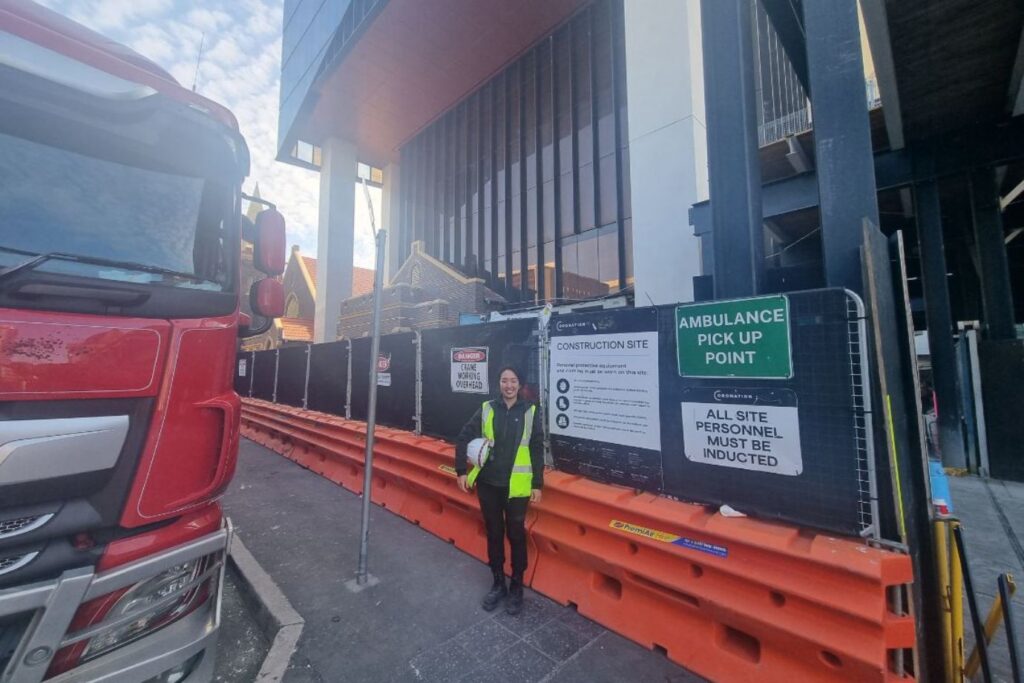
International Women in Engineering Day, celebrated annually on 23 June, shines a spotlight on the women helping to shape our cities, infrastructure and communities. It is also an opportunity to consider why women remain underrepresented in engineering and what more can be done to change that.
Today, I am a Project Engineer overseeing work on Coronation Property’s landmark 8 Phillip Street development in Parramatta. Before joining Coronation, I worked on major projects including Sydney Metro’s Pitt Street Station and the Green Square Aquatic Centre.
But a career in construction and project engineering was never part of my original career plan.
In fact, by the time I had finished high school, I had never seriously considered it.
My experience reflects one part of the broader challenge facing the industry. Conversations about women in engineering rightly focus on attracting, supporting and retaining talent. But before any of that can happen, young women need to know that these careers exist and be able to imagine themselves pursuing them.
The numbers show the scale of the challenge. According to the Federal Government’s STEM Equity Monitor, women account for just 27 per cent of Australia’s STEM workforce. In engineering-related fields, representation remains significantly lower than many other professions. Yet the issue is not a lack of ability or interest. Often, it is a lack of awareness.
You cannot choose a career you do not know exists.
During my high school, I intended to study architecture. When it came time to consider my university options, I began exploring related pathways and came across a degree in Construction Management and Property at UNSW.
At the time, I had absolutely no background in construction. The closest experience I had was completing a woodwork subject at school.
Still, I was curious.
After researching the degree and the career opportunities it could lead to, I decided to give it a chance. That decision set me on a path that has now spanned almost a decade across some of Sydney’s largest and most complex projects.
Looking back, what stands out most is how easily I could have missed the opportunity altogether.

Construction management, project engineering and development were never presented to me as realistic career options while I was at school. I knew about professions such as law, medicine, teaching and architecture. I knew engineering existed, but my understanding was limited to the pathways most people hear about, such as civil or structural engineering.
What I didn’t know was that there was an entire industry focused on bringing projects to life, managing teams, solving problems and helping shape the built environment.
I suspect many young women today are in the same position.
Throughout my career, I have worked in a predominantly male industry. While that can sound intimidating from the outside, my experience has shown that construction is far less daunting than many people imagine.
I’ve also been fortunate to work alongside several highly accomplished women whose leadership left a lasting impression on me. Some of the strongest professionals I’ve encountered throughout my career have been women leading major projects, managing contracts and overseeing complex engineering works.
Seeing women succeed in these roles matters because visibility creates possibility.
I see that visibility within Coronation and its Build-to-Rent platform, Nation. Nation’s leadership team includes Charlotte Dillon as General Manager, Beatrix Kiss as Head of Operations, Sally Picot as Head of Leasing and Nicole Kallin as Head of Marketing – women leading across several areas of the property sector.
Women also currently represent 44 per cent of Coronation’s senior leadership team.
Representation at a senior level matters. It gives people entering the industry visible examples of the different careers and leadership pathways available to them.
Increasing female representation in engineering will require action across education, recruitment, workplace culture, development and retention. One important place to start is ensuring young women understand the breadth of careers available.
That means introducing students to a wider range of pathways while they are still at school. It means inviting women working across engineering, construction and development into classrooms to share their experiences. It also means continuing to challenge outdated assumptions about who belongs in these industries.
For many young women, awareness may be the first barrier they encounter.
I know because I was one of them.
International Women in Engineering Day is an important opportunity to celebrate the women already making an impact across the industry. It is also a reminder that there are countless others who could thrive in these careers if they were shown what is possible.
Sometimes creating change starts with something as simple as showing someone a path they never knew existed.