
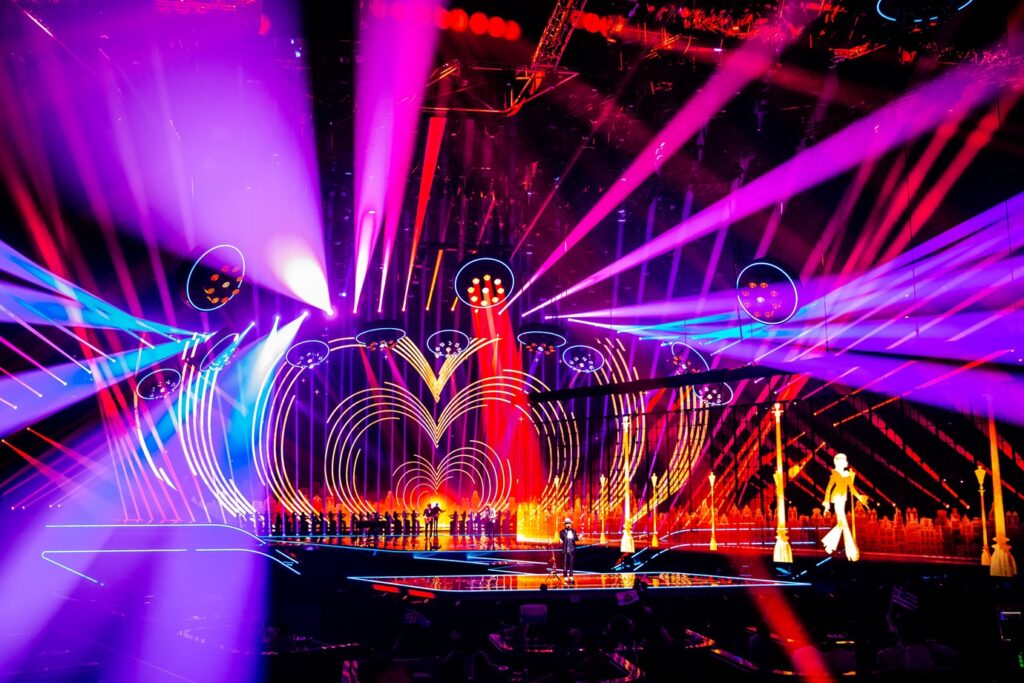
Four countries have pulled out of the 2026 Eurovision Song Contest, as Israel was cleared on Thursday to participate.
Ireland, Spain, the Netherlands and Slovenia have all announced boycotts to the competition, over Israel’s actions in the war in Gaza.
Ireland’s RTÉ said it felt that “participation remains unconscionable given the appalling loss of lives in Gaza and the humanitarian crisis there which continues to put the lives of so many civilians at risk.”
At a meeting on Thursday, the European Broadcasting Union (EBU), the body that organises Eurovision, voted ‘yes’ on Israel’s participation in the competition.
In a statement, the EBU said: “A large majority of members agreed that there was no need for a further vote on participation and that the Eurovision song contest 2026 should proceed as planned, with the additional safeguards in place.”
Instead, the EBU said its members backed rules intended to discourage governments and third parties from disproportionately promoting songs to sway voters. This comes after allegations that Israel unfairly boosted its 2025 entrant.
Dating back to 1956, Eurovision reaches around 160 million viewers, according to the EBU.
Spain, who is part of the big five Eurovision contestants, alongside France, Germany, Italy and UK, has boycotted with their broadcaster RTVE refusing to broadcast the contest or the semi-finals in Vienna next year.
RTVE described the EBU’s decision-making process as “insufficient” and engendering “distrust”.
Ahead of Thursday’s vote on Israel’s participation, RTVE had formally requested a secret ballot at a summit of broadcasters in Geneva, along with seven other countries, but the EBU denied the request.
“This decision increases RTVE’s distrust of the festival’s organisation and confirms the political pressure surrounding it,” the RTVE said in a statement.
RTV Slovenija confirmed it also requested a secret ballot, which the EBU denied, as well as Montenegro, the Netherlands, Turkey, Algeria and Iceland.

Icelandic public broadcaster RUV said its board will make a decision on Wednesday on whether to participate in the next Eurovision.
In a statement on Thursday, the Dutch broadcaster Avrotros announced its Eurovision boycott as well, saying: “After weighing all perspectives, Avrotros concludes that, under the current circumstances, participation cannot be reconciled with the public values that are fundamental to our organisation.”
In 2022, Russia was banned from Eurovision after its full-scale invasion of Ukraine. Disputes against Israel’s participation have been ongoing for the past two years.