
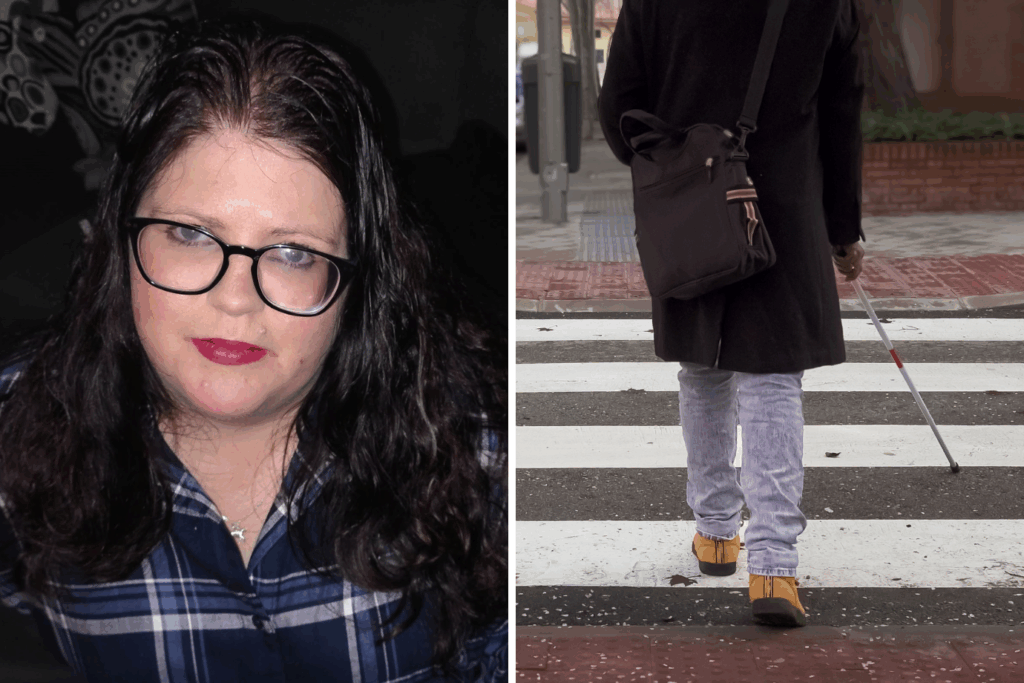
International Day of People with Disabilities is held annually on December 3 to promote the rights of people with disabilities worldwide.
The theme for 2025 is ‘Fostering disability inclusive societies for advancing social progress.’ But what is inclusive for some can be exclusionary for others, and social progress for one group is not social progress for all.
As someone who is blind, I am constantly asked if I read Braille – a tactile feature used by some people who are blind to ‘read’ words on a page. If seen with a plain, paperback book, I am asked if I am really blind at all.
When I leave the house to go somewhere independently, somewhere I don’t know very well or can be unsafe mobility-wise, I do so with my long, white cane. If somewhere I know very well, like my home or a small shop, I often don’t require it.

Often growing up, I felt I was either too blind or ‘not blind enough.’
Media representations of people with disabilities have all too often relied heavily on stereotypes and ableism.
Blind people with guide dogs, reading braille, deaf people who are mute, using sign language, and athletes in wheelchairs.
But these stereotypes also ensure the media’s interest (and the public’s warranted outrage) when a person with a disability is excluded.
In September, the ABC reported about how Paralympian Jeremy McClure was refused “multiple Uber rides” because of his guide dog.
Paralympian Sue Ellen Loveitt, who competed during the Sydney 2000 Paralympics, was also discriminated against because of her guide dog, when in 2012 she was refused entry to two restaurants and a hotel.
The experiences of people with disabilities are often very different, impairment being a spectrum with varying degrees of impact.
Yet the stigma placed on people with disabilities remains strong; the emphasis or deemphasis of impairment can exacerbate tensions.
Academics Carla Filomena Silva and David Howe (also a Paralympian) suggest this tension can lead to what they term ‘achievement syndrome’—the impaired are successful despite their disability.
The Paralympics have a mandate of advancing social progress, yet are a highly exclusive environment.
Many people with disabilities will never have the physical ability, the skill, the passion or the funding to reach this socially acceptable realm of impairment. Many do not wish to enter that field and instead choose to pursue alternative passions, vocations, skills, and professions.
And many are actively excluded from participation in society – told they can’t, that they are burdens, that they will need additional, expensive or time-consuming support.
This paradox – of people with disabilities as burdens, yet also unworthy of being supported to live successful, happy and fulfilling lives, is a plague on society. It’s insidious and pervasive daily.
And so, some people are included, some are excluded, and some are not given little thought at all. The ones who slip through the cracks because their stories are neither remarkable nor confronting.
This speaks to the fundamental lack of acknowledgment of diversity amongst people with disabilities. One of the reasons I choose not to be referred to as a ‘disabled person’ but instead a person with a disability.
Diversity can be confronting when a united voice is needed to oppose discrimination and advance social progress. It can be hard to advocate ‘progress’ when so many voices are trying to be heard, when there are so many views on what that progress looks like.
Sometimes, any news or representation may be seen as ‘good news’ – if it gets the message across or draws people’s attention.
Sometimes, by failing to critique dominant assumptions, stereotypes or practices, people become more marginalised.
On International Day of People with Disabilities, many people with disabilities will share their experiences of pride or of survival. Stories of inspiration or those that make the public angry at the discrimination people with disabilities often face.
But many voices will remain silent. Those who feel excluded from the conversation or who see disability advocacy as a daily struggle rather than a once-a-year call for action. But just because you can’t hear something or see something, that doesn’t mean it’s not there.