
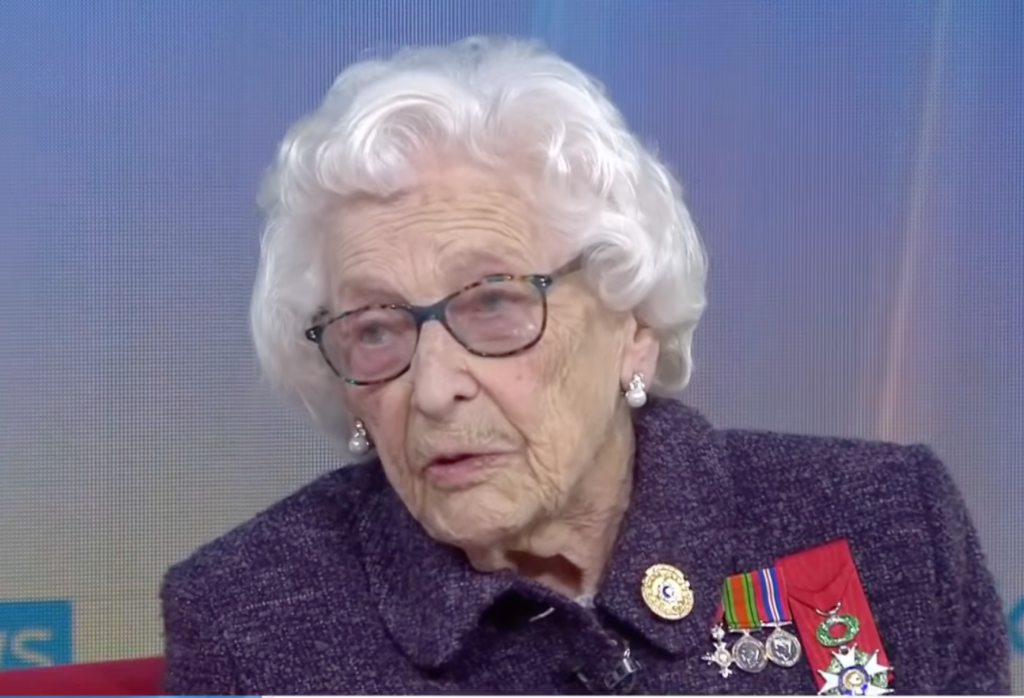
Celebrated World War II code breaker Charlotte “Betty” Webb has died, aged 101.
The Bletchley Park code breaker was one of the last surviving members of Britain’s top-secret team, who between 1941-1945 interpreted decoded Japanese messages for the Pentagon in the US and intercepted German police messages exposing the beginning of the Holocaust.
Webb was just 18 when she arrived at the Auxiliary Territorial Service in Buckinghamshire where Bletchley Park was located, joining the women’s branch of the British Army to help decrypt German messages and decipher Japanese signals.
The Women’s Royal Army Corps Association (WRACA) and Bletchley Park Trust confirmed her death on Monday night.
Announcing her death on Facebook, the WRACA described Webb as an individual who “inspired women in the army for decades and we will continue to take pride in her service during WWII and beyond, and as a champion of female veterans.”
Bletchley Park released a statement, commemorating Webb’s contributions to the estate’s work and establishing its legacy.
“Betty was not only a member of the incredible team at Bletchley Park during world war two, but she also dedicated much of her life to raising the profile of Bletchley Park in more recent years,” the statement read.
“Her tireless efforts in bringing the history of Bletchley Park to a wider audience, through sharing the stories of those who worked here, helped ensure that the vital role of Bletchley Park during world war two and its impact on the conflict was recognised. Betty’s impact at Bletchley Park will be remembered for many years to come.”
Bletchley Park Trust CEO Iain Standen said Webb would be remembered “for her efforts to ensure that the story of what she and her colleagues achieved is not forgotten.”
“Betty’s passion for preserving the history and legacy of Bletchley Park has undoubtedly inspired many people to engage with the story and visit the site,” he said in the statement.
British historian, broadcaster and author Dr Tessa Dunlop posted her tribute to Webb on X, saying she was “the very best.”
“I was lucky enough to hold her hand yesterday as she gently glided to another place. She is one of the most remarkable woman I have ever known.”

When Webb arrived at Bletchley in 1941, she joined a team of code breakers, mathematicians and cryptographers all working to crack encrypted messages by the Germans and Japanese.
In 2012, she recalled how she and her fellow students, who were studying domestic science college near Shrewsbury had dropped out as war swept across Europe.
“…several of us decided that we ought to be serving our country rather than just making sausage rolls,” she said. “We left before the end of the course, which must have caused our parents a lot of angst.”
After her arrival at Bletchley, she was put straight into the office upstairs over the ballroom.
“That was where I did the registering of messages, right from day one; there wasn’t any training,” she said. “We were told very little about what we were doing or why, we were just told to get on with the job. None of us understood the whole picture, certainly not the more junior people like me and with the constraints of the Official Secrets Act, we didn’t talk about it outside our immediate office.”
She never told anyone about her work, including her friends and family, and it remained a secret until 1975, when restrictions were lifted.
“We were given the Official Secrets Act to read, which is pretty lengthy and frightening,” she reflected. “We knew that we had to abide by the rules within it and sign it and not speak about anything outside the four walls for as long as it took.”
In 2023, Webb told Sky News that keeping her job a secret was “not as hard as you might imagine, adding: “— there was no option. I knew I had to keep everything to myself — everything I heard and saw and read. So, I did that — as everybody else did who was there.”
As a German speaker, Webb worked on taking decoded messages and reordering the unencrypted wording to be delivered to allied commanders to ensure that if intercepted by the enemy, they would not discover their transmissions had been deciphered.
The decoded enemy messages could then ensure that Allied ships would change course and avoid peril. At the end of World War Two in May 1945, Webb travelled to Washington DC to work at the Pentagon to paraphrase translated Japanese messages.
“I can’t remember any of them now,” she once said. “I think it is because we shut our minds to everything, because that’s how we were trained to abide by the Official Secrets Act. There was no need for me to remember them once I’d done them and it was a long time ago. The number of messages I worked on over the course of a week would vary because there were messages coming in from different signal stations and it would depend on how many the enemy was sending out anyway. Probably hundreds.”
She admitted that when she found out about her secret work being “out” she “wasn’t at all impressed.”
“I still felt that I had no reason to talk about it and didn’t, for years,” she said, adding that it wasn’t until the 1990s when she realised: “I’m free, I don’t have to worry any more.”
“I’m very glad that I was chosen to go, I don’t understand why I was chosen but it did me a lot of good, it taught me a lot about life. In a way, it was like a university and I met a lot of very nice people. I feel honoured to have been there.”
Webb went on to publish a book, No More Secrets, detailing her time as a code-breaker at Bletchley Park and the Pentagon.
In 2015, she was appointed as Member of the Order of the British Empire (MBE) and continued to work on preserving the work of Bletchley Park as the president of the WRACA Birmingham branch.
In 2021, she was awarded the Légion d’Honneur, France’s highest honour, after a decision by President François Hollande in 2014 to celebrate British veterans who helped liberate France.
In May 2020, Webb appeared on the cover of National Geographic in an issue titled The Last Voices of World War II. In an interview with the magazine, the then 97-year old said, “I wanted to do something more for the war effort than bake sausage rolls.”