
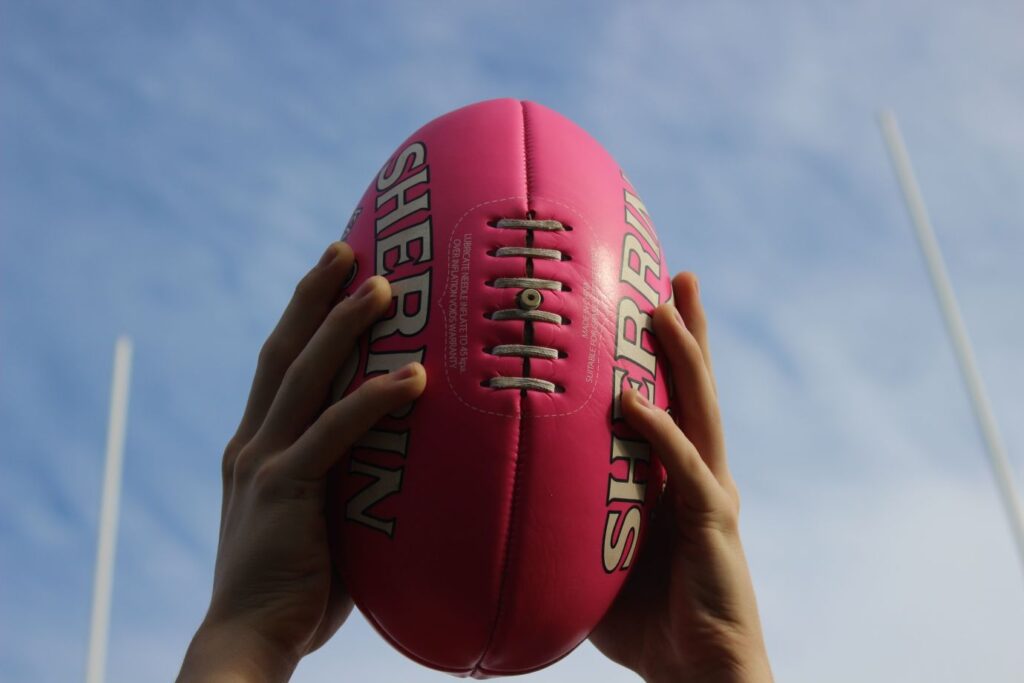
My great uncle Jimmy Matthews played football for St Kilda and is remembered as a man of principle. Growing up in country Victoria, I remember football meant loyalty to a community.
That loyalty is now at the heart of questions surrounding the actions of the Sydney Swans players at a Melbourne hotel last week. As Victoria Police investigates an alleged crime, the Sydney Swans’ own enquiry found five players breached club standards through some ‘wrong decisions’.
A police investigation asks whether a crime has occurred. A football club asks whether its players have breached its rules. Both processes can legitimately operate at the same time. The problem begins when the language of the second dominates the first, softening claims of assault beneath a whitewash of corporate speak.
In 2016, I completed a PhD and novel called Siren, both examining sexual violence, hypermasculinity and the mistreatment of women in Australian football. I spoke to retired players and reviewed many alleged assault cases involving footballers over several decades, examining not only what was alleged to have happened but what happened afterwards.
Former Victoria Police detective and whistle-blower Scott Gladman, spoke publicly about his investigation of 2004 sexual assault allegations involving AFL players. Gladman alleged that a fellow police officer pressured him to drop the investigation and referred to the complainant as ‘just one of these footy sluts’. Gladman said he was so fearful for the safety of his family that they relocated to Panama.
Today we hear terms such as ‘breach of standards’, ‘poor choices’ and ‘disappointing conduct’. The ‘poor choices’ have been referred to as ‘inappropriate touching’ however various reporting has also referred to a claim of sexual assault. The Swans have stressed that their sanctions are separate from the police investigation and relate to club rules, not any criminal finding.
That distinction is legally important. It is also linguistically revealing.
‘Alleged sexual assault’ directs attention towards a potential victim, the criminal law and the question of what happened. ‘Breach of club standards’ directs attention towards employees, workplace behaviour and the reputation of the organisation.
My research convinced me that football’s protection system is more than a matter of players refusing to dob in teammates. It is a matrix of loyalty in which players, clubs and supporters could all have reasons to protect the group.
That system has not necessarily disappeared. It has just acquired better vocabulary.
This is not an argument that football clubs should wait for police before disciplining players. Nor is it an argument that the five Swans players should be presumed guilty of sexual assault.
But when an institution conducts its own investigation alongside a police investigation, we should pay attention to who gets to define the event, by inserting a language of media speak into the public sphere.

The Swans have imposed the most serious internal sanction available to them, suspending the five players for the remainder of the season. They have apologised and condemned behaviour they say fell well below their standards. Sponsors are distancing themselves from individual players. The Brownlow invitations are in the bin.
But there is a broader question that football should confront.
For years, the AFL has invested in education about consent and respect. The AFLW has transformed the visibility of women in Australian football. Clubs have policies, workshops and codes of conduct.
AFL chief Andrew Dillon says the game has ‘no culture problem’.
And yet a week after the alleged events in the Pullman hotel we have footage of Richmond Tigers players spanking and whipping each other while mocking women at a Mad Monday gathering.
My research suggests we need to look at what happens when those policies collide with football’s oldest value: loyalty.
Not loyalty to a criminal act. Loyalty to teammates, careers, reputations, sponsors and the club itself. Loyalty to codes around what it means to be a man in this country.
For many men, including the good men I know, escalating reports of crimes against women must be distressing to witness. They see a version of masculinity they do not want to represent. With around 40 Australian men dying by suicide each week, we need to question the kind of masculinity we reward and protect.
The old language paraded misogyny, as Gladman’s account demonstrates. The modern language shines with professionalism and spin.
Victoria Police will establish the legal facts. That process must be allowed to proceed without interference or assumptions about guilt.
Football should use the same period to examine something within their bro-codes. Not simply whether players have breached its rules but how the institution’s own language shapes the public understanding of what has happened.
The old language silenced women. The new language makes the silence harder to see.