
Recently, two women were having a quiet drink at a bar in Dromana on the Mornington Peninsula. A stranger approached their table and asked one of them: “Where are you from?” She replied: “Dromana”. He asked again, this time aggressively: “Where are you really from?” She replied: “What relevance does this have?” The other woman then said: “Surely you can see that my friend is African. “Yes,” he replied. “You are a liar saying you are from Dromana. You should go back to where you came from.”
Although my friend has experienced racism before, she had never been told to go back to Africa. Courageously, the bystanders (her friend and a waitress) told the man to leave them alone. Fortunately, he did.
When my friend told me about this experience, I felt extremely sad. My friend has lived on the Mornington Peninsula for more than 20 years. How dare this man make her feel unsafe.
However, I was not just sad for her, but also for our country. We are a multicultural nation with an Indigenous heritage. Australia is widely recognised as one of the world’s most successful multicultural societies. According to the Bureau of Statistics, about half of all Australians were born overseas or have a parent who was.
Despite the success of Australia’s migration programs, One Nation leader Pauline Hanson declared during an inflammatory address to the National Press Club that Australia cannot be multicultural. We must be a “monocultural society”. Hanson also lamented the end of our White Australia policy on a podcast with a far-right UK activist who goes by the name ‘Tommy Robinson’. In another media interview, Hanson claimed there are “no good Muslims”.
Has One Nation’s focus on Muslims, migration and multiculturalism caused an escalation of racial prejudice, hostility and division? Or perhaps the escalation of hostility is the consequence of Trump, Brexit, social media algorithms, the manosphere and the re-emergence of far-right white nationalism?
The bloke who intimidated my friend was an older white man, estimated to be around 60 years old. According to recent research, most One Nation voters are Anglo-Aussie men over 50 who hold trade qualifications.
It is interesting to note that during the recent Nepean by-election, One Nation won the Dromana booth. Although my friend’s recent experience may be a one-off event in a specific location, I began to reflect on whether something has changed over the past few years on the Mornington Peninsula.
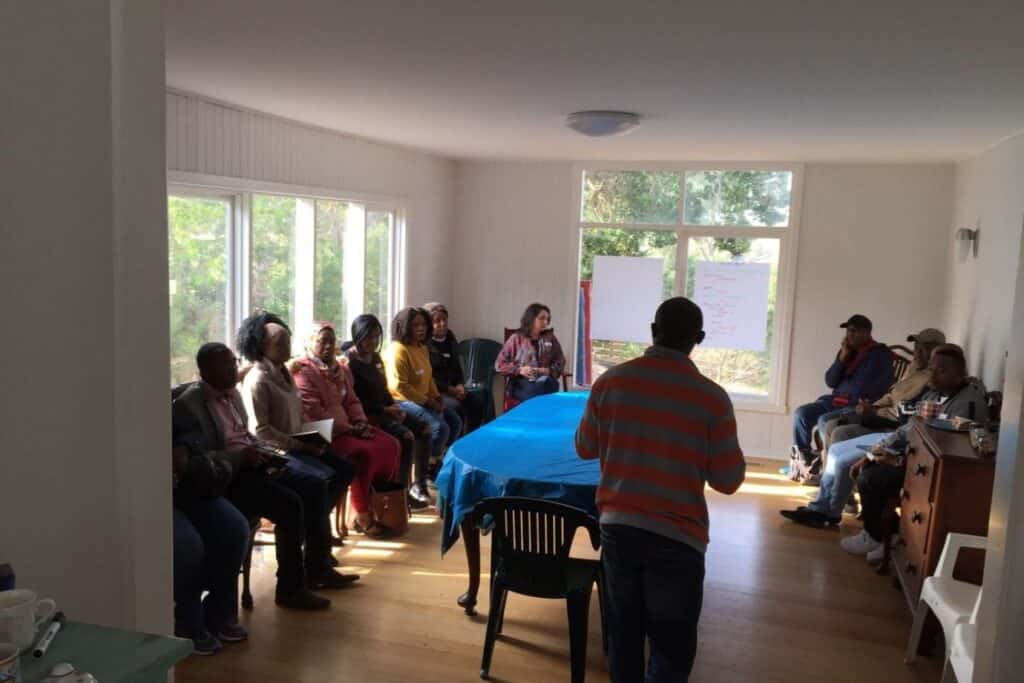
A few years ago, I hosted an annual workshop at my home in Mt Martha for about 15 people from Sierra Leone (pictured above). This was around the time former federal Opposition leader Peter Dutton had suggested that Victorians are “scared to go out to restaurants” because of “African gang violence”.
Given the population of Mt Martha is predominantly Caucasian, I was slightly concerned when the group said they would like to visit the local shops. How would this group be treated when they walked along the boardwalk? When they returned from their trip to Mt Martha Village, they told me how welcomed they felt.
Although the social and economic demographics of Mt Martha and Dromana are different, it is worth considering why, only a few years after the Sierra Leone workshop, an older Anglo man thought it was OK to speak aggressively to a woman of African heritage who was having a quiet drink.
Has the rising popularity of One Nation on the Mornington Peninsula, evidenced by the recent Nepean by-election where Darren Hercus, the One Nation candidate, received nearly 25 per cent of first preferences, given licence to some people to behave so offensively? After all, the leader of One Nation told Greens Senator Mehreen Faruqi to “piss off back to Pakistan”.

It is worth noting that the Federal Court ruled that Hanson’s tweet about Senator Mehreen Faruqi was seriously offensive, constituted a strong form of racism, and breached federal discrimination laws.
We all need to show kindness to each other to halt this increasingly dangerous polarisation. We also need to stand up against racism – wherever and whenever it occurs. Social cohesion requires bystanders to speak up when they witness racist behaviour. As my Indigenous friends at Clothing the Gaps say: “There is no room for racism.”