
Aboriginal and Torres Strait Islander readers are advised that this article contains the names of those who are deceased. It also discusses Aboriginal deaths in custody.
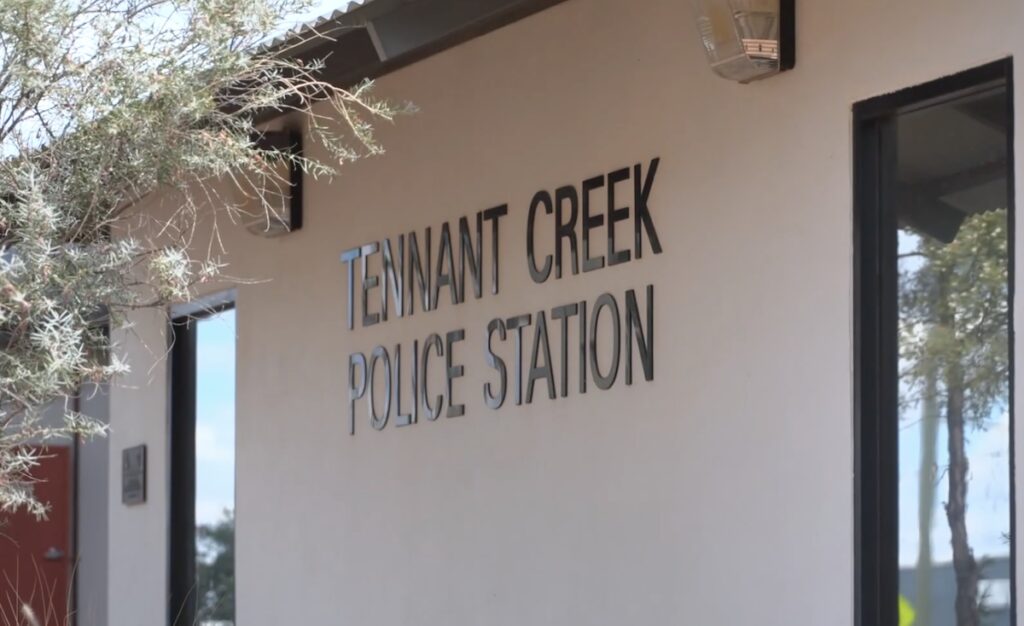
A 44-year-old Aboriginal woman is dead after being locked in a police watch house in Tennant Creek on Saturday. Tabitha Lean and Debbie Kilroy, spokespeople for The National Network of Incarcerated and Formerly Incarcerated Women and Girls, share this piece.
Police say it was a “medical episode”. They say CPR was attempted. They say they are investigating themselves, following the death of an Aboriginal woman in custody in Tennant Creek.
None of this should reassure anyone.
A review of CCTV footage shows the woman collapsing alone in her cell at 12:34pm on the 27th December. CPR was not commenced until around 1pm. In a police watch house. In 2025. In a jurisdiction that knows better than anyone the lethal consequences of custody.
Police have also said there was no nurse on duty to check the woman’s medical records.
This mother of five is the fourth person to die in custody in the Northern Territory this year alone. She is the 619th Aboriginal person to die in custody since the Royal Commission into Aboriginal Deaths in Custody handed down its findings in 1991.
Six hundred and nineteen deaths later, the state still speaks as if this is unexpected.
This is not an isolated incident. It is not a “tragic event.” It is not bad luck or bad timing.
It is the predictable outcome of a system that continues to scoop Aboriginal people off the streets and cage them.
Police investigating police is not accountability
Northern Territory Police have confirmed that the investigation into this woman’s death is being led by police, with oversight from Professional Standards Command. Acting Assistant Commissioner Peter Malley told the media: “We investigate our own all the time, we’re very good at it… we’re legislated to do it and we do it very well.”

This statement does not fill any of us with confidence.
Police investigating police is not independent. It is not transparent. And it has never delivered justice for families of people who have died in custody. If it did, we would not be here, again, counting another death, another vigil, another family left waiting for answers that rarely lead to accountability or structural change.
There has never been satisfactory justice for a death in custody in this country. Not one. No amount of repetition of “we take this very seriously” can erase that record.
Investigating deaths in custody “to the same standard as a homicide” is meaningless when the investigators are embedded in the very institution whose practices, policies, and failures are under scrutiny. This is not a confidence-building exercise.
Watch houses are killing people
The Northern Territory continues to rely on police watch houses as sites of imprisonment, despite decades of evidence that they are dangerous, inappropriate, and lethal, especially for Aboriginal people.
Watch houses are not designed for prolonged imprisonment. They are not health facilities. Police are not clinicians, nurses, or care providers. And yet Aboriginal people, particularly Aboriginal women, continue to be locked in these spaces, often while unwell, distressed, intoxicated, or experiencing trauma.
In this latest case, police have admitted there was no custody nurse on duty in Tennant Creek. There was no access to medical records. A “custody health assessment” was conducted by a police officer, and because there were “no disclosures” and apparently “no visible injuries,” everything was believed to be fine.
We have seen this before.
In 2014, Ms Dhu died in a Western Australian police cell after repeatedly begging for medical assistance. Police reviewed CCTV footage. They dismissed her pain. They accused her of faking illness. She was mocked, ignored, and treated as less than human. Ms Dhu was not given care because she was seen not as a woman in distress, but as a problem to be managed. She died from septicaemia and pneumonia, entirely preventable conditions.
In 2017, Aunty Tanya Day, a Yorta Yorta woman, died in police custody in Victoria after being arrested for public drunkenness. CCTV footage showed her falling and striking her head in a cell. She was left without adequate medical care. A coronial inquest later found neglect, a lack of humanity, and systemic failures in police duty of care. No officers were prosecuted. Her family had to fight, and continue to fight, for truth, dignity, and accountability.
These deaths were not anomalies. They were warnings.
Like Ms Dhu. Like Aunty Tanya Day. Like this 44yo woman in Tennant Creek, Aboriginal women in police custody are treated as disposable. Their pain is doubted, distress is minimised and need for medical care ignored until it is too late.
The absence of a custody nurse in Tennant Creek is not a staffing oversight. It is an indication of how little value is placed on Aboriginal women’s lives in police custody. Police cells are run on suspicion, punishment, and control, not care. When Aboriginal women collapse, they are not seen as patients. They are seen as perpetrators. As bodies to be watched, not lives to be protected.
And others will not care, because this latest woman will be framed as an offender, not a victim. If it is true that she was arrested in the context of domestic and family violence, she will be read through the lens of blame, not harm. Another “troublesome” woman whom the state has already decided does not deserve urgency or compassion.
Another disposable woman.
This disposability is not incidental; it is built into how the racialised and gendered violence of policing understands risk, care, and credibility.
It is a system that relies on what can be “seen” by police, while ignoring the realities of chronic illness, disability, mental distress, withdrawal, trauma, and fear; conditions that Aboriginal people are far more likely to live with as a direct result of colonisation, poverty, and state violence.
The Northern Territory government’s relentless “law and order” agenda under the Finocchiaro government has fuelled a mass imprisonment crisis. More police, more arrests and more remand. More people funnelled into watch houses that are fundamentally unsafe.
This is not about safety. It is about control.
Every death in custody is a policy choice.
Deaths in custody do not happen in a vacuum. They are the result of decisions made again and again by governments that choose policing over housing, punishment over care, and incarceration over community-led solutions.
They are the result of ignoring decades of recommendations, including those from the Royal Commission into Aboriginal Deaths in Custody, many of which remain unimplemented more than 30 years later.
They are the result of rejecting independent oversight, including the Northern Territory Parliament’s decision just months ago to overwhelmingly vote down a proposal for a national, independent body to investigate Indigenous deaths in custody.
When governments choose surveillance over support, cages over care, and police over health services, people die.
That is not an accident. That is policy.
Aboriginal women are being criminalised, not “misidentified”
Aboriginal women are disproportionately policed, arrested, and imprisoned in this country, often in the context of domestic and family violence. Too often, when Aboriginal women are arrested after violent incidents, the language of “misidentification” is used, as if police have simply made an unfortunate mistake.
This framing is deeply dishonest.
Aboriginal women are not being accidentally identified as perpetrators. They are being deliberately criminalised as a result of the racial, gendered violence of policing, racial capitalism, and systems that uphold white supremacy.
Police responses to domestic violence are shaped by racialised assumptions about who is “violent,” who is “credible,” and who deserves protection. Aboriginal women, particularly those who are poor, homeless, intoxicated, or mentally distressed, are routinely framed as aggressive, non-compliant, or culpable, even when they are the ones experiencing harm.
Australia is on a killing spree
The Northern Territory has a long and brutal history of Aboriginal deaths in custody. Each time, we are told the cause of death is “yet to be determined.” Each time, families are asked to wait. Each time, the system closes ranks.
Meanwhile, Aboriginal people continue to be scooped off the streets, caged, neglected and continue to die.
The question is not whether this latest death was preventable. Instead, it’s how many more deaths the state is prepared to tolerate.
Because this system is working exactly as designed.
Until governments stop relying on police to manage poverty, homelessness, trauma, and mental distress; until watch houses are shut down as sites of detention; until deaths in custody are investigated independently; until Aboriginal women are protected rather than criminalised, people will keep dying.