
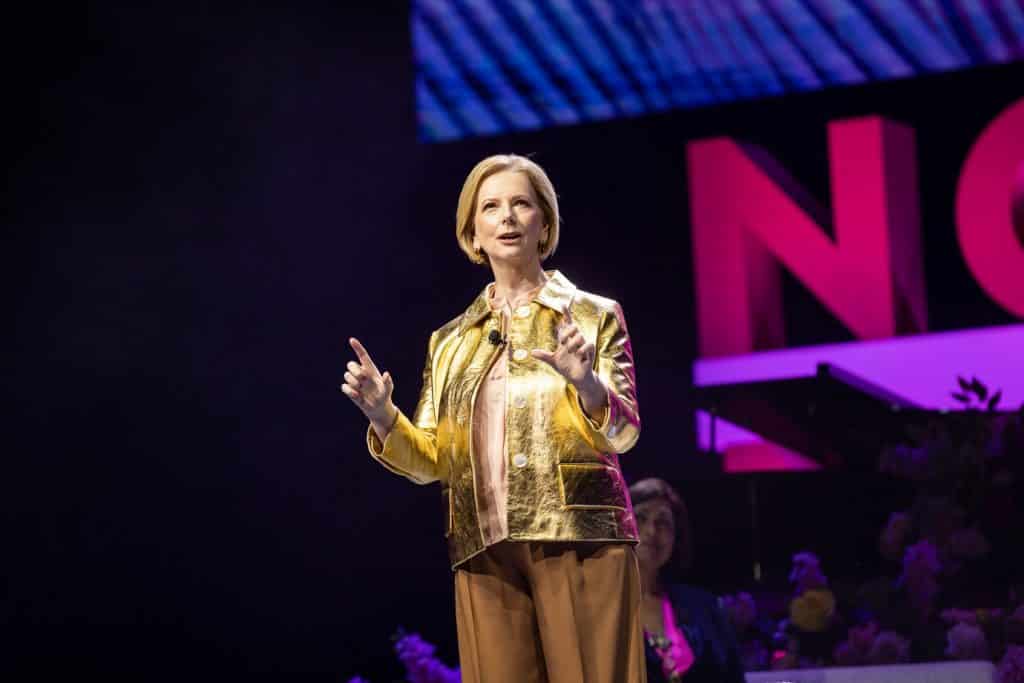
Former Prime mininster Julia Gillard pens this piece in the lead-up to Women Deliver, which is expected to see thousands of gender equality advocates arriving in Melbourne next month. Women’s Agenda is a media partner of Women Deliver.
The most common topic I am asked about in my post-politics career and life is gender equality. I’ve acknowledged the role gender played in my time as Prime Minister, and unsurprisingly, people often want to know whether I think things have changed since then.
I’m glad to say that yes, we have made progress and that is worth celebrating. Research shows that the majority of people worldwide say gender equality matters to them.
But unfortunately, in many areas, that progress is glacial, stagnating, or at worst, going backwards.
Next month, thousands of gender equality advocates from around the world, from grassroots organisers to policymakers, will descend on Melbourne. For the first time ever, Australia, alongside the Pacific region, will host the Women Deliver Conference. As an organisation, Women Deliver strives to advance gender equality by advocating for the health and rights of girls and women, but it is best known for its convening power. The first Women Deliver Conference was held in London in 2007, where some 2,000 people from 115 countries declared that the deaths of over 500,000 women each year during pregnancy and childbirth would no longer be tolerated. The conferences have grown since then. I was fortunate to be among the more than 8000 people who gathered in Vancouver in 2019 and to attend the Copenhagen conference in 2016.
This rolling back of women’s rights is not being done in secret. It’s being heralded by key global political leaders.
Women Deliver has also grown in its mission since 2007. Beyond the vital topic of maternal mortality, it now tackles the full gamut of issues around the ability of women and girls to control their own bodies and to control their own lives.
Having seen firsthand the power of these large-scale gatherings of women and organisations that are passionate about creating change and accelerating forward momentum, I am incredibly excited for what’s about to happen in Melbourne.
This global event could not be occurring at a more crucial time.
There is no way of lifting our eyes and looking at the planet we share without being confronted by truly alarming images of conflict, violence, the effects of climate change, political polarisation, increasing geopolitical turbulence and rising authoritarianism. For women in countries around the world, including many western democracies, we see reproductive rights under blatant attack, we see girls being denied their basic right to an education, and in conflict zones, women and girls are targeted with deliberate physical and sexual violence.
This rolling back of women’s rights is not being done in secret. It’s being heralded by key global political leaders.
This rolling back of women’s rights is not being done in secret. It’s being heralded by key global political leaders.It’s not being disguised or done in tiny increments. It is overt, strategic and being attempted in bounding leaps. So we must push back in the same way and find the courage to take bounding leaps as well. We must not allow the next five, 10 or 20 years to solidify a retrenchment of rights.
It is this environment that makes next month’s Women Deliver conference so important. It will provide a vital opportunity to come together as a global community and share perspectives, identify opportunities, confront challenges and chart tangible action. Women Deliver will also ensure we amplify the voices of people who are too often not heard in global events, including women from Pacific nations and First Nations communities.
As described above, we know there are organised forces actively working to dismantle gender equality gains, but as we come together as a community in Melbourne, we must also acknowledge that the movement for gender equality has to do better. We have not won community hearts and minds in the way that we need to. We have allowed the impression to settle that gender equality is a zero-sum game where if women and girls get more, then men and boys must get less, and that perception has been exploited. We need to ensure everyone is brought along on this journey and comes to understand that a gender equal world is a better world for everyone. A boy who aspires to become an aged care worker or a man who wants to take extended paternity leave will feel as confined by gender stereotypes as a girl who aims to be a leader in space technology or a woman who chooses not to have children. We must bust through these barriers to create more options and choices for all.
So how will Women Deliver and its community of determined changemakers tackle these challenges? The Conference has bold goals, including elevating a new generation of feminist and youth-led leadership; defining new policies which break down all forms of oppression; and strengthening transnational gender equality movements to hold governments and institutions to account.
Central to this effort is Women Deliver’s Feminist Playbook, a collective declaration and roadmap to transform how power, resources, and decision-making shape gender equality. People consulted in nations across the world raised a common concern: financial and decision-making authority remains concentrated among a small number of wealthy governments and donors. When decisions are made far from the people most affected by inequality, they often fail to reflect daily realities and needs.
In Melbourne, the playbook will be debated, refined and formally adopted as a shared expression of principles and direction. But this is not an endpoint. Rather, it is a new beginning to ensure that we, as a global community, deliver for girls and women, not only in commitments but also in measurable outcomes.
When one lists all the challenges we face in today’s world, things can feel dire. But we have hope and confidence that we will harness this opportunity to come together and emerge with renewed energy and a plan for action.