
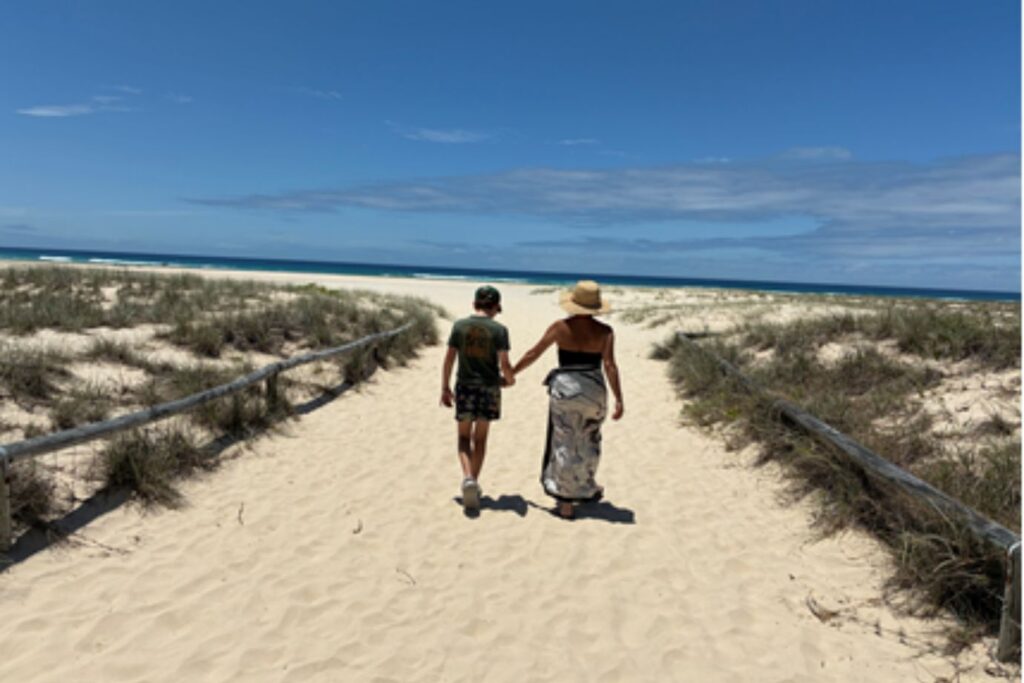
It was a shocking end to what had been a wonderful family holiday in Coolangatta.
Walking back to our apartment after lunch we witnessed something truly horrific that began as a drunken screaming match between a man and a woman on the busy beachside promenade.
The screaming stopped and the man, wild with rage, grabbed the woman. In one swift movement he wrapped his long elbow around her neck and locked his other arm around her head, securing a stranglehold. He then lent backwards and wrenched her off the ground, her dangling legs kicking furiously in the air as he set about choking the life out of her. All this took place in a matter of seconds.
My partner, my son and I were close by, watching on, momentarily frozen. And then my partner ran towards the man, shouting. I found myself screaming too, “Stop, you’re going to kill her!” – and beside me, my 12-year-old son, a look in his eyes I’ve never seen before, was also screaming, “STOP!”. The man released the woman, and she fell to the ground.
Almost immediately my partner was joined by six other men. They confronted the perpetrator – and within seconds the nightmare escalated.
The perpetrator was punched to the ground by one man and then kicked repeatedly in the guts by another. As he vomited a river of alcohol onto the pavement, the same man then started kicking – and then stomping on his face.
It was a brutal snapshot of male violence.
My partner yelled at him, “Enough!”. The stomper was dragged away from the scene. The others followed.
Shortly after, the police arrived. The man who choked the woman was tasered and taken away. The woman went in a different police car.
In the space of a few minutes, I thought I was going to see a man kill a woman – and then that same man be killed.
Shaken, my son Francis asked that we walk on the other side of the road to get home – he didn’t want to be in the same space as these men.
I’ve been working in the violence prevention policy and advocacy space for the past five years. I’ve heard harrowing stories from victim-survivors and experts in the field – but it doesn’t dilute the horror of seeing something like this unfold.

For Francis, it was his first experience of violence. Later that night, still processing, he would confide in me – “that’s the scariest thing I’ve ever seen, Mum”.
This wasn’t Vecna in Stranger Things. This was real life.
Sadly, this isn’t a rare occurrence in Australia.
Family and domestic violence is a national emergency, and it doesn’t discriminate by post code.
Victoria Police respond to a family violence incidentevery 6 minutes.
In the 12 months to March 2025, they recorded over 105,000 family violence incidents — a 3.2 % increase on the previous year. The Crime Statistics Agency says a key contributor to the increase has been the new choke/strangle/suffocate family member offence, which came into effect in October 2024.
While recent Australian Institute of Criminology data shows the rate of women killed by an intimate partner has increased by nearly 30%.
As I write this piece, accused triple murderer Julian Ingram is still on the run after allegedly killing his ex-partner Sophie Quinn and her unborn child, her friend John Harris and her aunt Nerida Quinn in north-west New South Wales. Ingram was out on bail for assaulting and stalking his former partner and was the subject of an Apprehended Violence Order.
Last month, 18-year-old Leija Michael was stabbed eleven times outside her Kew home by a man known to her. She survived.
Already in 2026, seven women have been killed by men. 77 women were killed by violence in 2025. Most by men known to them.
Whenever I write about gendered violence, a man inevitably asks what about violence against men?
The facts are the vast majority of family and gender-based violence is perpetrated by men – as is most violence against men. Respect Victoria reports that 95% of victims of all violence, whatever their gender, experience violence from a male perpetrator.
Let’s call it for what it is – a male violence problem.
Back in Melbourne, Francis asked me if I thought the woman who was choked was safe now?
I explained that leaving can be the most dangerous time for a woman.
Then I offered him some hope.
The Adolescent Man Box survey by Jesuit Social Services released last year shows encouraging signs that boys are moving away from narrow and restrictive views of masculinity that that promote dominance and control, aggression and suppression of emotion, behaviours that are harmful to their mental and physical health, and the girls and women in their lives.
Through conversations at home and respectful relationships education at school, Francis already understands what respect and healthy masculinity looks like. This is more than some grown men, particularly those who desperately cling to the #notallmen hashtag.
Prevention must begin in childhood.
Education is kryptonite to the algorithms that lure boys into online misogyny and radicalisation.
As the mother of an almost-teenage boy, it’s important to me that Francis has the toolkit to build a healthy version of masculinity for himself – one that’s grounded in respect, empathy and equality.
My greatest hope is that he’s part of the generation of boys that changes the culture forever.