
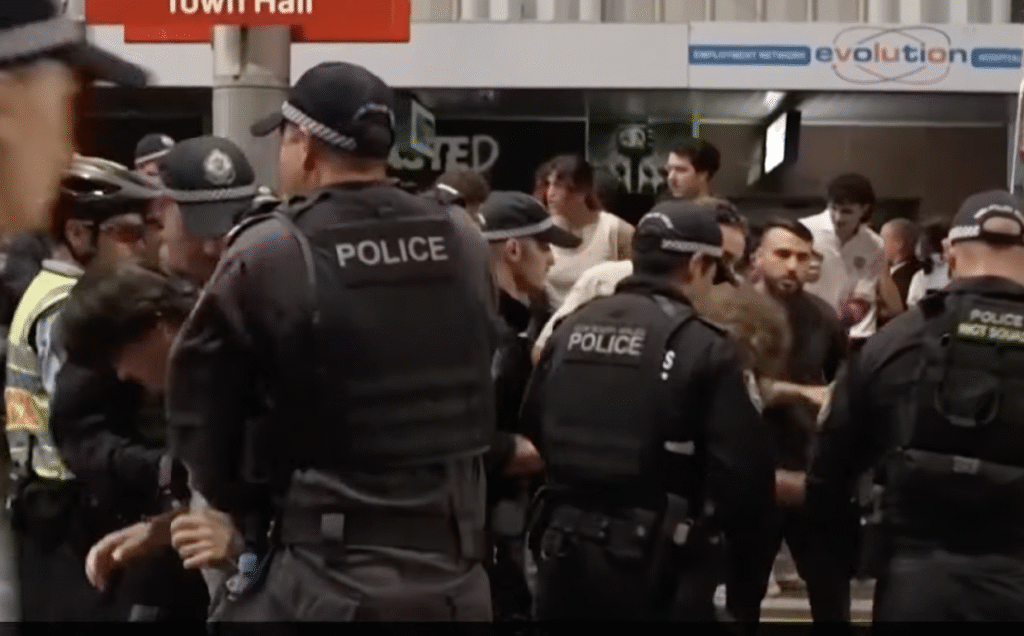
Thousands gathered at Sydney’s Town Hall on Monday night to protest the arrival of Isaac Herzog, Israel’s President. Herzog, who has previously made controversial comments like suggesting that Hamas’s deadly attacks against Israel were the work not just of the terror group but of “an entire nation”, was invited by Australia’s PM Anthony Albanese in the wake of December’s horror terror attack in Bondi.
Of course, the protests were expected to be passionate. Violent? Not so much. And certainly not at the hands of the police. It’s what makes the footage shared from last night so unsettling to watch.
Across the media, numerous clips have now been released. Odds are, you’ve seen some of the more shocking ones.
A middle-aged man punched repeatedly in the stomach by police with his hands up. Protesters hemmed in so tightly they can’t move. People crashed tackled to the ground and pepper sprayed. A group of Muslim men kneeling in prayer forcibly and brutally removed.
None of it looks like the Australia we know; where peaceful protest is messy but fundamentally accepted and valued as part of democracy.
NSW Premier Chris Minns jumped on the defence in record time, urging people not to “draw conclusions from short clips of footage,” — the inference being that there’s “nothing to see here”. Former prime minister Tony Abbott went further, defending police actions and arguing that officers may need more force next time, including tear gas or rubber bullets.
And with everything happening globally right now, and specifically our problematic obsession with America, we should be deeply worried.
We may not have Donald Trump’s minor dictatorship here, but it’s still worth noting that in the US, it didn’t take long for the ground to shift. Protests have quickly been reframed as disorder and footage of state violence has become as commonplace as KFC.
It’s why agencies like ICE have spiralled in intensity. The shift may have been small at first, but over time, arrests increased and tactics hardened to the extent that when civilians are shot dead in the streets and 5 year-old children are lured and detained, Americans may feel angry but they’re not surprised.
Australia isn’t America. But the connection on this is starting to feel uncomfortably familiar, as is the position of some of our leaders.
Greens MP Sue Higginson didn’t dance around that reality. She called what happened last night a “monumental stuff up” and described the police response as “state aggression.” She said police created a “pressure cooker” that made peaceful dispersal almost impossible.

She also raised how some police officers themselves were shocked by what unfolded, watching some of their colleagues become “supercharged” by the operation.
Higginson called for a full investigation, citing excessive force, violence against peaceful protesters, and the extraordinary reality that people were charged after being injured by police, including individuals like Blaxland MP, Ahmed Ouf, who was there peacefully and pepper sprayed acting as a shield to protect kids.
Social Services Minister, Tanya Plibersek also said there should be an investigation into what happened and into police conduct.
While Prime Minister Anthony Albanese stated that “people have a right to express their views,” he stopped short of criticising law enforcement, and instead zeroed in on his defence of allowing Herzog to visit Australia, despite the controversy and despite it clearly being a horrendous decision with disastrous consequences.
His response, in effect, was irritatingly political and totally inadequate.
When politicians tell us not to look too closely at the evidence, when former leaders float stronger weapons as reasonable crowd-control tools or when peaceful protest is framed not as civic participation, but as a threat requiring immediate escalation, all of us should be rattled.
Australia has a long history of protest shaping who we are. Whether that be through union or anti-war movements, gender equality marches, Indigenous rights campaigns etc. These are an important part of our democracy, and they’ve led to critical policy changes and proud culture shifts.
That should be something for us to fiercely protect and uphold. Because if we stop being willing to look at what’s happening in our streets, we shouldn’t be surprised when the line between democratic policing and something far harsher quietly disappears.