
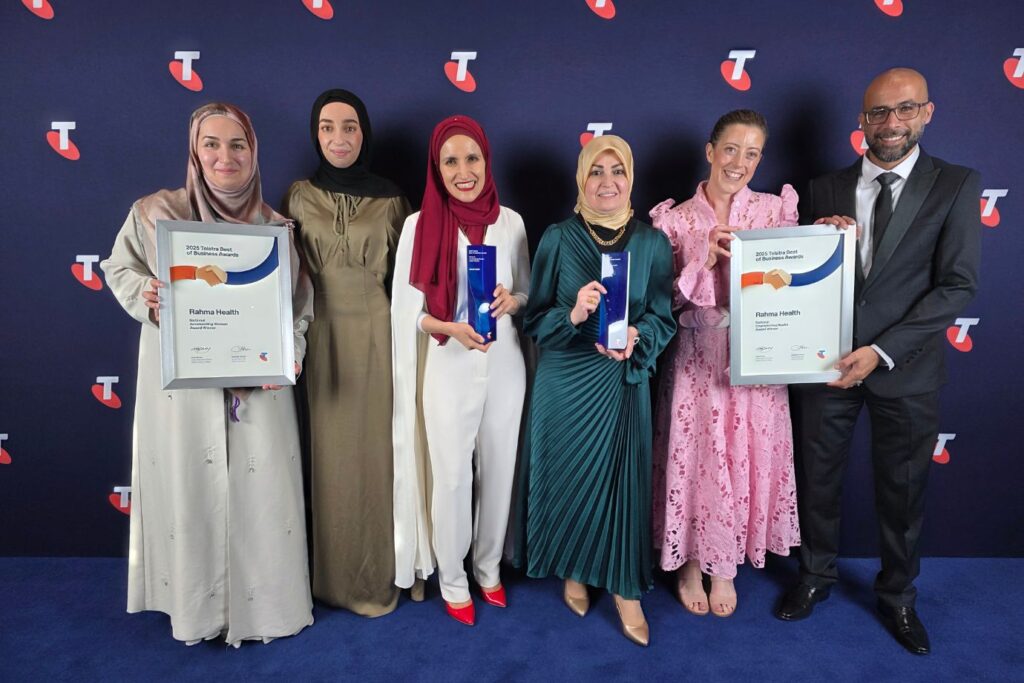
Last night, our Rahma Health team was announced as the winner of three Telstra Best of Business Awards: Championing Health, Accelerating Women and the overall Business of the Year for 2025. Standing on that stage in Brisbane, surrounded by my incredible team, I felt an overwhelming sense of gratitude — for every single person who has believed in our vision of a world where health equity knows no borders.
I am so grateful for every single person walking the path with us towards a better future for all humanity.
After a rigorous six-stage assessment process that spanned nine months, Rahma Health was chosen from 20,000 applicants for these prestigious business awards. We have spent the last three days meeting the other incredible applicants – they are all phenomenal, doing incredible work. My work has been totally transformed due to crossing paths with the incredible Telstra Awards Community.
This recognition is a testament to our team’s ambition for a better world. We thank Telstra from the depths of our hearts for their recognition of the importance of women’s health and the health of multicultural families. Thank you for giving us this incredible platform and for making space for our voices.
What is Rahma Health?
Rahma Health is Australia’s only community-led, evidence-based organisation serving the global Arabic-speaking community. We’re creating resources in Arabic and English that have been used three million times all over the world—from Sydney to Baghdad, Dubai to Dublin. Our reach extends across a target global market of 400 million Arabic speakers, and we’ve already touched the lives of three million people.
What makes Rahma unique is that everything we do is co-designed with the community we serve. We have a network of 70 passionate volunteers and global partners spanning from Ireland to the UAE to Iraq. We work alongside 50 partner organisations worldwide, all united in the belief that quality health information should be accessible to everyone, regardless of where they were born or what language they speak.
Our approach isn’t just community-centred—it’s evidence-based. A rigorous evaluation conducted with the Murdoch Children’s Research Institute demonstrated that Rahma content increases health literacy and changes parental behaviour.
This is the power of culturally appropriate, linguistically accessible health information. This is what happens when communities are empowered to take charge of their own health.
First revolution: health equity without borders
Rahma Health is leading two global revolutions, and the first is in health equity itself.
Traditionally, health resources have been confined to geographic locations. Resources developed in Australia have been used primarily by people in Australia. Resources created in the UK stay in the UK. This model made sense in an analogue world, but it’s fundamentally outdated in our interconnected, digital age—and it’s failing millions of people who live in countries with broken or under-resourced health systems.
The Rahma Health team is breaking down these outdated barriers, and we’re doing it by recognising a simple truth: the Arabic-speaking community is profoundly connected globally. This young, tech-savvy, optimistic community has created a new era in health information sharing. They’re embracing social media for evidence-based information and transcending geographic barriers like they don’t even exist.
Our antenatal series exemplifies this revolution perfectly. Families in refugee camps in Jordan, Syrian families in Turkey, and women in rural Yemen are using the same pregnancy and childbirth videos that we originally created for expecting mothers in metropolitan Melbourne. A woman preparing for birth in Western Sydney can access the same culturally nuanced, medically accurate information as her cousin in Beirut or her sister-in-law in Stockholm.
We believe at Rahma that this is the next era of Health information. It doesn’t make sense that every country should reinvent resources for their population and that people living in countries with broken health systems should continue to miss out.
I am so proud of and grateful for our amazing Australian partners such as the Raising Children Network, who are allowing us to culturally adapt and translate their world-class work to benefit the entire global community. This collaborative approach—taking proven resources and making them accessible across borders—is not just efficient; it’s transformative. It represents a fundamental reimagining of how we approach global health equity.
Second revolution: bringing love back to parenting
Our second revolution might be even more profound: we’re creating the world’s first comprehensive resources on what love actually is, and how to express it fully in parenting.
Love is the most energising, incredible, joyous experience we can have as human beings. It is so powerful that many philosophers and religions describe it as the purpose of life itself—the peak of what it means to be alive. One of the most important gifts we will ever give our children is love. The love we offer will shape their mental health, impact their physical health, influence their academic performance and behaviour, and affect their lifelong wellbeing.
Yet despite love’s fundamental importance, we rarely talk about it explicitly. We don’t commonly sit down—alone, with family, with friends, or with professionals—to truly think about love: defining it for ourselves, learning its behaviours, examining what patterns we might need to unlearn, and giving love the time and energy it deserves.
Like exercise or healthy eating, being able to love correctly and openly requires research, self-reflection and intentional effort. It’s a skill we must actively develop.
For many people in refugee communities, experiencing unconditional love in their own childhoods wasn’t possible—whether due to living under constant threat of death, having parents in perpetual fight-or-flight response from trauma, languishing in refugee camps, or surviving active war zones. But this experience isn’t unique to refugee communities. Many people have lacked love in their childhoods due to intergenerational trauma, emotionally unavailable parents, financial hardship, boarding schools, substance abuse, colonisation, parental loss, family violence, and countless other factors.
For those who want to know love—who want themselves and their children to experience a fully joyous, vibrant life—we need to commit to learning how to love in our generation. We, our life partners, our children and all our loved ones deserve pure, unconditional, authentic love. We deserve to do this important, incredible work so that we can enjoy loving and living every single day.
Our generation of parents is committed to breaking the cycle of lovelessness.
Through our resources, we’re addressing inherited patterns of love that urgently need examination: conditional love, misconceptions about love and children’s behaviour, the full expression of love, the qualities and behaviours that constitute real love, the importance of loving ourselves before we can love others, and the role of shame in preventing authentic connection. Correctly offering love—unconditionally, fully and safely—is a core human need, as essential as food and water. We must fulfil this core need for ourselves and our families.
The journey ahead
Rahma Health is changing the world, one family at a time, one community at a time. Our team is so deeply honoured to go on this journey, and these Telstra Awards fill us with more resolve and energy. Thank you to the whole Australian community for backing us on this mission.
To every volunteer, partner organisation, community member, and supporter who has believed in our vision: thank you. To every parent who has watched our videos, read our resources, and decided to break cycles and build new legacies of love: you inspire us every day.
This is just the beginning.
Please explore our resources on our website (https://rahma.health/) and follow our journey on social media via Instagram, YouTube and TikTok.