
We’ve all been asked that question: who would you invite to your dream dinner party, dead or alive?
For me, the answer is easy: Rose Scott. I often wonder what she would make of the organisations she helped found, and whether she’d recognise her legacy in our work today. There are moments when I find myself asking: what would Rose do? A reformer, suffragist, journalist, and one of Australia’s OG social entrepreneurs, Rose Scott was a woman of fierce intellect and conviction. She didn’t just create spaces for conversation, she championed women’s right to think, speak, and write their way into public life.
This year marks the centenary of Rose Scott’s death, and yet her impact continues to resonate. In 1889, she co-founded the Women’s Literary Society – the first women’s organisation in Sydney to meet independently at night. As historian Judith A. Allen notes, many members had little or no formal education yet were determined to develop their critical thinking and influence philanthropy and public opinion in ways that would improve the position of women. They read widely, wrote papers, delivered lectures, and debated the major questions of their time: the value of higher education for women, the morality of marriage, the need for improved conditions for working women, and the political implications of suffrage. In asserting their right to serious cultural engagement, they laid the foundations for a tradition of women-led critical inquiry and public dialogue.
Rose Scott’s literary influence extended far beyond the parlour. She corresponded with Miles Franklin, who would later write Scott’s biography, and advocated fiercely for the visibility of women in music, literature, visual art and theatre. She understood that changing laws was only part of the work; shifting culture was just as crucial. In many ways, she anticipated the work of feminist thinkers like Beatrice Faust, believing that women needed not just the vote, but the intellectual tools to use it effectively.

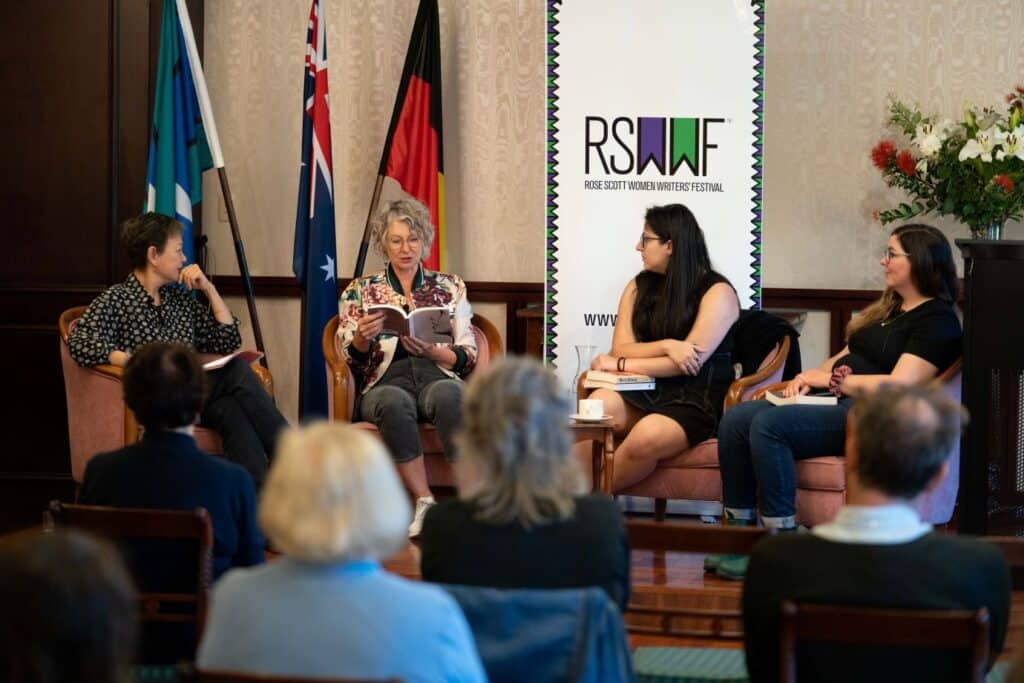
The Rose Scott Women Writers Festival (RSWWF) carries forward that legacy. Established in 2013 by members of The Women’s Club, RSWWF is now Australia’s only literary festival created by women, for women writers.
It began with a simple, radical idea, that women’s stories matter, and they deserve a dedicated platform, one that respects their craft, pays their worth, and prioritises their voices.
Each year, the festival presents a vibrant mix of emerging and established writers across fiction, journalism, poetry, theatre, film, songwriting, and criticism. Our speakers explore the personal and the political, offering perspectives that are both provocative and reflective. From climate anxiety to sexual politics, historical reckonings to creative resistance, audiences can expect generous thinking, bold ideas, and sharp creative minds in dialogue.
The curation of the program is shaped by a working committee drawn from The Women’s Club’s membership including booksellers, editors, curators, marketers, and cultural producers, working in collaboration with writers, cultural partners, and expert festival moderators to shape every session. This is not a passive festival of readings and signings. The sessions are designed with the speakers themselves, built to challenge assumptions and ask timely questions. Writers like Sophie Gee and Sara Saleh have worked closely with us to frame conversations that speak directly to the current moment. This is a space where women’s voices drive the narrative and challenge who gets to define culture in the first place.
And yet, the need for such a platform remains. According to Creative Australia’s 2023 report Widening the Lens: Social Inequality and Arts Participation, women are consistently more likely to engage in reading for pleasure than men, a pattern also supported by Australia Reads and the Australian Society of Authors. This suggests that women not only read more, but are likely the primary purchasers of books, forming the foundation of the country’s literary economy. Yet, they remain underrepresented where it counts. The 2020 Stella Count revealed that books authored by women made up 55% of reviews in major Australian publications – up slightly from 53 per cent in 2019 – yet gender disparities persist across publishing, media coverage, and awards. The 2022 National Survey of Australian Book Authors, also found that women authors earn, on average, 30 per cent less than men, with a median income from creative work of just $18,200 per year. Visibility, viability, and fair recognition remain hard-won.
This is why the RSWWF is essential. It provides visibility and economic recognition by remunerating all contributors at the Australian Society of Authors’ recommended rates. But beyond that, it offers space for professional growth, collaboration, and connection. It affirms the value of women’s stories not as side notes, but as central to our cultural landscape.
If I ever did sit across from Rose Scott at that dream dinner, I’d hope she’d let me try on her famous feather boa. I imagine she’d be disappointed that we still need to ask the same fundamental questions about representation and equality. But I think she’d also be proud that women now hold the highest level of representation in federal parliament in Australian history, and that so many platforms, like ours, exist to elevate women’s voices. And I’d like to think she’d see, in this gathering of writers and readers, a living continuation of her vision and a future that still belongs to women who dare to speak.
So, how can you get involved? Show your support for women writers. Buy a ticket. Attend a session. Make a donation. Read more books by women. Share the program with your community. Support diverse and essential voices. Because in a world where women’s stories are still too often silenced, sidelined, or unpaid, festivals like ours are not just nice to have. They are necessary.
Feature image: Eda Gunaydin, Bastian Fox Phelan, Bronwyn Rennex, Beth Yahp. Photographer Connor Malanos.