
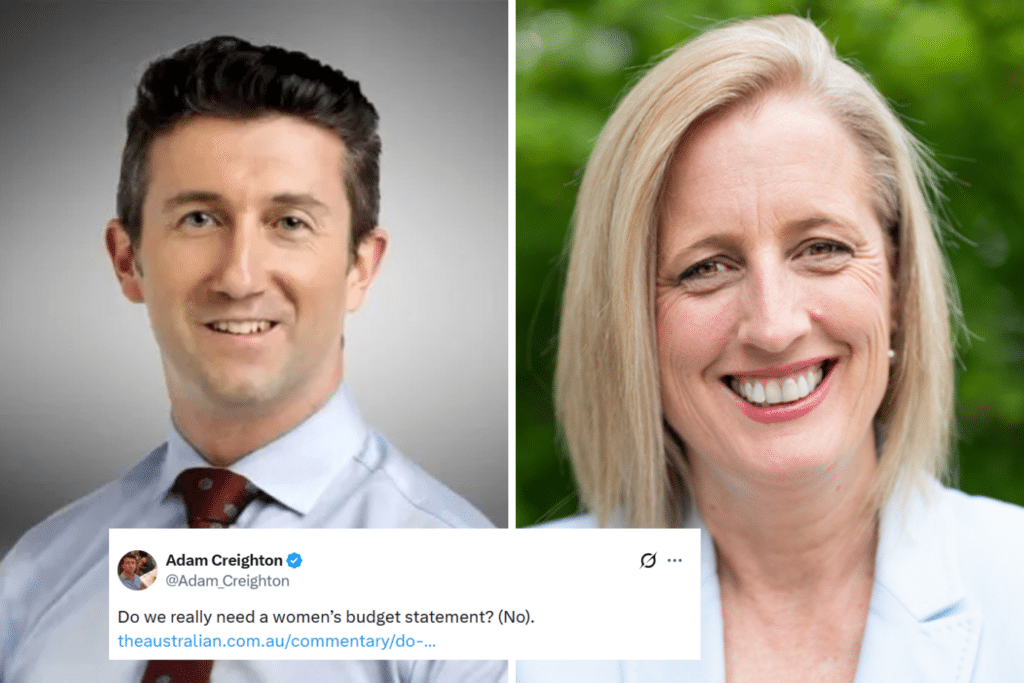
Chief economist at the Institute of Public Affairs, Adam Creighton devoted his column in The Australian this morning to ridiculing the Women’s Budget Statement, dismissing it as “divisive, ideological nonsense” and evidence that the Albanese government is more interested in rhetoric than reality.
I guess he’s right, if you choose to ignore reality altogether.
Because while women have undoubtedly made progress over the past few decades, the idea that gender no longer shapes economic outcomes, health outcomes, safety outcomes or life opportunities is an extreme display of wilful blindness
Gender responsive budgeting is an “analysis of the impact of the budget on gender equality and a process of changing budgetary decision-making and priorities” where there are seen to be gaps.
A budget, of course, is a reflection of priorities. It determines who gets support, who carries the burden of care, who can afford childcare, who can access healthcare, who can leave a violent relationship and who retires with financial security.
While Australia was seen as a pioneer in gender responsive budgeting in the mid 80’s under Labor’s Bob Hawke, the WBS was scrapped in 2013 under Tony Abbott, and years of successive governments largely failed to ask those questions in a nuanced way until it was reimplemented under Albanese in the 2022-23 Budget.
It’s one of the better reforms we’ve seen in federal policymaking in years. Not because it’s perfect. It’s not. But because it forces our government to examine the impact of their decisions rather than pretending everyone starts from the same position.
Despite deeming it “ideological nonsense” Creighton apparently perceives such “ideological nonsense” to be fair game if it’s directed at poor, disenfranchised men. He argues in his piece that young men should be receiving special attention instead; seemingly failing to comprehend that society can walk and chew gum at the same time.
The struggles facing young men are real and they’re well-documented. The government has invested significant money into these issues, including addressing male youth suicide and mental health through several key initiatives, including a $1 billion commitment to free mental healthcare and programs targeting boys and men.
There are programs around the declining educational engagement of boys as well as the loneliness and disconnection epidemic driving uptake in the manosphere.
This is all valuable and needed. And while, no doubt more should and could be done, Creighton forgets that we’re not competing for victimhood, here. It’s not a zero-sum game.
Nowhere does his argument unravel more spectacularly than when he turns to domestic and family violence.
He objects to references to “men’s violence against women”, suggesting violence is committed by only a “tiny sliver” of men.
It’s an eye-twitching attempt to minimise one of Australia’s most persistent national crises.
Because, most of us, (not living under a rock) know that in Australia, police respond to domestic violence incidents every few minutes. One in four women has experienced violence by an intimate partner since the age of 15, and on average, a woman is killed by a current or former partner every few weeks. Family violence also remains one of the leading causes of homelessness among women and children.
We’re halfway through the year, and already 32 women and 12 children have lost their lives to domestic violence. These aren’t fringe statistics. Creighton, like all of us, would know several women who have experienced the same. He may not know their experience, but he would know them.
And, when the overwhelming majority of perpetrators of intimate partner violence are men, and the overwhelming majority of victims are women, pretending gender has nothing to do with the problem isn’t just stupid, but shameful.
Another firm bugbear for Creighton is the “ludicrous” suggestion that women’s health has historically been overlooked.
He may need some catch ups with the generations of women whose pain was dismissed, whose symptoms were minimised, and whose conditions went undiagnosed for years. Up until 1993, women weren’t even included in clinical trials, and until recently there were no enforceable policies mandating the analysis of sex and gender.
Women’s health didn’t suddenly become a policy priority because governments woke up one morning and felt generous. It became a priority because women fought for it and because more women entered Parliament and brought lived experience with them.
Leaders like former Assistant Minister for Health, Ged Kearney, who understood firsthand where the system was failing as a former nurse, union leader and advocate. She oversaw the current government’s landmark investments into endometriosis care, menopause support, contraceptive access and broader women’s health services.
When women finally have enough influence around decision-making tables to make things happen, they happen.
The Women’s Budget Statement isn’t about portraying women as helpless victims. It’s about acknowledging reality.
The reality that women still perform most unpaid care, that we retire with less wealth, that we face unique health challenges, and that violence against us remains widespread. Public policy affects different groups differently.
If that sounds ideological, perhaps it’s because for so long we’ve mistaken the male experience for the neutral one.
The Women’s Budget Statement won’t solve every problem facing Australian women. But abandoning it because we’ve made progress would be like arguing we no longer need economic data because the economy has improved.
Progress isn’t the end game. It’s just proof that paying attention changes things.