
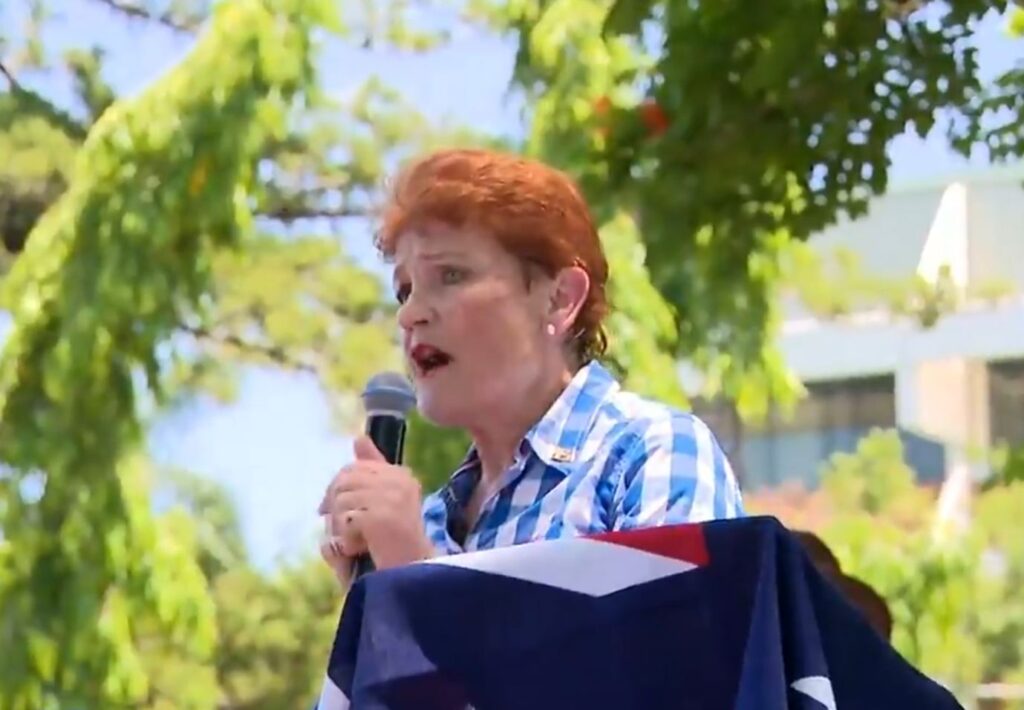
Pauline Hanson is all over my social media feed. She is popping up in the photos of people I know, at places that are very familiar to me. She’s at the local shops, kids sporting events and the Riverina Field Days. Right now, it feels as though she is everywhere.
This is because I grew up in a town that is now in the seat of Farrer and more than one in four people in the electorate are considering voting One Nation.
Farrer is not an electorate that has received a lot of media attention in the past. This changed when the local member and ousted opposition leader, Sussan Ley, retired from politics prompting a by-election. Farrer will now be the first federal seat where an election is being held following the collapse of the Coalition and ascension of One Nation. This attention has increased further following the South Australian election where One Nation has won four lower house and three upper house seats.
Farrer is located in Southwestern NSW. It includes the city of Albury, with almost half of the electorate’s population. It also includes smaller towns like Hay, Balranald, Goolgowi, Coleambally, Narrandera, Finley, Carathool, Yenda, Yanco, Griffith and Leeton. Some of these have just a few hundred people.
This by-election also comes at a time when people across Australia are facing unprecedented challenges. Over the past few weeks, we’ve seen soaring petrol and diesel prices. These increases have a huge impact on everyone, particularly farmers. The closure of the Strait of Hormuz has not just affected the supply and price of oil, but also fertiliser.
Right now, many farmers living in the region are deciding whether to plant their winter crops. If they do go ahead, they will incur greater up-front costs, along with the added risks and uncertainties or what will be happening in the world when they are ready to harvest.
In these communities, increasing costs and pressures have flow on effects for the region. There is less money to spend in small businesses. People are also laid off because there isn’t enough money or work.
And this crisis isn’t isolated. It comes off the back of several increases in interest rates. Everything costs more right now – including essentials like groceries and housing. And all of this is happening when we’ve only just emerged from the peak of the pandemic.
People are trying to figure out how to pay their bills, and living in rural communities, they already face difficulties accessing healthcare, specialist services, dental, early childhood education – the list goes on.
If people don’t see a leader who represents them, they seek out someone who will ‘mix things up’ and ‘say it how it is’. It doesn’t matter what their policies say or whether they can create change. What matters is that they are seen to be listening and reflecting the anger and despair that many are feeling.
At the by-election on 9 May, people will vote for change. In Farrer this change is being presented in the form of two very different candidates who are neck-and-neck in the polls – the Climate 200-backed independent Michelle Millthorpe and One Nation’s David Farley. This in itself is a very different scenario for an electorate that has traditionally been a very safe Coalition seat.
The question about the Farrer by-election isn’t just who people will vote for. It’s also about how we as a community respond to a political environment that is increasingly divided, where tactics are used that aim to pit us against each other, rather than unite us.
It’s easy to judge people for the way that they vote, but it’s harder to seek to understand why. Being in rooms with people who we disagree with and approaching conversations with curiosity is a far more useful tool for us than judgement and hate.
What we need right now is political leaders who can work together to develop long term solutions for families and communities who are doing it tough. This can only occur when decisions and engagement are driven by compassion, kindness, and the understanding that when one of us struggles, we all lose. We are living in uncertain times and things will likely get worse before they get better. We can’t overcome this with hate and division. That will only make the road to meaningful change longer.