
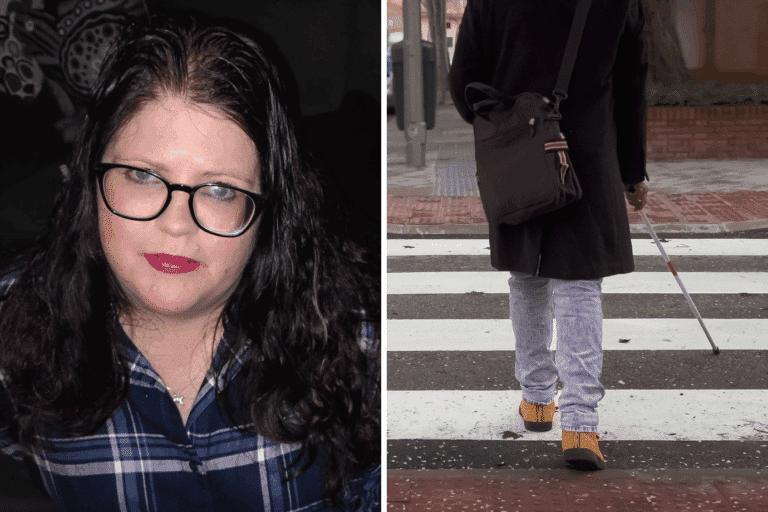
Melissa Marsden’s mum was her closest support, her housemate of seven years and, in the government’s language, an “informal support”. Since she died, Melissa has been working out what the NDIS expects her family to absorb.
There have been many discussions recently about how the lives of people with disabilities will be affected by the implementation of the National Disability Insurance Scheme Amendment (Securing the NDIS for Future Generations) Act.
People are scared that the supports they are afforded will be cut or minimised, leading to a loss of independence and fundamental human rights.
One area that the government is attempting to reinforce is the use of “informal supports.”
In other words, our family and friends with whom we have been locked within a disabling binary.
They are either represented as being burdened by supporting their children, siblings or parents; or as being willing and capable of doing so and having chosen to act as “carers,” and are therefore deserving of a small government allowance (the provision or restriction of which also relies on those children, siblings and parents being perceived as “helpless” or being independent enough that the government can wash its hands).
So often these are the loved ones we live with, who help us survive the cost-of-living crisis, who provide support and who provide love.
Too often, the discourse is on either people with disabilities as burdens or people with disabilities living independent lives — but what about when a healthy median is found, and what happens when that is removed?
My Mum passed away recently after a long experience with melanoma. She and I had lived alone and rented for almost seven years. My most substantial “informal support,” Mum, not only helped me manage my disability related needs, providing mobility support and sharing the cost of living load, but also provided emotional support, as any mother would.
Now my big brother and sister (thirteen and eleven years my senior) are trying to help me manage on my own, and while support from the NDIS is certainly helping, with an increased emphasis on “informal supports,” I cannot help but feel that I have become a burden. I know that they do not feel this way; however, with my informal supports now distinctly fewer, fear grips me.
NDIS plans are going to be cut, and it is hoped that those with fewer informal supports to rely on will not feel the brunt as badly as others. But this is uncertain. Whether people with disabilities like myself, who now have less informal support than before, will feel the brunt of these cuts remains to be seen.
Now that I am on my own, I will look to social and community participation even more to feel a connection where I once had my Mum to see every day.

I am not saying that I would have needed to stay with my Mum forever; this is uncertain. But the suddenness of this means that if I stay in the house alone for too long, my mental health is undoubtedly going to suffer.
I have worked hard during my life to strive for greatness, with ambition and determination never lacking. Yet the opportunities to contribute have been the hardest to seize.
I will never forget when former Prime Minister Scott Morrison announced that “if you have a go, you’ll get a go,” and the Albanese government’s apparent emphasis on capacity building and de-emphasis on social and community participation is, though not explicitly, dripping within this discourse.
The disparity between cuts to capacity building (10 per cent) and social and community participation (50 per cent) suggests that my supports are only as valid as they contribute to me becoming a productive member of society.
As a journalist and a doctoral candidate in Media, I would like to think that I have met that criterion.
I can do so much independently. However, there is also so much that I cannot.
But why should receiving support to live a meaningful life rely on my ability to be productive – an entirely subjective concept?
What the government has not considered is that reliance on informal supports is often greater than reliance on formal supports, precisely because those formal supports are often rigid, costly, unreliable, and unstable.
People with disabilities are targeted as expensive budget blowouts, and the discourse surrounding the business model of the NDIS reinforces this. We are commodities to be bought and sold at a rate determined by how much of a burden that transaction is perceived to be.
More and more commonly, mental health is being highlighted as an epidemic challenging the wellbeing of society.
When there is a death in the family, mental health becomes unstable, and anxiety inevitably ensues. For people with disabilities like myself, questions race through our minds about how we will manage with the supports we have. A tug-of-war between formal and informal supports emerges, where striving for greater independence increasingly relies on others.
Will we be able to afford the supports we need, whether through reduced NDIS plans or out of pocket? Will we feel like a burden, no matter how willing our loved ones are to help where they can?
Formal and informal supports are easy to talk about when the government has not thought about what relying on them means.