
Women have ended up as the victors in this year’s “killing season”. Despite many predictions over the past few months that Federal Liberal Party leader Sussan Ley would soon meet her political demise, she has for now managed to hold onto power.
Meanwhile, in Victoria, earlier this week Jess Wilson became the Victorian Liberal Party’s first woman leader. And just today, Kellie Sloane was elected leader of the NSW Liberals.
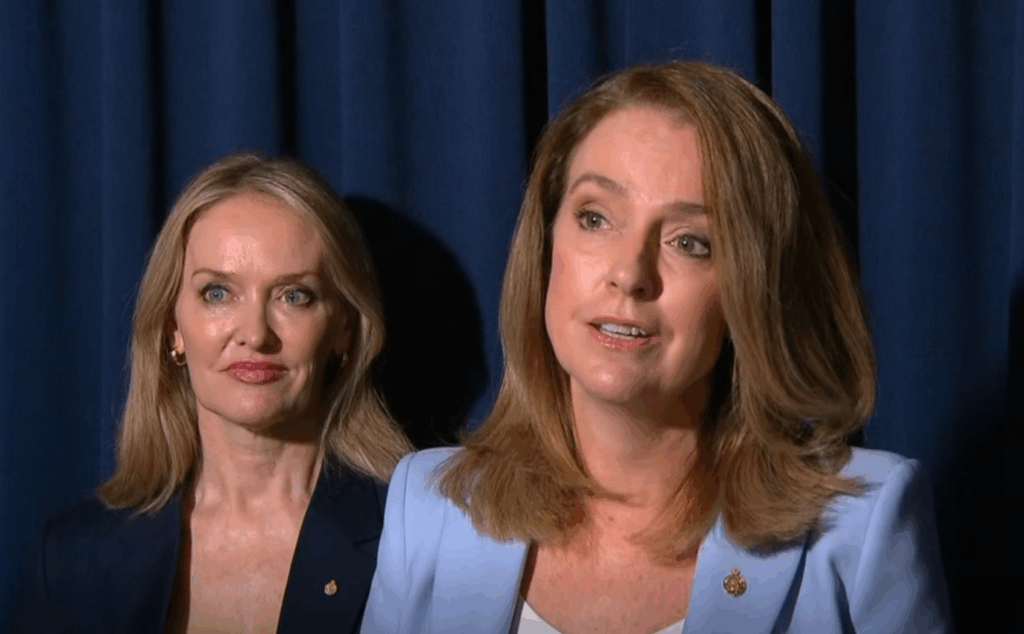
With Sloane as leader and Natalie Ward continuing as Deputy, the NSW Liberals have just made history by electing a woman to both of the top two positions.
Unlike the Victorian or federal Liberals, NSW has a better record of women’s representation. Women comprise 43 percent of parliamentarians—almost double that of the federal party. Women have also served as premier, deputy premier and leader of the opposition. The Party was also more than happy to stand behind Gladys Berejiklian during her four years as premier.
Yet the NSW Liberals have a more chequered history when it comes to the party’s broader “woman problem”. Only a few months ago, the interim head of the Party jokingly remarked to a virtual meeting of the NSW Liberal Women’s Council that Liberal women were “sufficiently assertive” and that the Liberals might need to “protect men’s involvement”. Not a great look when the topic at hand was the need for gender quotas.
They are likewise struggling when it comes to attracting women voters. Recent polls suggest that only a quarter of women would vote for the Liberal party in the next state election. People under the age of 45 are also moving away from the Party, especially young women.
Eighteen months out from the election, the NSW Liberals were in trouble. Not only have they struggled to appeal to women and young people, but their leader Mark Speakman wasn’t cutting through. They also lacked strategic direction and a big vision that would take voters along with them.
Their choice in electing Sloane is a savvy one. She’s a former television journalist and a solid media performer. She knows how to persuasively communicate to the public and has, unsurprisingly, become one of the most high-profile members of the opposition.
In her first comments as leader, Sloane demonstrated her relatability to the voters who her party most needs on side, pointing out that she’s: “a country-raised, public-school educated working mum who has built a career listening to people, telling their stories and advocating for them.” She is the NSW Liberals’ best bet at holding onto their remaining seats in the 2027 election.
The Liberal Party around Australia remains in deep turmoil. The party’s refusal to implement gender quotas, persistence in preselecting men for safe seats, as well as a toxic blokey culture and an ongoing veer towards the reactionary right, have contributed to a crisis affecting women within and outside the party.
The ideological divide within the party also continues to grow. Moderates are urging the Party to drop the culture wars, return to the Menzies-era centre, and broaden their appeal to reconnect with women and younger voters. Conservatives are pushing against this narrative by insisting a need to accelerate a move to the MAGA right, which would further alienate women voters.
Given the significance of gender equality for many of their constituents, the Party must reflect on why women are losing interest – as voters, members and political candidates – before they can even begin to remedy the problem.

The election of a moderate woman leader in NSW and Victoria visually signals a shift back toward the centre-right. However, it comes at a time when the federal party is in shambles and Ley’s authority has been repeatedly undermined by the conservative faction. The Liberal Party needs to unite to support these moderate women leaders in a push to the centre, otherwise these are simply empty gestures.
Additionally, the election of these women leaders during the most unstable period of the party aligns with the “glass cliff” scenario. This phrase refers to the frequency with which women break the glass ceiling to gain leadership positions during times of crisis, while men tend to wait for calmer waters.
Women are seen as a good choice of leader during times of political instability due to the persistent assumption that they are more trustworthy and honest than men. It also reflects their status as outsiders in contrast to the dominant male elite and assumes they will be responsible for fixing longstanding problems. However, this opens them up to greater risk as, if they fail to live up to high expectations, they face greater levels of outrage and reputational damage.
We can see how well that is currently playing out for Ley. Just six months after the federal election, mounting pressure from the conservatives and their consistent undermining of Ley have led to speculations of a leadership challenge in 2026, with conservatives Andrew Hastie and Angus Taylor seen as leading contenders for her replacement. The premature removal of the LPA’s first woman leader by a conservative faction at odds with the values of women and young Australians would not only deepen their woman problem, but would be politically disastrous.
If the party has truly changed, they must also elect women leaders during times of stability, instead of just relying on them to clean up the mess left by their male predecessors.
The change in leaders will not heal the party overnight, nor should we expect Sloane—or Wilson and Ley—to miraculously fix the party’s longstanding problems. The NSW Liberals must unite and rally behind their leader, instead of undermining her authority as has been the case with Ley.
Either way, the role of a first-term opposition leader is a poisoned chalice. It’s made even more difficult as Sloane must now wrangle a divided party while also keeping her distance from a crumbling federal counterpart.
Feature image: New NSW Liberal leader Kellie Sloane and deputy leader Natalie Ward speaking to the media.