
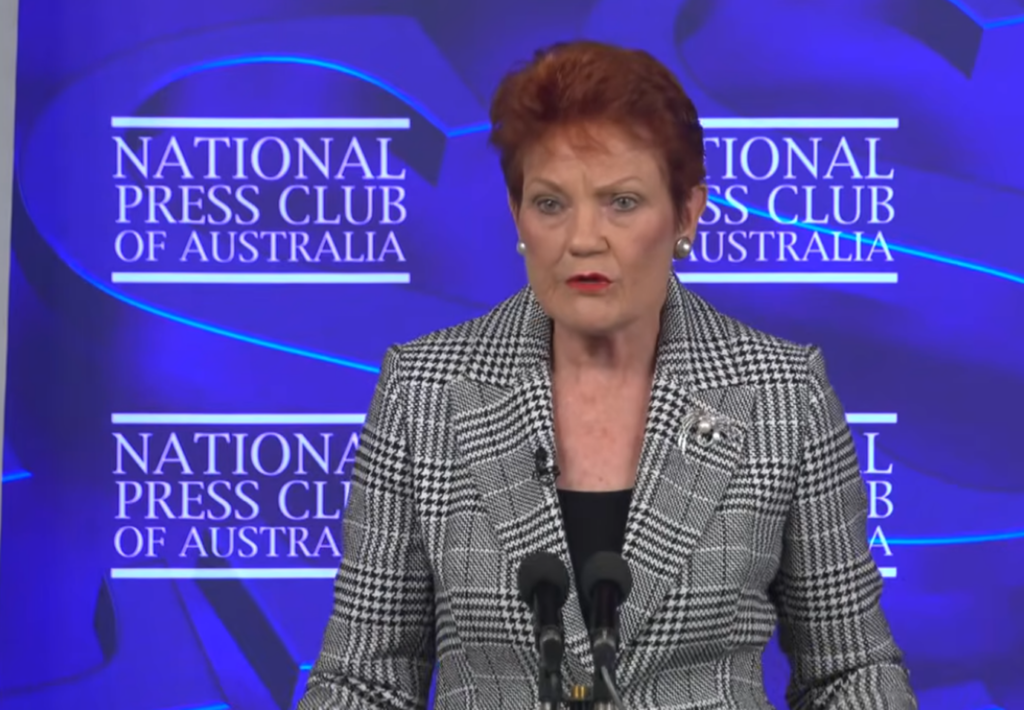
Pauline Hanson stood at the National Press Club and said the thing she has built thirty years of a political career on, “we cannot be a multicultural society. We are a multiracial society but we must be monocultural…Australians must live under one umbrella… under the failed policy of multiculturalism, all cultures are allowed equivalence to ours. Surely opposing that is not racist, it’s common sense”. Strip away the folksy delivery and that is the policy she is asking the country to adopt.
It is worth pausing on the word she chose, because she did not choose it by accident.
Monoculture is, first and foremost, a farming term. It describes planting a single crop species across the same land, season after season. Agronomists will tell you it has real upsides such as it is efficient, it is easy to mechanise, and in the short term it can produce a high yield. But every farmer also knows the cost. A single crop strips the same nutrients from the soil year after year until the land is exhausted. It wipes out the insects and pollinators that a mixed planting would support. And, most dangerously, it leaves the whole crop vulnerable to one disease or one bad season, because there is no diversity left to absorb the shock. An entire harvest can fail at once, precisely because nothing was different enough to resist what wiped out the rest.
Transplant that word into a society and the same pattern holds. A cultural monoculture is one where a single set of values, a single language, a single way of dressing, eating and worshipping is treated as the default, and everything else is, at best, tolerated and, at worst, suppressed. It looks orderly. It looks efficient. And like the paddock planted with one crop, it is brittle. It has no capacity to adapt, no reserve of different ideas to draw on when circumstances change and no resistance built from variety.
Hanson never said which culture should sit under that umbrella. She didn’t have to. When she talks about a country losing its “identity and values,” about people not speaking “the language,” about a “Judaeo-Christian” foundation under threat, the unspoken word doing all the work is ‘Anglo’. It is the same argument One Nation has made for three decades, just with the nouns rotated. And it sits oddly alongside the party’s other core claim that government should get out of people’s lives. You cannot simultaneously demand small government on economics and a state strong enough to police which language is spoken at the dinner table. That is not freedom. It is freedom for some and control for everyone else.
Here is what a real audit of Australia actually finds, instead of a hypothetical one. Roughly a third of us were born overseas. More than 300 languages are spoken in our homes. First Nations peoples have cared for this continent for over 65,000 years, longer than almost any other living culture on earth. None of that is a threat to be managed. It is simply what the country already is, and has been since before Hanson’s “umbrella” was ever raised.
Walk down any suburban strip and you’ll find a Vietnamese bánh mì shop beside a Greek souvlaki joint beside a pub serving a parma with extra napoli sauce. That is not three cultures politely coexisting beside Australian culture, that is Australian culture, full stop. It is the Tamil family lighting diyas for Diwali down the street from the Lebanese grandmother teaching her grandkids to roll kibbeh, while they speak fluent slang and barrack for the Western Bulldogs on the weekend. Loving your language and your food and your traditions has never made anyone less Australian. If anything, it is what makes the place worth living in. We are richer, more interesting and more resilient than any single crop could ever be.
Mateship, a fair go, looking out for your neighbour are not values of one ethnicity, and they never were. They are lived daily by people whose surnames Hanson would stumble over, who staff our hospitals, build our homes and teach our kids. The Sri Lankan family who arrived with nothing, built a business, raised kids who are now teachers, nurses and engineers — they didn’t dilute Australian values. They embodied them.
The idea that cultural pride is somehow incompatible with belonging here is not just wrong, it is an insult to millions of Australians who hold both, proudly. A dear friend put it to me that “divisive politics is easy. It finds the differences between us and tells us it’s a threat. Australia’s story has never been one people, one culture, one way of life, it’s been many, choosing to build something together. That’s worth fighting for. Not the boring monoculture lie Hanson keeps selling, but the real Australia is pluralistic, loud, generous, and stronger every time someone new brings their whole self to it”.
A monoculture is one bad season from collapse. A country that plants many things together is the one that survives the drought, the floods, the bad year because it never bet everything on a single crop. I speak Arabic to my kids every day especially when I’m cursing. I blast my favourite Lebanese songs and dance around the kitchen, there’s nothing better than falafel and hummus for dinner, and come game day I’m screaming at the TV for the Bulldogs to win. None of that has made my family less Australian for a single moment. This is what this wonderful sunburnt country actually looks like.