

Victoria has introduced the Restricting Non-disclosure Agreements Sexual Harassment at Work Bill 2025, a reform that marks a major turning point for workplace safety and gender justice. It directly confronts the systems that have enabled silence and eroded accountability. For decades NDAs have protected institutions over survivors, concealing misconduct and shielding perpetrators. This Bill is designed to break that cycle once and for all.
When the Bill was debated last week in the lower house of the Victorian Parliament something extraordinary happened. Female MPs across parties stood and shared their own experiences of workplace sexual harassment and assault. It was a rare moment of political unity driven by shared pain and purpose. The Bill passed the lower house and it should have been a moment of pride for all those who have campaigned long and hard to protect Victorian women and girls in the workplace.
Among the female MPs who spoke was Minister for Women Natalie Hutchins, who is also Minister for Prevention of Family Violence, Government services, Treaty and First Peoples. It was a significant week for Minister Hutchins. The Treaty Bill passed into law and the reform to restrict NDAs moved forward. She had every reason to feel hopeful. Instead, by the weekend she was being vilified on social media by strangers, predominately men, who seemed enraged that a woman dared to tell the truth about her own experiences.
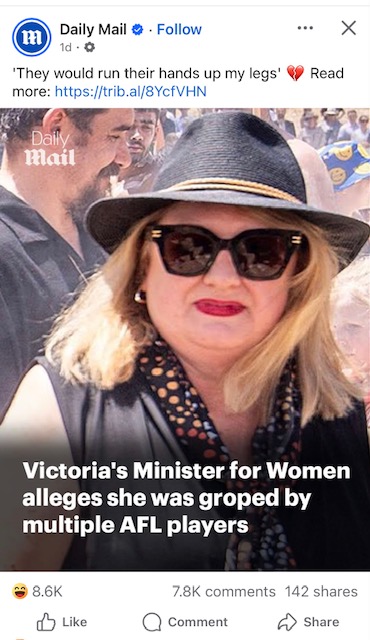
During the parliamentary debate, Minister Hutchins revealed that in the 1990s when she was sixteen and working as a waitress near Windy Hill, she was groped by Essendon players who came into the restaurant after training. They would run their hands up her legs as she carried trays. She said she had been required to wear a short skirt at work. According to Minister Hutchins, the incidents were reported to Essendon Football Club at the time and the club management handled the matter appropriately. She emphasised that she didn’t believe such behaviours still occurred in the AFL. Her story was one of many shared by MPs and should have been a catalyst for reflection on how young women are treated in the workplace. Instead, it ignited a vicious online backlash.
A male sports reporter at the Daily Mail Australia published an article calling her disclosure “explosive”, while scouring her social media for images and opening the comments section. More than seven and a half thousand comments poured in. If the story had been about a male AFL player accused of assault the comments would have been turned off. The comments were predictable. When a woman speaks about her own experience the public is apparently free to tear her apart.
The #MeToo movement surged in 2017 to shine a light on sexual harassment, abuse and rape culture. It was supposed to be a turning point yet the responses to Minister Hutchins show how little progress we have made. Reading the comments was genuinely distressing. She was mocked for her appearance, called a liar and accused of dreaming it up. Some claimed she was too unattractive for anyone to grope. Others used the phrase “and she woke up” which is shorthand for belittling women who speak out.
What made it darker was that many of the men commenting had profile pictures featuring their daughters, wives, mothers and granddaughters. They demanded to know why she did not go to police, why she did not quit, why she did not tell someone. She did tell someone but she was a child. She was 16 years old. She was not an adult. The adults at her workplace had an obligation and duty to protect her. Sexual harassment is about power and control. Ridiculing a woman for speaking out only reinforces that power.
We constantly ask why women do not enter politics. We launch campaigns encouraging more women to stand for local, state and federal parliament. Yet when women reveal painful experiences to shape better laws so others do not have to go through what they did, they are treated like targets. The hypocrisy is staggering. We say we want honest politicians but the moment a woman speaks honestly, she is accused of attention seeking.
Some commenters even used the phrase #BelieveAllMen as a parody of #BelieveWomen, l kid you not. This is exactly why we are here. For generations society believed men by default and dismissed women as unreliable, dramatic or vindictive. When a woman reports harassment, she is immediately labelled a liar, told she is trying to ruin a man’s life or that she is too unappealing to be harassed. The misogyny is so blatant it barely tries to disguise itself.
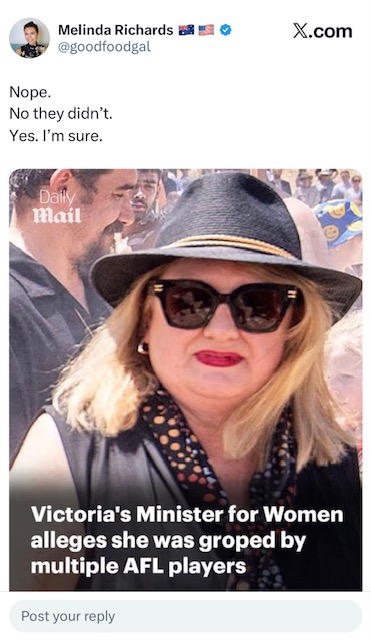
On social media the pile on Minister Hutchins intensified. Melinda Richards, a self-described ‘freedom fighter’ and critic of what she calls the ‘woke narrative’, posted a screenshot of the Daily Mail article with the caption “Nope. No they did not. Yes. I am sure.” As in no the Minister was not groped and yes Ms. Richards is sure of this.
Speaking on the backlash, Minister Hutchins said “the insulting comments are not only personally demoralising but also concerning for other women who want to disclose their experience of sexual harassment in the workplace. No one should have to endure public attack when they disclose sexual assault. It’s just another attack on women’s voices and power.”
However, there were messages of support. Emily Yuille sums it up perfectly “solidarity Nat. Thanks for your bravery! Every time a woman speaks out, it inspires countless others to influence change. #MeToo.” The anger directed at Minister Hutchins reveals how threatened some people are by women who refuse to be silent. Men aren’t “emasculated.” They’re just furious that women no longer tolerate their behaviour. They want to return to a time when our voices were whispers. But that era is over. And if the backlash against Minister Hutchins proves anything, it’s that speaking out still comes at a cost—a cost women shouldn’t have to pay.