
Surfing has made real progress on gender equity, with reforms having tackled access inequities within the sport such as prize money, competition slots, funding, and board representation. With these measurable gender disparities improved, competitive surfing is now fairer than it has ever been.
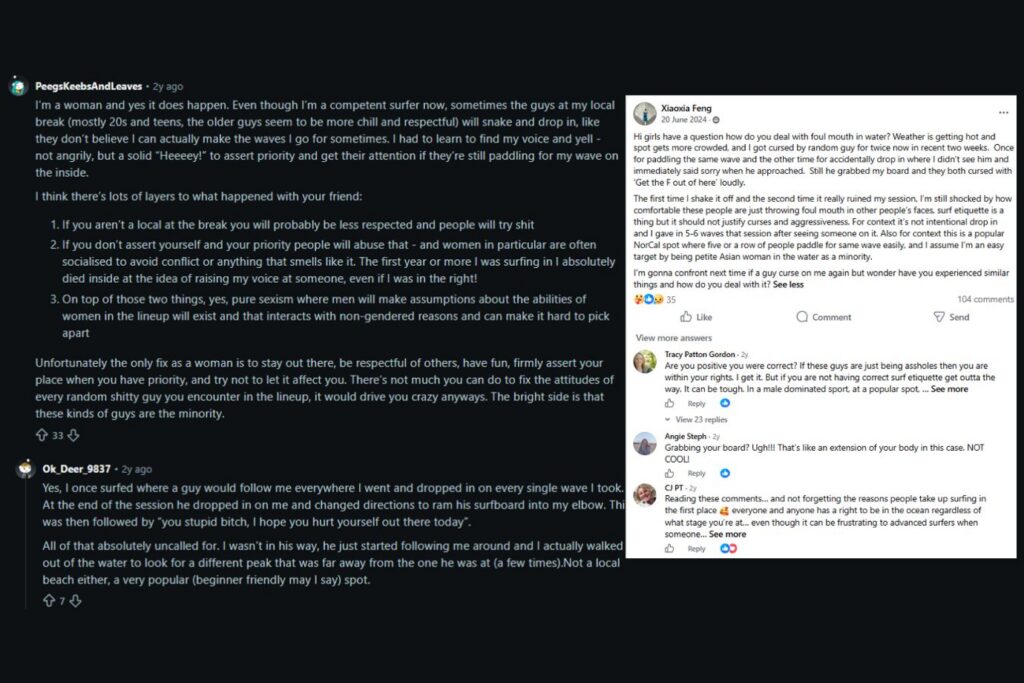
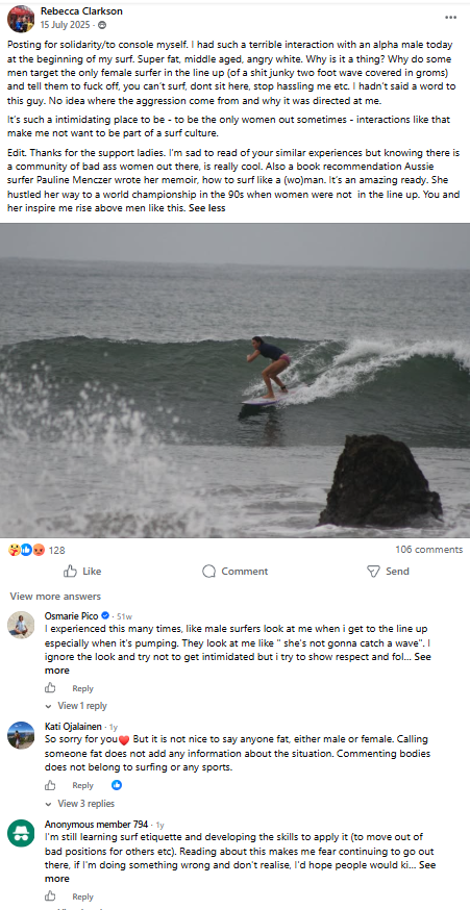
But there remain challenges, especially outside of formal competition where the oversight of surfing officialdom is absent. Indeed, recreational surfing remains a bastion of male dominance. The most toxic demonstration of this lies in the abuse and violence directed towards women at surf lineups. This is the waiting zone where surfers observe wave conditions and, in principle, follow priority rules when catching a wave.
Our research provided an opportunity to explore what happens inside the lineup.
Out in the ocean and away from tournaments there is no surfing official, no participation record, and no written standard; priority is a code that can be invoked or ignored at will by those who use physical power and intimidation to be the lineup’s gatekeepers.
The aggressive behaviour continues in the car parks and creates serious safety concerns enough to change where and when women surf, or whether they surf at all. When two-time Surfing World Champion and Olympian, Tyler Wright described being physically and verbally attacked in the water, the response from women surfers across the country was not shock. It was recognition.
“I’ve been attacked by men in the water, I’ve been hit in the head, I’ve been yelled at, screamed at. These environments are not only passively dangerous, but they can be actively dangerous, intimidating and not welcoming if you don’t know what you’re doing,”she said.
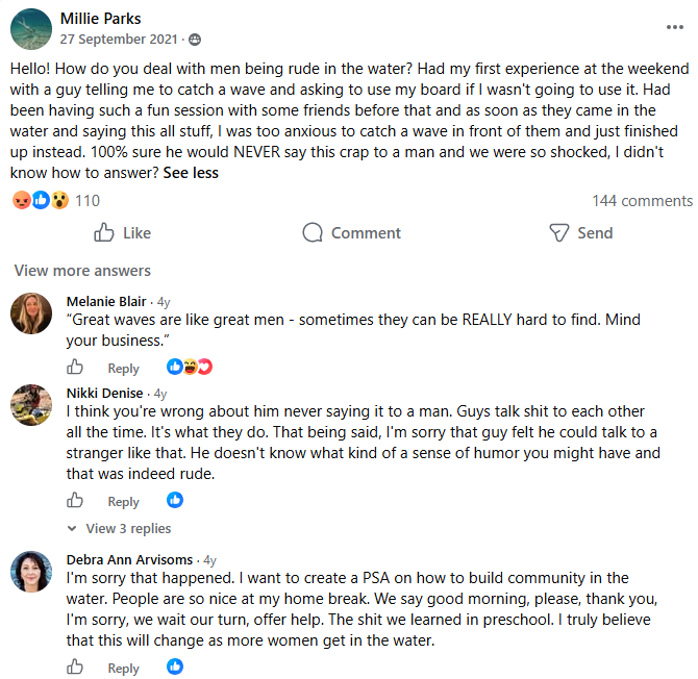
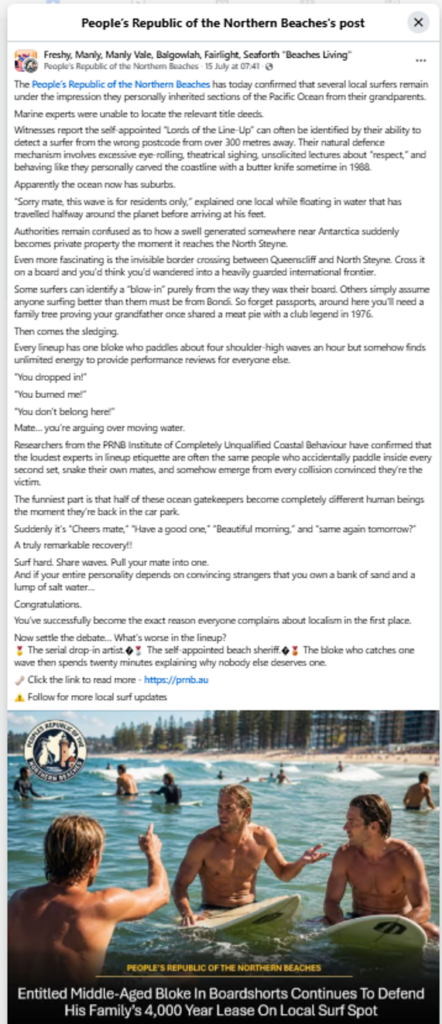
Public conversation about women in surfing has settled into a story about representation – equal prize money, more women’s events, more women coaching. Those wins are real. But they haven’t fixed the lineup, because the lineup is governed by “surf etiquette”: an unwritten code that everyone claims is about safety, and that in practice is enforced at the discretion of whoever already owns the break. Our research finds that etiquette is most effective mechanism of exclusion in surfing, precisely because it is unwritten, and precisely because it sounds reasonable.
Gender is the clearest fault line in surfing, and the one we’ve studied most closely.
As part of our ongoing research in partnership with Surfing Australia, as researchers we attended the NRMA Insurance RISE Women’s Program’s annual development camp in late May 2026, with around 40 women ranged in age from 17 to over 60 from across Australia for a weekend of sessions on coaching, judging, wellbeing, leadership and media representation.
The session scheduled on etiquette and localism ran more than two hours past its finish. Participants kept the conversation going for days afterwards. What struck us was not that the women had stories, it was that most had never before been in a room where the stories could be laid side by side. Individually, each incident is deniable: a bad day, a rude stranger, a misread situation. Collectively, a pattern is obvious. Several participants said aloud that they had assumed the problem was them.
“It was all very much intimidation and localism, like very heavily guarded spots and violence in the water. So yeah, a lot of stuff. It’s gonna put anyone off. Not quite gang culture, but very much localism, very much protected little stretches of beaches. —Surfer 1”
Beginners, older entrants, adaptive surfers, migrants, people who learned somewhere else, people who simply don’t look like they belong. All of them encounter the same discretionary enforcement, with the same defence available to those enforcing it. This is a cultural feature of how surfing governs itself.
Everyone in surfing can recite the priority rule: the surfer closest to the peak has the wave, and dropping in on them is the sport’s cardinal sin. It is presented, correctly, as a safety rule. Our participants described something specific happening to that rule. One younger competitor told us the hardest part of paddling out is that the boys simply don’t care; if she’s paddling for a wave, they drop in anyway. Her strategy is to catch a wave fast, at the start of the session, to establish that she can surf:
Honestly, […] the biggest challenge is going out, and it’s just boys. It’s just a common thing you feel because you’re a girl and they’re not used to … girls surfing. They’re all looking at you. The biggest challenge is having to get a wave quick … to show them. Because if I’m paddling for a wave and boys paddling, they don’t really care. They just drop in. You just have to prove yourself. —Surfer 16
Note what that is. It isn’t a woman failing to understand etiquette. It is etiquette being suspended around her, and her needing to purchase its protection in advance through a display of competence no man is asked for.
The same asymmetry runs through the smaller interactions. Another participant, surfing longer than the men advising her, described the steady stream of unsolicited coaching from strangers in the lineup, advice, she noted, they would not offer a man: “…you do get comments [all the time]. Like, oh, you surfed great for a girl. You’ve done well; you surfed with the boys” (Surfer 10). A third was told she should be back in the kitchen.
The women we interviewed were not waiting to be invited into their sport. Several were already running clubs, coaching, competing and building the pathways that didn’t exist for them. What they were waiting on was for the reforms to reach the parts of surfing where somebody would have to move over.
With thanks to our research supporters: 2024 UTS Business School Research Grant, 2026 UTS Social Impact Grant Scheme, the UTS Centre for Social Justice and Inclusion, the UTS Business School and Surfing Australia.