
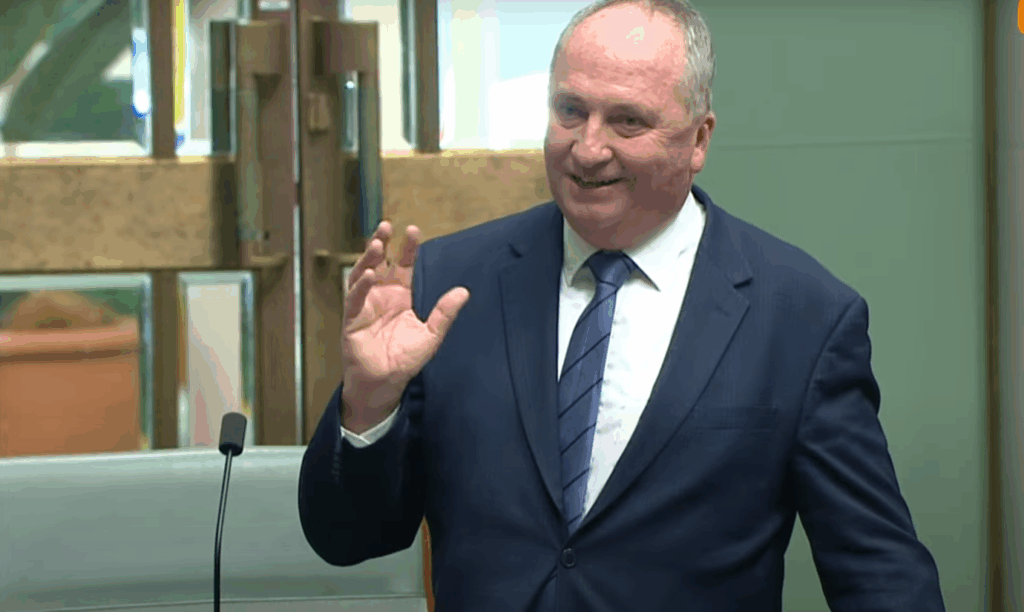
Australian politics really is a dump fire of epic proportions right now.
And it’s not because there are too many hard decisions being made. It’s not because there are heated (yet critical) debates happening across all chambers. It’s not a “it’s hard governing” mess, but a far more basic, embarrassing one.
While the country is grappling with violence, extremism and global instability, one of the core headlines today centres around Barnaby Joyce speculating (out loud and to the media) about which of his former Nationals colleagues is primed to defect to One Nation and calling it a “scoop”.
According to Joyce, a sitting National Party MP is ready to jump ship to Pauline Hanson’s One Nation in the next 24 hours. He even left us on edge, confirming he won’t make “the announcement” prematurely, yet threw us tiny scraps of intrigue like the fact “it’s not Bridget McKenzie, there.”
Forget the premiere of Married at First Sight tonight, we don’t need it. Politics in this country is already reality television. Worse, it’s being treated as legitimate national news by outlets like Sky.
And while legacy media is to blame for paying this tripe airtime, we might be at fault for paying the pollies. How do we keep electing individuals who can’t fulfil the basic aspects of their jobs?
This is not just a Barnaby Joyce problem, although he remains a walking symbol of the Coalition’s inability to take itself, or the country, seriously. It’s a Coalition problem. A political culture problem. A problem where ego and internal sabotage have become so normalised that they crowd out any sense of responsibility to the public.
The Nationals flirting with One Nation is not new. The Liberals’ internal chaos is not new. But the casualness with which this is discussed while the world is quite literally on fire is unforgiveable.
Just reflect on the week Australia has just had.
In regional New South Wales, three people were shot dead in what police describe as a domestic and family violence incident. A manhunt is still ongoing for the alleged murderer Julian Ingram. Of course, violence against women and families remains an urgent, unresolved crisis that demands leadership, funding, coordination, and political will. None of which the Coalition is capable of demonstrating right now.
In Perth, on Invasion Day, a man allegedly threw an explosive device into a crowd. The terrorism alarm did not immediately sound—with an absence of media concern and public outrage. Questions were raised about preparedness, messaging, and whose safety is prioritised in moments of national tension. The Coalition stayed silent.
Globally, protests in Iran continue under brutal repression with the death toll climbing. And in the United States, Donald Trump continues to destabilise global politics with threats to NATO, and a campaign that grows more extreme by the day.

These are seismic issues that the Coalition simply isn’t capable of dealing with.
What they are capable of? Some serious navel-gazing, and inane gossip about who might defect to a far-right minor party, as if this is shrewd insider knowledge rather than a flashing red flag.
There is something profoundly broken when politicians are more animated by their own relevance than by the crises unfolding around them and internal party games are raised above the critical issues facing Australian’s lives.
The Coalition appears incapable of lifting its gaze. Years out of government, it has learned none of the lessons that voters tried to teach it. Instead of rebuilding credibility, developing a clear policy framework and serious alternatives on housing, climate, cost of living, safety, or national security, it remains trapped in a loop of grievance, ego, and internal warfare.
Australians deserve better than this. Not perfection, but seriousness. Politics should be about grappling with hard problems, not fuelling the egos of men who confuse attention with importance.