
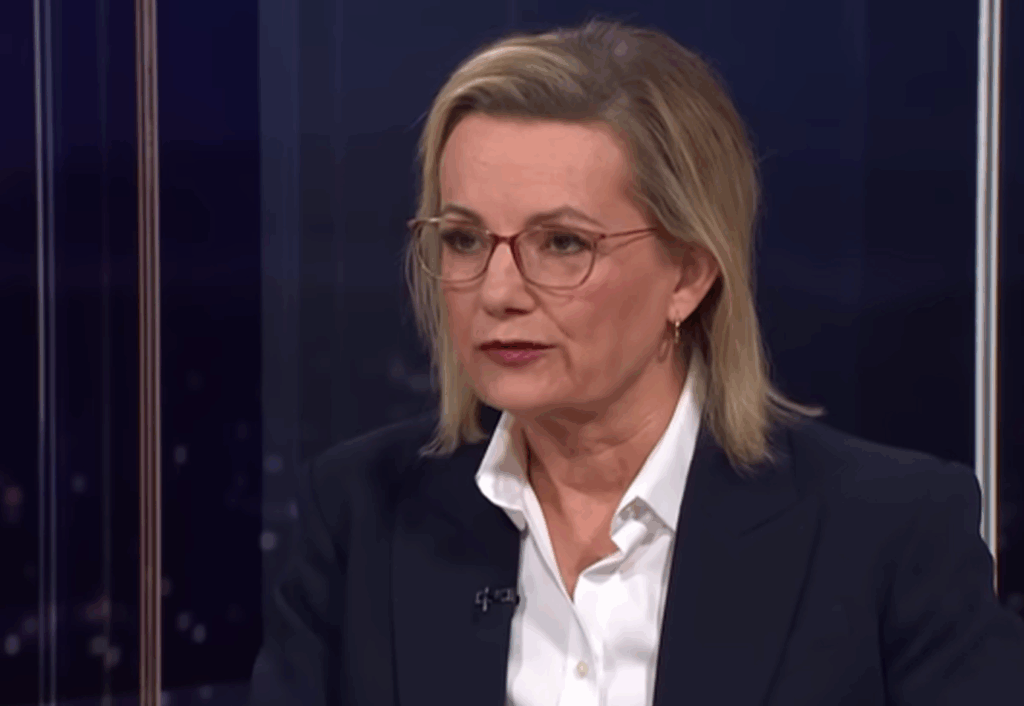
This week on ABC Melbourne, Liberal Leader Sussan Ley managed to do what many thought impossible: revive Tony Abbott’s legendary “women of Australia will do the ironing” moment except this time, it was the grocery shopping, Christmas organising, budgeting, gift-buying, and general family emotional labour that she neatly bundled into the basket marked women’s work.
In an interview with Raf Epstein, Ley described her plans to head to an IGA in Mt Evelyn to speak to “mums who are struggling with the cost of living… sitting at the kitchen table working out how to make it all come together for Christmas, buy presents, you’ve got to look after family.”
I’m sorry, but what? Are only mums shopping at IGA? Are dads barred from the Mt Evelyn fresh produce aisle or do fathers mysteriously evaporate the moment tinsel hits supermarket shelves? More likely we are hearing yet another politician default to the tired gender script where women run households and men run the country.
Sussan Ley is not wrong about the cost-of-living crisis. It is severe. But to gender it so explicitly and to paint it as a burden that weighs solely on “mums at the kitchen table” is almost impressive in its tone-deafness. Because while Australia in 2025 is not quite the world of Abbott’s ironing board, political leaders still seem remarkably comfortable reinforcing the idea that women naturally shoulder the domestic load.
And yes, women do perform the bulk of unpaid labour in Australian households. That is a fact. According to the ABS, women spend around 80–90 minutes more per day on unpaid care and domestic work than men. They also continue to carry the emotional labour planning, scheduling, meal prepping, childcare organising, remembering who likes what and when. Researchers routinely describe unpaid care as the “scaffolding” of the economy. Which is ironic, given that politicians mention it only to reinforce the assumption that of course it’s the mums doing it.
However, recognising gendered labour is very different from reinforcing it. And Ley’s comment did the latter. It positioned women not as citizens facing a national economic crisis, but as household managers whose central role to stretch the family budget until it snaps. Even more frustrating is the political nostalgia baked into this narrative. The image of the “mum at the kitchen table” is straight out of the 1950s political playbook: the stoic woman who quietly makes do, absorbs pressure, and ensures everyone else is okay. It is a comforting image for those who benefit from women’s unpaid labour remaining invisible and unquestioned. It also sidesteps any need to discuss systemic change, like wage growth, childcare investment, paid parental leave reform, or workplace equity.
And yes, dads also feel the cost-of-living squeeze. Plenty of fathers comparison-shop at supermarkets, stay up late budgeting, and panic about Christmas spending. But you wouldn’t know it from the way our politicians, women included, invoke gender. Ley could easily have said “families,” “parents,” or “households.” But she didn’t. She said “mums.” And that was a choice.
There is symbolism in political language, and women notice it. We notice when the default parent is always female. We notice when the domestic sphere is feminised but economic policy is masculinised. We notice when women’s everyday labour is suddenly worthy of mention only when it’s politically convenient. And we especially notice when the gender norms we are fighting to dismantle are casually reinforced by a woman who has risen to one of the highest positions in the country.
It’s not that women don’t do these things. Many do shoulder the Christmas mental load, often because if they don’t, no one will. But the answer to gendered labour is not to keep describing it as if it’s natural, inevitable, or unchangeable. A leader committed to equality might have said, “In the lead-up to Christmas, families across Mt Evelyn are struggling. Women, men, single parents, grandparents, everyone is feeling the pressure.” But we didn’t get that. Instead, we got the domestic goddess narrative wrapped in cost-of-living commentary.
Perhaps this is why the comment had me shaking my head. It wasn’t only the sexism it was the missed opportunity. Because the real, honest conversation about cost-of-living pressures is inseparable from gender. Women feel economic stress more acutely because they earn less, save less, and retire with about 25 per cent less superannuation than men. They are more likely to work part-time, to take on unpaid care, and to absorb the shock when household budgets implode. There is a gendered cost-of-living crisis, but not because “mums shop at IGA.” It’s because our economic systems continue to rely on women’s unpaid labour while simultaneously undervaluing their paid labour.
Ley is right about one thing though and that is women are doing a huge amount. But invoking that labour as though it’s the natural order of things is precisely the problem. Women don’t need politicians reinforcing outdated gender roles; we need them challenging them. Until then, the least we can do is call it what it is another political moment where women’s unpaid labour is acknowledged not to fix inequality, but to use it.