
Sometimes, it’s a picture that really cuts through and reminds me what’s at stake when it comes to tackling the climate crisis.
Since being appointed as the Australian Government’s Special Envoy for Climate Change, Adaptation and Resilience in June this year, I’ve had the privilege of meeting with many young people from Australia and the Pacific who are advocating for climate action.
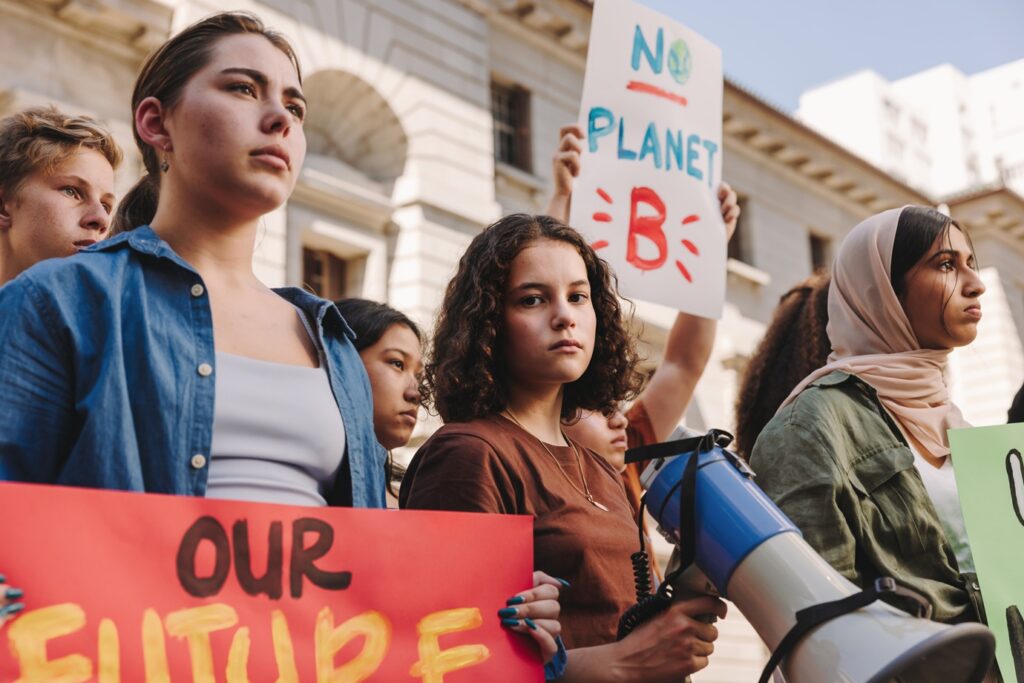
As a 45-year-old Gen-X mum of two, who definitely can’t claim to be young anymore, some qualities I’ve noted about all these impressive young people include that they’re passionate, they know what’s at stake and they are arguing for their future and the future of their communities. They’re smart and they’ve done their research, they understand climate science and consequence, and they’re hardworking. They’re doing the work not just in their communities, but in national, regional and global forums.
And the picture that made me tear up recently was given to me by a young woman from the Marshall Islands. It shows a woman, standing strong in the middle of rising waters, facing an existential threat but demonstrating resilience. It’s now on display in my Parliamentary office.
Part of what I’ve been talking with young people about recently is the United Nations’ Climate Conference, or COP. The Australian Government wasn’t successful in our bid to host COP31 in Adelaide, but next year we will have the opportunity to hold the pre-COP in the Pacific, and my colleague the Climate Change Minister Chris Bowen will be the President for COP negotiations. Chris is a fellow Gen-X’er, but he and I both know just how important it is that young people’s voices from the Pacific and Australia are heard at these forums. They deserve a say as the world continues to work out how we’re approaching the transformation that is going to be critical to the rest of their lives.
The advocacy of these young people also helps drive the Australian Government’s work domestically to transform our energy system and drive down emissions. We’re getting on with the job of the energy transition because the facts show it is in Australia’s national interest.
Recently released data shows the Albanese Government’s policies have just led to Australia recording the largest annual fall in emissions outside of the pandemic.
We’ve hit record renewable uptake. Since the start of September this year, renewables have been 70% or more for at least 30 minutes in a day on 65 days, or 81% of days. In October renewable electricity was half of our national grid, and in the last 12 months, Australia has produced over 100 terawatt hours of renewable electricity, enough to power every household more than one and a half times.
We’re also investing in giving young people the skills and training to work in the clean energy economy, including providing money to upgrade TAFEs so that they can teach new skills such as maintaining electronic vehicles, installing wind turbines, and connecting and maintaining batteries.
I wish I could say it was all going to be smooth sailing from here, but there are still threats to climate action. Here in Australia, that includes from the Federal Opposition, who under the leadership of Sussan Ley has gone backwards on their already thin climate policies, by dumping their commitment to net zero emissions. The Liberal-Nationals are not so much hearing the voices of young people as they are listening to the echo chamber on Sky after dark.
In contrast, our Government knows we need to keep going. This year marks ten years of the Paris Agreement. There is good progress globally, reducing emissions and building a more reliable energy system, and bringing the world’s projected emissions down from 4 degrees of warming to 2.8 degrees.
2026 will be a big year of climate action in Australia and in our region. I’ll be looking up at that cut through picture in my office as I make sure the voices and the qualities of young people in Australia and the Pacific crucial to action are heard.