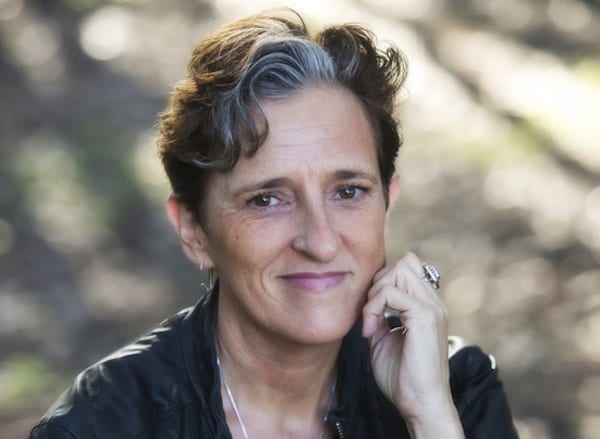
Charlotte Wood: There were times when I thought, ‘why am I writing this and will anyone want to read this?’.
Lisa Gorton and Charlotte Wood have been named joint winners of the 2016 Prime Minister’s Literacy Award for fiction, with the $80,000 prize divided between them.
Women dominated the full list of winners, with Dr Karen Lamb and Sheila Kitzpatric both taking out the non-fiction prize, Sally Morgan taking home the children’s fiction prize, Meg McKinlay awarded the Young Adult Fiction prize and Suzanne Rutland being named one of two winners (along with her co-author Sam Lipski, and Geoffreny Blainey) in the Australian History prize.
Gorton’s fiction novel, The Life of Houses, explores the tense relationships between three generations of an Australian family, while Wood’s The Natural Way of Things is a dark and gripping story exploring misogyny and corporate control.
Announcing the winners in Canberra on Tuesday night, Prime Minister Malcolm Turnbull said the 30 shortlisted books, selected from 425 entries, reflected Australia’s long history of story-telling.
Cannot believe this rollercoaster week. So proud & happy to share the 2016 #PMLitAwards for fiction w the gorgeous Lisa Gorton. THRILLED.
Our publisher Angela Priestley recently had the pleasure of interviewing Charlotte Wood after she won the Stella Prize back in April this year.
We’ve republished an edited extract of that interview below.
Charlotte Wood won the Stella Prize for her novel The Natural Way of Things, but she still finds discussing its subject matter difficult.
The dystopian novel based on a group of incarcerated women who’ve at some point been victims of a public sex scandal is a gripping read, but is deeply harrowing and reflects much wider themes that women experience all the time.
“I don’t know how long I want to talk about it for,” she says. “I know that all women pretty much have to shut their eyes and ears to get through the day because of all the messages of negativity that we can internalise. I have experienced it my whole life, everything that’s said about our gender is bad from birth.”
Wood thought about a writing career in her mid twenties, but took a few years to get seriously started.
“Part of that was that I didn’t think i’d know what to say, I didn’t realise you actually discover what you want to say by writing it down.”
But the real catalyst came when, at the age of 29, she lost her mother. “Those times of great change or grief really separates the important things and not so important things in this world, and I knew suddenly that this was important to me and I had to stop thinking this is something I’ll get around to doing one day.
“What’s the point of waiting around? I had to get stuck in. I committed in my own mind to it. I had full time work, I committed to finding a way to making it happen. There’s never going to be a time in your life that says you suddenly have this time and confidence and money to make it happen.”
As for her latest — and now award winning novel — the idea was sparked from a documentary on the Hay Institution for Girls, an offshoot of the Parramatta Girls Home.
“It was a horrible, sadistic place for young women, back in the sixties. When I was about to head into my adolescence I realised there were girls being treated in this way.”
Wood says that as harrowing as her book is, there’s nothing in it that comes anywhere close to what these girls endured.
What really activated her anger from the documentary was that one of the key reasons girls were in such places was because they had been sexually assaulted and dared to tell somebody about it. “They were considered dangerous because they spoke the truth about what had happened.”
Wood says her own “antenna was up” for what she realised was a phenomenon that still goes on today — women being punished for speaking up about sexual assault. She specifically refers to the Skype incident that saw a young female Army cadet shamed after being secretly filmed having sex. Women are no longer getting locked up for speaking up, but they’re certainly being punished.
“That’s what we understand happens to women who complain about stuff that happens to them, that they have to get punished. When I heard that story I was so filled with anger, it was so clear cut who was in the wrong.”
Wood spent three years writing the book, a process that she says wasn’t particularly fun, given she needed to inhabit such a dark world imaginatively.
“I don’t want to be dramatic, but there were times when I thought, ‘why am I writing this and will anyone want to read this?’.”
Wood says that when she’s immersed in a writing project, she’ll sit down at her desk around 8am until she’s put down at least 1000 words. Sometimes that’s at 10am, other times she’ll still be going at 6pm that night.
During the first draft, she says the quality is irrelevant. It’s purely about output and getting to know the characters. She also doesn’t write from start to finish, often finding her ending well before anything else.
“I like to work on my characters, have them walk through doors and come together, until they develop life on the page. And that’s when it’s pleasurable.
After spending three years producing a very dark work, Wood hopes her next project will be “nice and pleasant.” She’s writing about women in their seventies, and plans to produce “a book about ageing that’s not about the past.”