
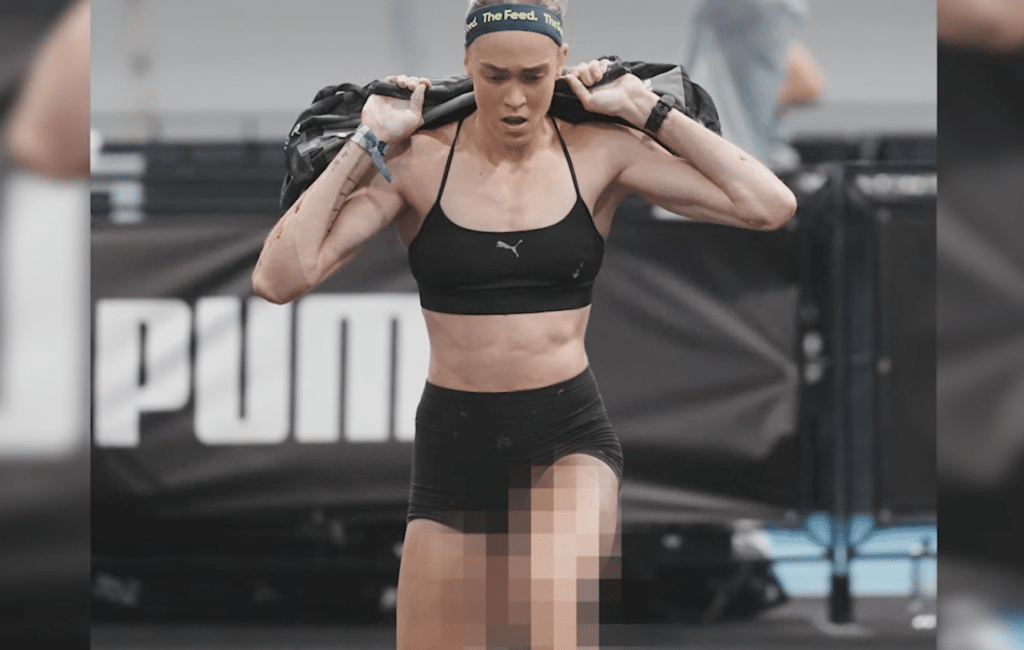
By now, you would have likely seen the viral images of Australian athlete Joanna Wietrzyk competing in a HYROX fitness race in Beijing. She looks strong, fierce, resolute. She also has a violent stream of diarrhoea running down her legs.
Wietrzyk, a HYROX world record holder, suffered faecal incontinence during the event. But rather than step out and concede defeat, she continued competing, using shared equipment and completing the course. In fact, she won.
The incident quickly prompted questions about the organisers’ health and safety procedures, as well as the decision to let her continue.
But there’s a much bigger question here, and it’s one we should be asking long before someone’s body reaches the point of no return.
When did being fit become a test of how much suffering we can endure?
Somewhere along the way, exercise stopped being about keeping strong. It instead became a performance of personal discipline, morphing into an identity, a community and, increasingly, a moral virtue.
We don’t just go to the gym or play sports anymore. We train relentlessly with specific challenges in mind. We measure every aspect of our output: our recovery, our sleep, our heart rate and our ability to withstand discomfort.
We plunge ourselves into ice baths, run marathons and do bootcamps. Our modus operandi has become to celebrate our ability to do things that most of our bodies would quite reasonably prefer not to do.
None of this is inherently bad.
I’m frequently in awe of these efforts of human endurance. There is also mammoth value in setting goals, building strength and discovering what our bodies can do. But there is a difference between challenging yourself and treating your body’s limits as an inconvenience to be overcome at all costs.
Right now, fitness culture is largely built around the idea that the harder something is, the more worthwhile it must be. If you’re not in pain, you’re not committing. If you’re not brutally exhausted, you must be lacking discipline. Finishing when you are depleted, injured or (in the case of Joanna Wietrzyk) literally shitting yourself, must be a sign of a significant character flaw.
The language of resilience and mental toughness can be particularly seductive here, and suddenly, “listening to our bodies” stops being the acceptable response. Even though we grow up with that message being hammered into our consciousness.

So why are we defining success like this?
There is something deeply revealing about the reaction to the latest incident concerning HYROX. Much of the conversation has focused on whether Wietrzyk should have been allowed to continue, and whether organisers should have intervened.
Those are reasonable questions, particularly given the shared equipment and indoor environment. It’s been widely reported that competitors raised concerns about both the health risks and the psychological consequences of being exposed to the incident.
The more useful question though, in my mind, is not whether she was sufficiently tough to finish or whether organisers should have intervened. It’s whether the culture around her made stopping feel like an unacceptable option.
I don’t know what medical advice Wietrzyk received, if any. But it’s difficult to imagine any reputable doctor suggesting she persevere through explosive diarrhoea. This was something that Wietrzyk more likely decided for herself.
This theory is backed up by a since-deleted Instagram story, where Wietrzyk shared a selfie of herself attached to an IV drip captioned, “Go hard of go home… a win is a win”, before thanking her supporters for their messages.
But when does a win become a loss? For women it’s doubly hard not to succumb to the pressure.
For decades we’ve been told that we’re not strong enough, fast enough or competitive enough. We’ve had to defend the idea that our bodies are simply less suited to sport than men.
At every turn, there’s been a fight. For access to sporting facilities, equal funding, equal pay, equal media coverage and the basic right to be taken seriously.
So is it any wonder that Wietryzyk felt the crushing pressure to prove herself?
But of course, that pressure can become another trap.
Women are expected to prove that they can endure extraordinary physical demands, while also being judged against a set of expectations about how they should look and present themselves.
The recent controversy around a Sydney Sweeney sports betting advertising campaign, and the response from female athletes who felt it reduced women to their bodies, is another example of the seismic double standards we’re up against. Women in sport are still navigating a culture that can sexualise them in one breath and question their physical capabilities in the next.
But the answer to a culture that has historically underestimated women’s physical capabilities is not to create a new culture in which women must demonstrate that they are almost superhuman.
I’m not anti-sport. I’m not even anti-HYROX, ice baths or endurance events. (Although I could and should never do them).
But I’m wholly sceptical that the ultimate measure of our health is how far we can push ourselves beyond what is comfortable or safe. We should be able to enjoy sport without having to turn every session into a test of our capacity for suffering.
And we should be able to stop when our bodies tell us to stop, without feeling that we have failed some larger test of our worth.