
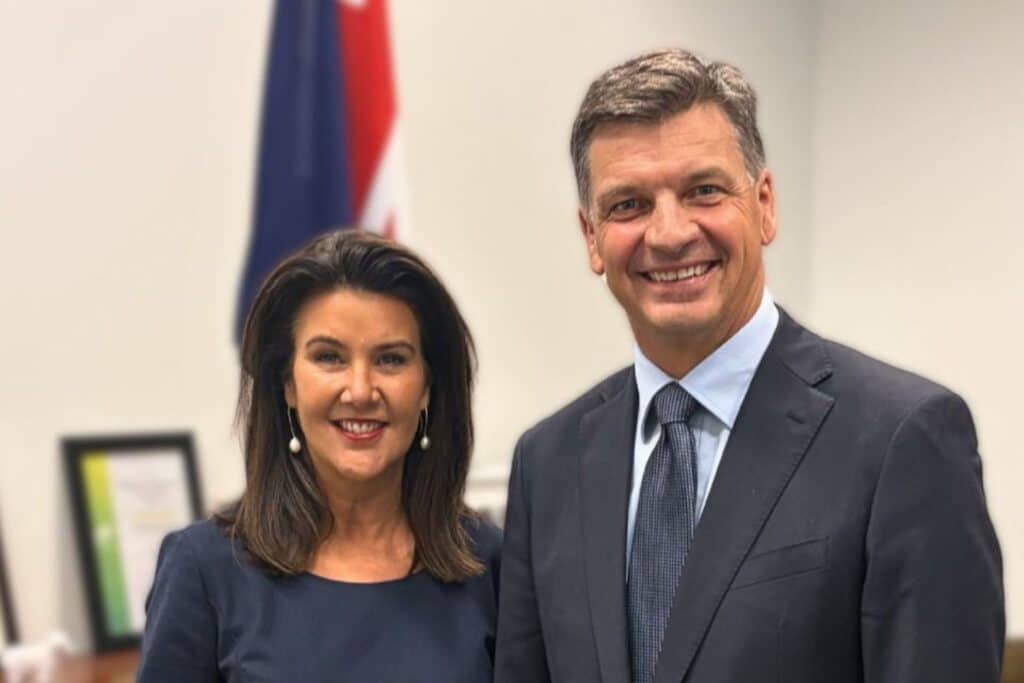
The election of Jane Hume to Deputy Leader of the Liberal Party marks a pivotal moment for the party as it recalibrates its policy direction and political messaging following the latest leadership spill.
This morning’s upheaval saw Angus Taylor defeat Sussan Ley in a decisive vote to end Ley’s short tenure as the party’s first female leader.
In the deputy contest, Hume defeated incumbent Ted O’Brien with 30 votes to 20, emerging victorious from a multi-candidate field.
As Hume now sits positioned as a central role in shaping the Liberal party’s new political direction, we’re taking a look at her career and previous policy stances.
Having grown up in Melbourne, Hume began her career in the financial services industry. She was elected as a Liberal Senator for Victoria in 2016 and has since held ministerial portfolios including superannuation, financial services, the digital economy and women’s economic security.
Ahead of Hume’s decision to run for Deputy Leader of the Liberal Party, she told reporters her motivations were because “the Liberal Party is crying out for change.”
“Sussan Ley has been a diligent, hard working servant to our party and to the country, but unfortunately, we’re simply not cutting through now.”
“Australians are rightly aggrieved at the moment. They’ve seen their standard of living go backwards under this Labor Government. Inflation’s gone up, growth has stalled. They’re feeling poorer, and they’re certainly not feeling safer,” Hume said.
“But that doesn’t seem to be translating in a switch to the Liberal Party. They’re not seeing an alternative in the message that we have, in the policies that we have articulated. So something has to change.”
What policies does Jane Hume support?
Fiscal conservatism
Hume has consistently stated her economic stance towards fiscal responsibility, lower taxes and reduced government spending. She has argued that the Coalition should deliver disciplined budgets, and she has criticised the Labor Party’s economic stance as harmful towards investors.
“I believe that fiscal responsibility is a moral imperative and we have a fiduciary duty to our constituents to ensure that we spend their money wisely,” Hume said in parliament.

A key point of Hume’s criticism towards iLabor has been in their plan to double the tax rate on superannuation funds with balances exceeding $3 million, which she said is a clear example of Labor targeting investors.
Hume also supports self-managed super funds and individual retirement control.
Women’s economic security
In 2021, Hume became Australia’s first Minister for Women’s Economic Security and was focused on improving women’s financial outcomes through superannuation reform.
She often, however, attributed women’s poorer retirement savings to financial literacy issues, while critics pointed out that structural inequality issues, such as low pay in female-dominated professionals and caring responsibilities disrupting career progression, were being ignored.
Work-from-home
Another notable policy stance from Hume includes her views towards WFH policies, which have drawn controversy.
During the 2025 election campaign, Hume criticised the Albanese government for giving public servants “a blank cheque to work from home”.
“While work from home arrangements can work, in the case of the APS, it has become a right that is creating inefficiency,” Hume had said, with critics worried that flexible work arrangements would be under threat with a Liberal government. Hume later clarified that there would be no change in WFH policies.
Ahead of the 2025 election, Hume also said the Liberal Party’s plan was to save $17.2bn by slashing the number of Canberra-based public servants by 41,000. However, critics were concerned this would drive the budget into a deeper deficit.
Net-zero emissions target
In climate debates, Hume has supported the net-zero emissions target, arguing that voters support this emissions reduction and that the Coalition should “embrace” it.
“When the Liberal Party is putting together its policy platform, it should consider not just the seats that we hold but the 33 that we need in order to form government,” Hume told Sky News last year, adding that “those 33 electorates have said that they want a net zero”.
To get to net zero, she has suggested nuclear energy could help meet this climate goal and criticised the Labor government’s renewable rollout and subsidies.