
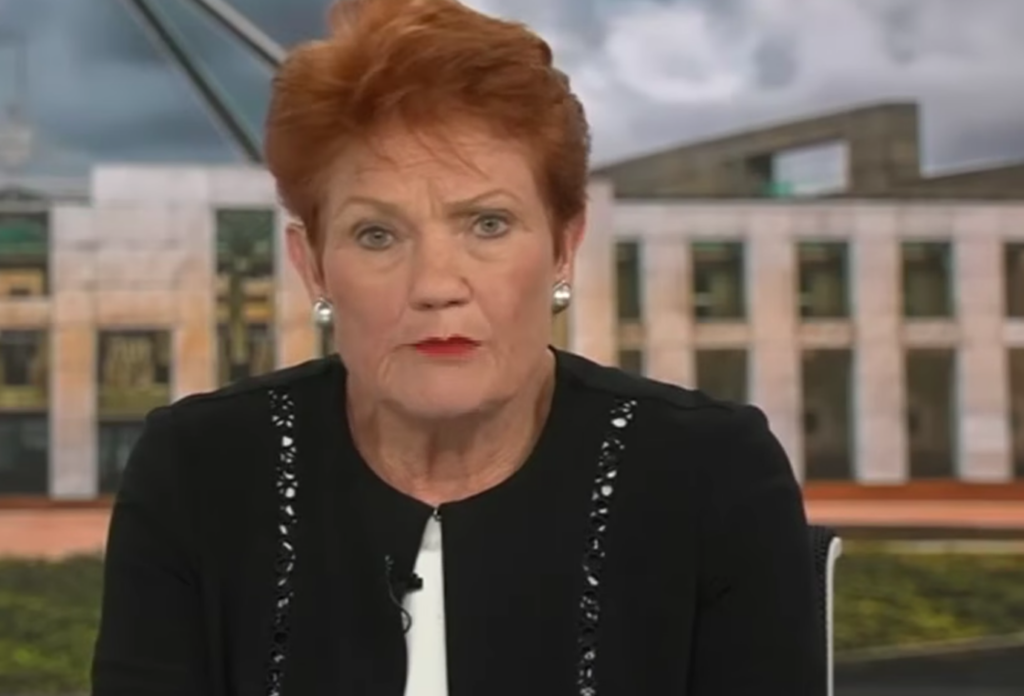
It’s tempting to look at the rise of Pauline Hanson yet still not take it very seriously. Maybe she points to a collective donkey vote of sorts; an act of political frustration and defiance that will pass once the cost-of-living crisis eases or the major parties start doing their jobs better.
I think it’s time we confronted our arrogance rather than continue thinking this way.
Recent polling showing One Nation has now surged to become the most popular party in Victoria signals something far more structural and sustained. As for women and minority groups? The political momentum behind Hanson indicates something especially sinister.
While economic discontent is real and people are struggling, this is not the crux of the issue where Hanson’s popularity is concerned. People don’t see her as the saviour to their hardship; they see her as an outlet to their anger. She is a safe confidant for all our worst thoughts and impulses. She stokes them and shapes them into a new worldview.
And that worldview is becoming more explicit. Just this week, Hanson inflamed already fraught cultural tensions by pledging ongoing support for Ben Roberts-Smith, despite the serious findings against him.
“Ben, his immediate and broader defence family need the Australian people’s support right now and I will not abandon him like so many other politicians,” she told media after Roberts-Smith was charged late on Tuesday with five counts of war crime murder, in relation to three incidents.
For Hanson, this was a purposeful act to cast powerful men as victims of an overreaching system. It’s a common thread in the Manosphere.
And who better to achieve this level of unrest than Hanson? After all, she has spent 30 years in politics honing culture wars as a fine art. Complex questions about justice, harm and responsibility are flattened into binaries: loyalty versus betrayal, “ordinary Australians” versus elites, men versus institutions that seek to hold them to account. It’s extraordinarily successful in building votes.
What is most unsettling is where Hanson’s support is growing. It’s no longer confined to a narrow base. Women, younger voters, and those who might once have been assumed to reject this brand of politics are now part of its expansion. The rise of One Nation tells us that a significant number of Australians feel not just economically squeezed, but culturally displaced.
But the populist politics of One Nation will do nothing to resolve peoples’ grievances. Instead, Hanson, Joyce and the rest of their mutating fray will redirect them. New divisions will be spurred on. The original problems will remain intact.
Hanson’s rise is not a uniquely Australian problem. We’ve seen similar patterns play out globally: Trump, Farage, Meloni, to name a few. But that doesn’t make it any less confronting.
And the failure is not just ours as a society to bear, nor is it purely Hanson’s.
It’s the fault of mainstream politics and systems that have failed to meet people where they are and where their problems exist. Limited visions, tired power struggles, egos aplenty. It’s little wonder that against that backdrop, simpler, louder, more divisive narratives have taken hold.
Hanson’s popularity will continue to grow and we’re at risk that her rhetoric, previously considered extreme will be normalised as we’ve seen in the US. Just last week, we witnessed Donald Trump threaten genocide on Iran in a series of expletive-laden posts. Barely anyone blinked.
And where culture wars become the sole agenda, small steps of progress will undoubtedly stall. Gender equality will be deprioritised, systems designed to address violence and discrimination will be weakened.
So the question is no longer whether we understand what is happening. We do. The polling is clear.
If this moment tells us anything, it is that disengagement is not neutral. The space left by weak leadership does not remain empty. And Pauline Hanson has always known this more profoundly than most.