
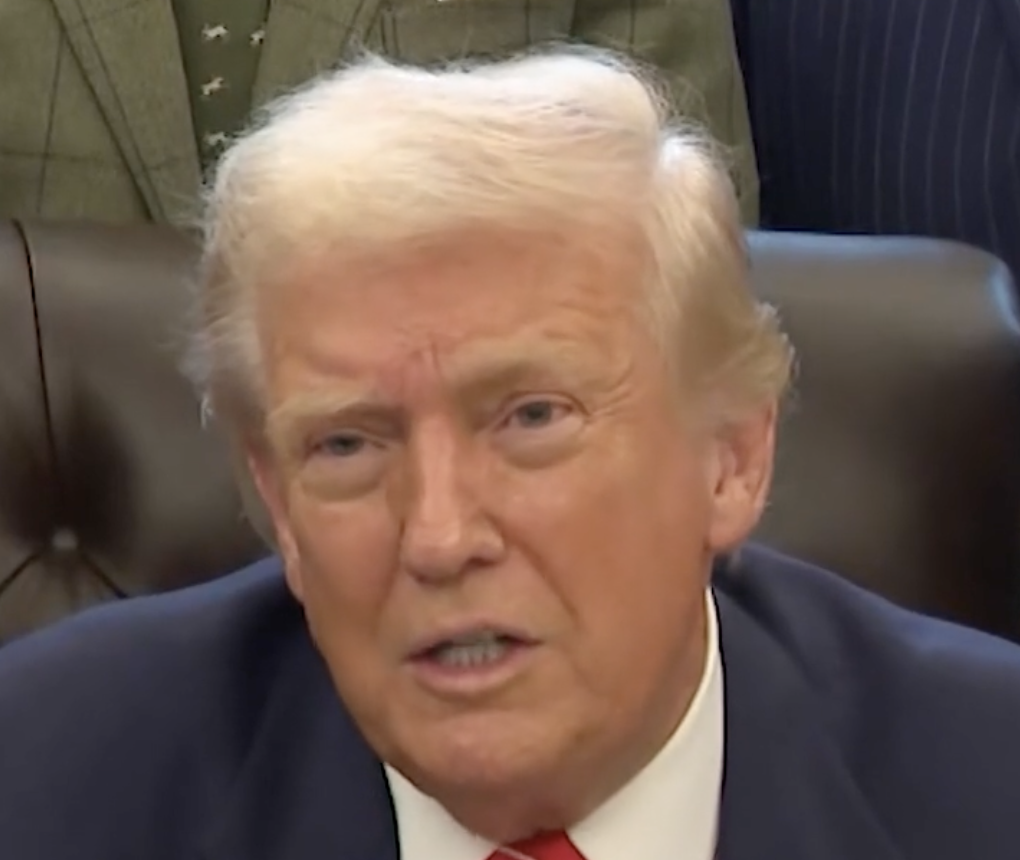
Donald Trump really is squirming under pressure from women journalists, especially those who dare to probe him on his (obvious) ties to prolific sex offender Jeffrey Epstein. And rather than respond with answers, Trump’s reflex is the same as it’s always been: to personally attack the woman asking the question.
CNN journalist Kaitlan Collins is the latest to send Trump into a public tailspin.
During a press meeting in the Oval Office last night, Collins asked the President a straightforward and entirely legitimate question in response to the heavily redacted sections of the Epstein files: “What do you say to people who feel like they haven’t gotten justice, Mr President?”
It was a question about survivors and whether the most powerful man in the world believes those harmed by one of the most notorious sexual abusers in modern history deserve answers.
Trump initially tried to palm the question off. But then he couldn’t help himself.
“What did you say, CNN?” he barked. “You are so bad. You know, you are the worst reporter. No wonder CNN has no— CNN has no ratings because of people like you.”
Trump then blanked the question entirely in favour of scrutinising Collins herself.
Addressing others in the room, he said: “You know, she’s a young woman, I don’t think I’ve ever seen you smile. I’ve known you for ten years. I don’t think I’ve ever seen a smile on your face.”
Collins, calmly and professionally, tried again. “Well, I’m asking you about survivors of Jeffrey Epstein.”
Trump interrupted her to say the reason she wasn’t smiling was because she “knows she’s not telling the truth,” adding that CNN “should be ashamed” of her.
“These are survivors of a sexual abuser,” Collins stated once more, refusing to be baited into the sideshow Trump was so clearly intent on creating.
Of course, we have seen this pattern repeatedly from Trump. Women journalists asking serious questions about Epstein, accountability and power and the President responding with gendered contempt.
In November last year, Bloomberg reporter Catherine Lucey questioned Trump about Epstein aboard Air Force One. His response? “Quiet. Quiet, piggy.”
The exchange took place while Congress was actively pushing for the Department of Justice to release remaining evidence in the Epstein case.
That same month, ABC News’ Mary Bruce asked Trump why he was waiting for Congress to pass legislation ordering the release of the Epstein files instead of doing so independently and straight away.
Trump’s reply was a tirade.
“You know, it’s not the question that I mind, it’s your attitude,” he said. “I think you are a terrible reporter. It’s the way that you ask these questions… You start off with a man who is highly respected, asking him a horrible, insubordinate and just a terrible question.”
He continued: “You’re all psyched up. Somebody psyched you over at ABC. You’re a terrible person and terrible reporter.”
Again, no answers.
At the time, White House press secretary Karoline Leavitt defended the comments, saying they showed the president’s “frank and honest” nature, and that Trump simply gets “frustrated with reporters” who behave in an “inappropriate and unprofessional way.” She also rejected the suggestion that Trump has an issue with women reporters — a claim that becomes harder to sustain with each new incident.
What we are witnessing is not a president bristling at unfair treatment but a man who becomes visibly unmoored when women refuse to soften their questions and demeanour toward him.
And while this behaviour may be familiar, that’s precisely why it’s so dangerous.
We should resist the temptation to treat these moments as background noise, because the greater the volume of chaos, the greater the risk of numbness. The more often we see this kind of abuse, the easier it becomes to shrug it off as “just Trump.”
But none of this should ever be normal.
The fact that Trump thinks it’s fair game to comment on a young female reporter’s facial expression while she is asking about sexual abuse survivors is beyond belief. The fact that he routinely insults, humiliates, and attempts to discredit highly respected women journalists when they ask questions the public has every right to hear answered should tell us exactly what is at stake.