
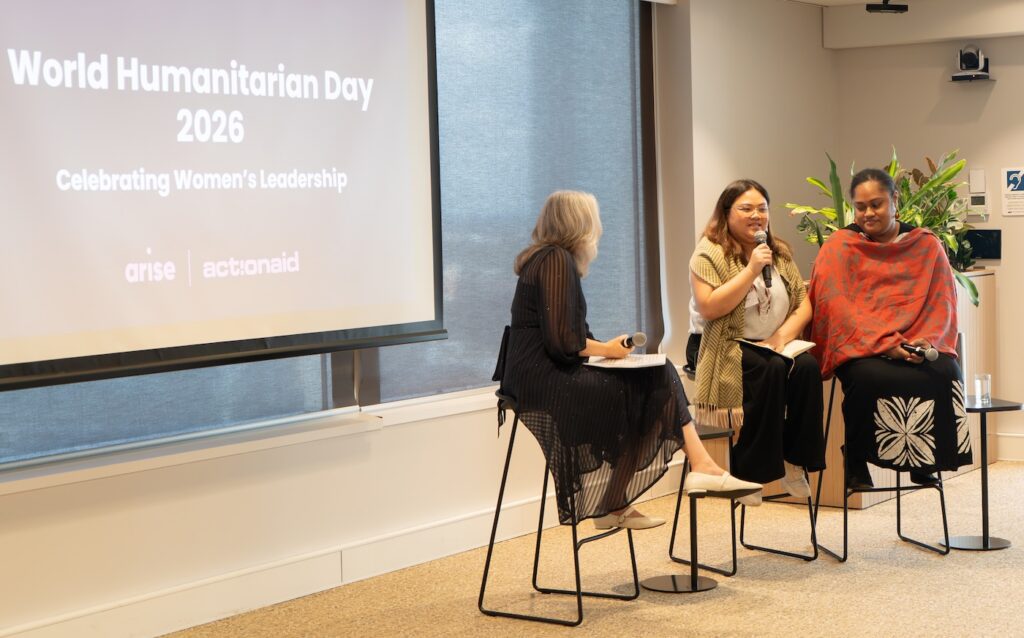
As Australia prepares to take the negotiating chair at COP31 in Antalya in November and Fiji hosts the Pre-COP, two women leading disaster responses across our region set out what they expect in return.
They made the comments at an ActionAid Australia lunch in Sydney, held to mark World Humanitarian Day.
Carolyn Kitione has watched Pacific experience travel a long way into policy rooms, only to see little return in terms of actual commitments.
“I get a little bit upset when you’re sitting in conferences that talk about Pacific stories, that use Pacific people as evidence of getting things going in those policy spaces,” she told the Sydney audience on Wednesday.
“Because you’re using our evidence, but you’re not giving us money to do that. You’re not opening doors for us to sit there and tell our own stories. And you’re not actually doing anything to come back to us … and say, ‘This is what’s come out of that.’”
“There’s always going to be the so what question from us when we hear, ‘Oh, we used your story in this space.’ Yeah, and then what happened next? What’s going to happen?”
Kitione works with the Shifting the Power Coalition, which now spans 15 women-led organisations across eight Pacific Island countries.
She was joined on the ActionAid panel by host Tracey Spicer AM, as well as Lei Escobar of the Philippines’ National Rural Women Coalition and Women in Emergencies Network
Australia is due to serve as President of Negotiations at COP31 in Antalya, Türkiye, from 9 to 20 November, with Fiji hosting the Pre-COP, an arrangement that gives Australia and the Pacific a rare opportunity to have more influence over the global negotiation.
But Kitione is not currently all that optimistic about the outcomes ahead.
“…you have the opportunity to advocate, to influence some of those discussions. It’s a reminder that Australia came into the COP31 leadership on the promise that it will back Pacific hard lines and red lines. And that is the outcome that we would also want to see, without just using us as a nice feel-good story. There has to be political action that matches what they’ve said and what they’re going to say at the upcoming foreign leaders meeting as well.”
Asked what she wanted out of the conference, Lei Escobar was blunt: more paperwork was the result.

“It’s been a lot of years that we’re going to these conferences. A lot of documents have been produced, a lot of agreements, a lot of discussions,” she said.
“But I’m also speaking on behalf of the rural communities, of rural women’s organisations, that we do not need a lot more rhetoric, a lot more documents that we cannot understand because they’re in English. We need complete actions. We need complete plans coming from our governments, coming from the countries who are doing a lot more to create this crisis.”
Escobar also noted the need to ensure actual representation.
“We have to ask ourselves, who is participating in these events? Who are leading the negotiations? Who is allowed to speak for more than two minutes?”
“Women’s groups is not a homogeneous category … So where are the women with disabilities? Where are the indigenous women? Are we all represented?
“The most vulnerable communities, the people who are actually living the effects of the climate crisis, should be the one leading these discussions… These communities have to be the one to define what ‘just’ is, what equality means. It shouldn’t be the one who’s causing this crisis, because justice for them would be a different definition.”
“We are only as empowered as the most vulnerable among us. So bring rural women in the room, bring the most vulnerable communities in the room. Let them lead the negotiation. Let them define the narrative.”
In her opening address at the lunch, ActionAid Australia Executive Director Michelle Higelin said the moment “urgently calls for women’s leadership”, and that the money has never matched the rhetoric.
Noting the dire stat of just 5 per cent of global humanitarian funding being directed to reducing the risk of disasters, she said, “yet it is crucial in saving lives and stopping inequalities from deepening when crisis hits. Inequalities that see violence against women increase, women shut out of decision-making and lose their livelihoods in disasters.”
Higelin also outlined the work of ActionAid’s Arise Fund, first established in 2017, and designed to scale up women’s leadership on climate and disasters. The fund has since supported the training of more than 49,000 women who have gone on to lead emergency responses in 23 countries, reaching more than 4.4 million people.
The fund has also supported the women’s networks that both panellists work with in their countries.
Escobar, whose organisation was running flood assessments across the Philippines even as she spoke in Sydney, asked the room to look past the tallies of affected households and economic losses when it comes to disasters.
“Behind every number is a story,” she said. “A story of a family, a story of a woman, and a story of a rural woman particularly that we are working with.”
“Rural women are asked to recover again and again and again in a crisis that we did very little to create.”
More than 2,000 women have been trained through her network in disaster resilience in the Philippines, with survival and feminist leadership skills. But Escobar said the harder work is what they’re doing to shift the narrative.
“We challenge the narrative that women are just victims of disasters, that women are just beneficiaries, that women are just recipients of aid,” she said. “Instead, women are agents of change. That is a simple but very powerful belief that is at the heart of our organising.”
From recognition to resourcing
The Shifting the Power Coalition that Kitione leads began when there were no local women around the decision-making tables of cluster meetings as government response teams went into communities after Tropical Cyclone Pam in 2015 and Tropical Cyclone Winston in 2016.
Years later, Fiji’s National Disaster Management Act was revised to recognise women as first responders. Kitione, then a young woman starting out, was proud. But now aged 32, she says she has run out of patience if recognition becomes the final goal.
“In ten years, if all we’re doing is recognising women as first responders, then we’ve sort of failed as policymakers, as decision-makers, because we should have moved from recognising to actually resourcing the women who respond to their community,” she said.
“There’s some real political will that needs to happen in Pacific governments, the Australian government as well… for money to be moving from just supporting government machinery to women-led coalitions and networks who have spent generations building the trust and the relationships that they have to keep the movement going.”
Asked from the floor what the ideal next step looks like beyond the lip service of calling women first responders, she went to the ledger: less than 5 per cent of climate funding reaches communities, less than 1 per cent of that goes to civil society organisations, and less again to women-led organisations.
“Direct the money directly to the communities, the women, the organisations that are doing it,” she said. “And it isn’t just about directing money to the women that do the work, it’s also about providing them with the space to learn from experts so that we understand the technical language. Again, that … needs money.”
“Ideally, when policymakers or disaster management officers start speaking about women as first responders, they’re not just recognising us — they can also announce how much they’ve actually invested in the leadership of women and girls responding to multiple crisis.”
She also pointed to the care burden Escobar had described, and to what it costs the women who carry it while running a response: “Yes, we can stretch $25 a week, but that doesn’t mean we should have to. Women should not be expected to choose between responding to their communities post-disaster and supporting the preparedness work, but it should also mean they shouldn’t have to choose between trying to keep the lights on at the office and at home.”
Escobar closed on connection, and on whose stories she had been telling.
“All of the things that I mentioned are coming from the rural women who are working harder than I am,” she said.
“For this movement to really push forward, we need to understand each other’s pains. We need to understand what empowers us. We need to understand what disempowers the others. And from that point of sharing the learnings, the challenges, we can envision a future, a kinder one, a more just future for each and every one of us.”
“So let us all help women rebuild the world.”