
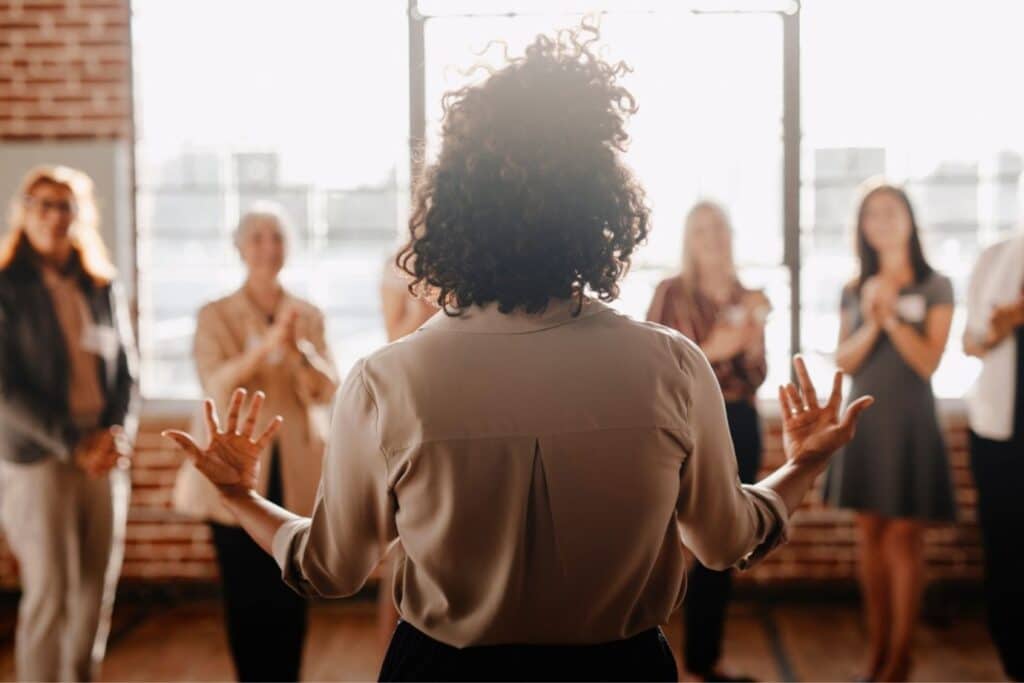
At the recent Commonwealth Bank Elevate leadership conference, Ruth Limkin, CEO of The Banyans Healthcare, asked the audience a seemingly offhand question:
“How many of you are the eldest child?”
Around 85 per cent of the room put their hands up. A room of senior leaders, executives and high-achievers across multiple industries. All women.
It also immediately made me wonder whether being the eldest daughter and carrying additional responsibility prepares women for leadership in a healthy way, or if we simply reward a set of behaviours that look like leadership, but can ultimately become a fast track to burnout?
It’s a question Limkin has been wondering too.
“It was an off-the-cuff question that I hadn’t planned to ask,” she tells me when we catch up about the moment. “But one of the things I’ve been thinking about over the last couple of months is really about the things that women bring into burnout and some of the pre-existing conditions and mindsets.”
“I think eldest daughters’ sense of obligation to others and responsibility to others is a contributing factor, and it’s not surprising, given sometimes the environment and the nurture of eldest daughters, that we see some correlation”, she adds.
The internet has dubbed it “eldest daughter syndrome”, that tendency to become the responsible one, the helper, the organiser and the person everyone can count on. While it’s not a clinical diagnosis, the phenomenon clearly resonates with women.
And perhaps that’s because many women can trace their leadership strengths back to the very same traits that are now exhausting them.
Competence becomes identity
Women who become leaders are often praised throughout childhood for being mature, capable and dependable.
They’re the ones who help with younger siblings, who take responsibility and don’t cause too much trouble. But Limkin warns there can be a hidden cost when those qualities become entwined with identity.
“Sometimes our identity can get woven into our responsibility,” she says.
“And that’s a really dangerous place to be, because if me being me means I’m the one who carries the responsibility for everyone else, we actually don’t know how to extricate ourselves from that performance expectation.”
It’s likely something that hits home for women who have built successful careers while simultaneously carrying the emotional labour of families, friendships and workplaces.
Many women aren’t chasing status or power for power’s sake. Instead, they’re trying to be useful and they’re trying to help. The problem is that responsibility left unchecked can become limitless.
Confusing resilience with self-sacrifice
The conversation also raises an uncomfortable question about the way we define leadership itself.
For years, many workplaces have rewarded visibility, long hours and constant availability. If you have no life outside of the office, and no ability to switch off, then you’re likely on the fast track to success.
Limkin believes we’re still celebrating the wrong things.
“One of the things that we’ve mistakenly done with leaders of all genders is we’ve really celebrated inputs rather than outcomes,” she says. “We’ve looked at who’s logged on the longest, who’s generating the most visible inputs, rather than thinking about how we’re actually getting things done.”
And for women already predisposed to carrying responsibility, that can become a dangerous combination. Because while society praises their capacity, very few people ask what it’s costing behind the scenes.
Why so many women struggle to ask for help
At The Banyans, Limkin works with professionals experiencing burnout, mental health challenges and substance dependence. One pattern she sees repeatedly among women is their reluctance to prioritise themselves.
“People feel like they can’t take the time or invest in their own recovery because it feels irresponsible,” she says. “They talk about, ‘I’ve got kids, I’ve got a business, I’ve got a partner that I have to be there for.'”
The paradox, of course, is that refusing to step away often makes things worse.
“We get into this self-defeating spiral of ‘I can’t step away because I’m responsible for people’, and yet our ability to care and love for those people keeps diminishing because we’re running on empty.”
The same people who would immediately tell a friend to take a break, book the doctor’s appointment or seek support are often unable to extend that same compassion to themselves.
The sandwich generation squeeze
The pressures facing women today aren’t happening in isolation. Many are raising children while supporting ageing parents, managing households, maintaining relationships and sustaining demanding careers.
The term “sandwich generation” exists for a reason.
“It’s used because it’s real,” says Limkin. But she believes another factor is making things harder. “We have increasing social isolation and less community connection. When you don’t have a village, you’re the only person who’s there to care for people.”
For many women, the load isn’t simply staying the same. It’s compounding.
Rest now feels irresponsible
Perhaps the most telling insight from Limkin is how many women have lost the ability to rest. Not because they don’t want to but because they no longer know how.
“Rest feels irresponsible,” she says simply.
At The Banyans, clients are often encouraged to slow down and rediscover what genuine rest looks like.
“The weekends are deliberately quieter because you need to learn how to rest and be okay with it. And you just know they’re going to be crawling up the walls that first weekend”, Limkin jokes.
But she argues emphatically that one of the things we all need to relearn is that rest isn’t a luxury but a life skill.
The signs you’re heading towards burnout
So what should women be looking out for?
According to Limkin, the warning signs often appear long before a crisis point. Increased alcohol consumption is one.
“We’ve seen about a 40 per cent increase year on year in inquiries for help with alcohol,” she says.
Other signs include losing the ability to switch off, abandoning healthy routines and becoming persistently irritable. And then, of course, there’s sleep.
“If we’re consistently waking up at three o’clock in the morning or we can’t get to sleep at night, that’s both an indication that we’re not functioning as well as we should be, but it’s also a contributing factor.”
Perhaps one of the simplest indicators is whether you’ve stopped doing the things that keep you well.
If you’ve skipped your annual health checks, cancelled routine appointments, stopped exercising and eating well, those small patterns can reveal a lot.
What we should be teaching the next generation
If eldest daughters are still carrying disproportionate responsibility, how do we stop passing that burden onto the next generation?
Limkin’s answer isn’t about what we tell kids but about what we show them.
“I think it’s less about what we teach them and more about what we demonstrate.” That means modelling lives that aren’t solely measured by productivity and performance.
Closing the laptop before everything is finished, taking the walk, going to the doctor and resting without guilt. Ultimately, showing kids that worth isn’t earned through exhaustion is the greatest gift we can give them for their own futures.
“I think the idea of work-life balance trips us up a little bit,” says Limkin. “Being really explicit around work-rest rhythms is helpful for us and role models for the next generation.”