
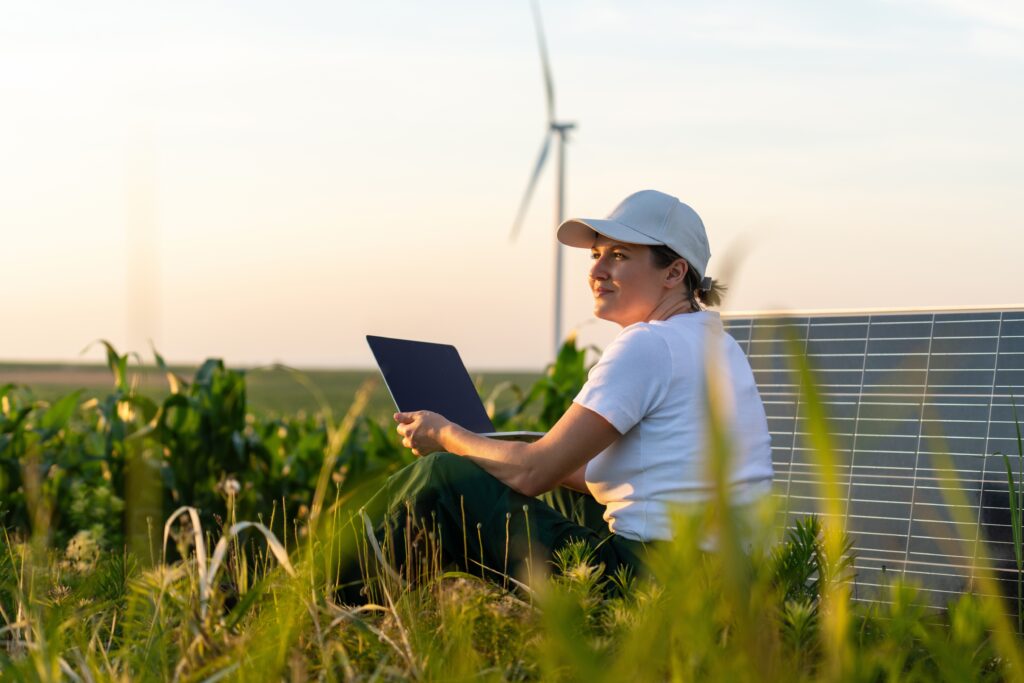
Women are already doing the heavy lifting in regional energy transitions, often without recognition or support. If Australia is serious about a just transition, governments must start treating women’s participation as core infrastructure, writes Kate Gaffney.
Climate change is a women’s issue, not only because women and girls face disproportionate harm when systems fail, but because the success of the clean economy transition depends on work already being done, quietly and consistently, by women in communities undergoing change.
In Australia, our transition debate has rightly focused on protecting workers in coal-fired power and other emissions-intensive industries. These workforces remain heavily male-dominated. Yet the day-to-day work that makes regional transitions real, from coordination and education to trust-building and community problem-solving, is often carried by women.
Transition policy must do three things at once: support existing energy workers and their communities, ensure the transition does not deepen gender inequality, and actively expand economic opportunity for women and girls in the regions that are changing.
Climate change is often framed as an emissions problem or an engineering challenge. But it is also a question of power. Who carries the risk, who gets protected, and who gets the opportunities created by change?
The evidence is consistent. Climate shocks amplify existing inequality. The United Nations and UN Women have long shown that women and girls experience disproportionate impacts because of structural inequalities in income, access to services, safety, health and decision-making power. Climate change also increases unpaid and care workloads, often at the same time as paid work and livelihoods become more precarious.
Writing recently in Women’s Agenda, Michelle Higelin, Executive Director of ActionAid Australia, shared how every degree of global warming deepens gender inequality, intensifying food insecurity, livelihood loss and risks of violence. Unless climate action is deliberately designed to address unequal impacts, climate change will continue to roll back progress on gender equality.
Despite this evidence, Australia’s transition frameworks have largely been built around managing the impacts on the male-dominated fossil fuel workforce, with far less attention paid to how transition is actually carried out at the community level.
When the transition is genderblind, it is not neutral
The clean economy is gathering pace. But if the transition is treated as a purely technological exercise, swapping coal for wind and gas for batteries, old inequities risk being reproduced in new industries.
Women remain underrepresented in clean energy work, particularly in technical, trade and leadership roles. These are often the most secure and best-paid jobs in the transition. Women currently comprise approximately 35–39 per cent of Australia’s clean energy workforce—a higher level of participation than in traditional energy sectors, but still far from gender parity. Beneath this headline figure lies a more troubling reality: women remain significantly underrepresented in the roles most critical to the energy transition, making up just 2–4 per cent of workers in technical trades and only around 19 per cent of leadership and board positions across the sector.
Government and industry bodies, including the Clean Energy Council, Jobs and Skills Australia and ARENA, have consistently warned that Australia will not be able to meet its clean energy and net-zero workforce demands without dramatically increasing women’s participation, particularly in trades, technical pathways and decision-making roles that shape the future of the clean economy. Without deliberate intervention, women can be clustered away from opportunity while still absorbing many of the social and economic costs of change.

But inequity is not only about formal employment. Much of the real work of climate transition does not happen in boardrooms or policy documents. It happens at the community level, and it is overwhelmingly carried out by women.
Women’s Agenda has documented how women are often on the frontlines of climate response as organisers, educators, volunteers and informal leaders. This work is essential to the success and legitimacy of the transition, yet it is rarely counted as part of the transition. A transition that relies on women’s unpaid and underrecognised labour, while excluding them from decision-making and economic opportunity, is not only unjust. It is structurally fragile.
From plans to practice
Australia is no longer short of transition frameworks. Governments have released net-zero strategies, energy transition plans and clean economy roadmaps, and the establishment of the Net Zero Economy Agency reflects growing recognition that decarbonisation is also a workforce and regional challenge.
But plans and good intentions alone do not guarantee a just transition.
Too often, transition policy treats workforce change as a technical exercise. Skills are mapped, jobs are forecast, and labour is assumed to move smoothly from one sector to another. What is missing is recognition that transitions are lived locally and that women are already doing much of the work that holds them together.
Australia’s just transition frameworks have largely been designed around the needs of male-dominated energy workforces. This focus is essential for protecting workers, but it obscures the gendered reality of how transition actually happens in regional communities.
If our definition of a just transition begins and ends with the fate of the directly employed power station workforce, we miss the social and economic infrastructure that makes the transition possible, including the local expertise and unpaid labour disproportionately borne by women.
What I learned in the Latrobe Valley
The Latrobe Valley in Gippsland has generated coal-fired electricity for Victoria for more than a century. It is now navigating profound economic change. The region is also Australia’s first designated offshore wind zone, meaning it is managing the decline of coal-fired generation while pioneering new energy industries.
Throughout 2024, I worked in the Latrobe Valley as Manager, Renewable Energy Transition at Federation University. Almost all of my work was with women leaders.
This was not by design. It was simply how the transition ecosystem in the region had evolved.
The women I worked alongside came from energy companies, universities, TAFE, adult and community education, secondary schools and volunteer networks. Their authority did not come from job titles or their position in a corporate hierarchy. It came from deep and interconnected local histories, trusted relationships and expertise built over years of work in and with the community.
These women translated policy into practice. They built trust, connected employers and educators, supported workers and families, and advocated relentlessly for their communities, particularly those least heard.
This is not unique to the Latrobe Valley. In many transition regions, women become the organisers, translators and stabilisers because they are embedded in institutions and relationships that persist through industrial change.
From recognition to opportunity
The lesson here is not that women should simply keep carrying this load. A just transition cannot depend on women’s unpaid or passion-driven labour alone.
If the clean economy is to be genuinely just, it must lift all women, not only by protecting communities from harm, but by ensuring women and girls have equal access to the jobs, training, reskilling and leadership opportunities the clean economy creates. Recognition without opportunity is not justice. Support without pathways is not inclusion.
If governments are serious about workforce transition, supporting women’s participation and leadership cannot be left to chance. This is the responsibility of governments and transition authorities. They must listen to, respect and work with the knowledgetransfer and leadership cultures and governance structures already in place in transition regions, and actively support them.
Access to training and employment is shaped by systems that policy controls. Workforce participation depends on safe, reliable and accessible transport, reliable digital connectivity, accessible childcare, paid placements and apprenticeships, and flexible education and training pathways for people who cannot step away from income or care responsibilities while reskilling.
These are not peripheral issues. They are core transition infrastructure. When these systems fail, women are the first excluded, not because of a lack of interest or capability, but because policy has misjudged what participation actually requires.
A transition that works
Climate change is a women’s issue because inequality shapes impact, and because transitions can either repair inequality or reinforce it. The clean economy is inevitable, indeed it’s already happening. Whether it is inclusive, skilled and community-anchored, or whether it repeats old patterns under new technology, is a choice we are making now.
A transition that fails to see women clearly, especially while unwittingly relying on them, will struggle for legitimacy. A transition that supports them will be stronger, fairer and far more likely to succeed.