
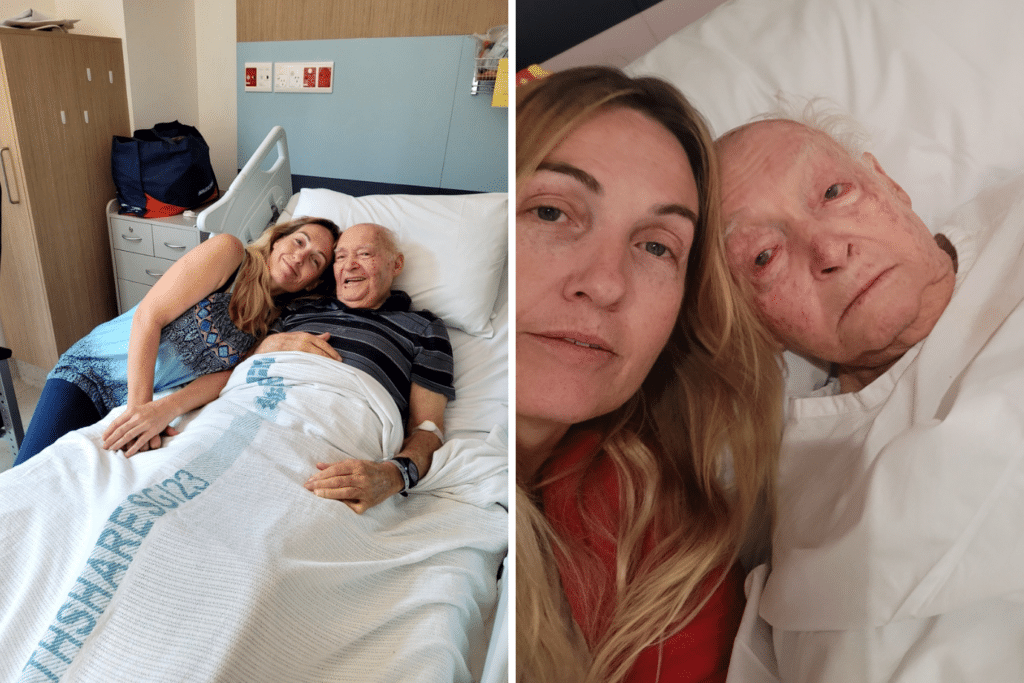
For almost two years, Jodie started her mornings with a coffee and a two way camera.
One camera sat in her father’s living room, three hours down the road from her place at Raymond Terrace. The other was on her phone. Before work she would watch her dad, in his late eighties, try to get himself out of a chair.
“I used to sit here every morning and look at the camera and watch him get up and struggle.”
Jodie has teenage daughters and a job. Every weekend she drove more than two hours from Sydney and more than two hours back to look after him. Jodie lives in public housing and asked for a housing transfer in November 2024 so she could live closer to him. It never came. Once she crashed her car racing to get to him after he had fallen while trying to get up off that damn chair.
Her father had been assessed the previous January and then waited eight months for a callback. He was approved for a Level 8 Support at Home package, the highest there is, and was told the funding would take another seven months to arrive.
The care package he already had went backwards while he waited. After the price rise on 1 July his provider cut his personal care to half an hour, took away the Saturday visit, took away the cleaner and halved his nurse visits. The system did not stand still while he waited. It shrank.
In August he was admitted to Nepean Hospital so anaemic he needed two bags of blood and an iron infusion. He died in late September. The call offering him a reassessment came after he had been moved to end of life care.
For eight of those months the only monitoring he got was a camera in the corner of the living room, watched every morning by a woman hours away with cereal and her heart in her mouth.
“If I had been there, his life would have been different these last 18 months. He said, I want to try and walk, and I’ve got no one to walk with.”
Nobody had counted Jodie
This week Vera and YouGov published the first national count of the Jodies: the Australians caring for an ageing parent. There are 2.43 million of them, aged 35 to 70, doing it at least once a week.
Treasury puts health care and social assistance, this country’s largest employing industry, at around 2.4 million people. We count every one of those workers every month. About the same number of Australians are caring for their own ageing mum and dad, and until this week not one of them appeared in a figure anywhere. Sometimes they are the same people juggling care jobs paid and unpaid on double duty.
The numbers we had were too broad, too narrow or too old. The Bureau of Statistics counts primary carers by help with mobility, self care or communication, which leaves out the appointments, the medications, the provider phone calls, the coordination and the chasing. That is most of what this work actually is.
Every existing definition of the sandwich generation also required children to be at home. It describes a 1950s household: one income, kids under the roof and a woman with time on her hands, which was not true then either. It writes off everyone whose children have grown up, everyone who never had any and anyone who married into the job. You do not need children to be in the sandwich. You need parents or parents-in-law. So Vera built a definition for the families this country actually has, and set a high bar, so nobody gets counted for a regular phone call on a Sunday night.
We never used the word carer in a single question. Ask people whether they are carers and you count the people who accept the word rather than the people doing the work. Which turned out to be the finding. Only 46 per cent of the sandwich generation think of themselves as carers. Carer Payment, carer leave, Carer Gateway: every door this country has built for these people has that word painted on the front of it, and most of them would never use it about themselves. You have to claim the label before you are allowed through.
What it costs the people doing it
More than half of working Australians caring for a parent have spent their own annual, personal or other leave on it. Almost a third say it has cost them career progression.
Leave comes back next year. Promotions do not.
And we found people who say their employer understands have used the same amount of leave than people who say their employer does not. Sympathy, it turns out, is free. Policy costs money, which is roughly why we have so much of the one and so little of the other.
Most of this work falls to women, as the Bureau of Statistics has told us for years. What is new is the size of the group it is falling on.
It is as common at 38 as it is at 68
Everybody pictures a retired daughter looking after her mother. But caring starts younger than we thought. One in five of Australians at every age group from 35 to 70. This means 700,000 Australians aged 35 to 44 are doing the work every week, most of them with small children, a mortgage and a full time job. Every carer program built for the over 50s is designed for a life stage that many have not entered.
Only one in four in the sandwich generation has a plan and somewhere to turn. The rest find out how the system works in an emergency department at two in the morning.
What has to change
Count this population. Put people supporting an ageing parent into the data used to plan health, aged care, work and family policy. You cannot plan for people you cannot see.
Reach them before the crisis rather than after the fall, the admission or the funeral.
And take the word off the door. When most of a service’s users would never claim it, the problem is in the design, and this is the cheapest thing on the list to fix.
6.32 million Australians aged 35 to 70 are either helping a parent now or expect to start within ten years, which is more than one in five people in this country. They will meet the same eight month wait for help unless something changes before they get there.
Jodie’s mornings for two years were a coffee, a camera and a man she loved struggling to stand, hours away. She did that work whether anybody knew it or not. Now she counts.
Stand up and be counted is published this week. Read the report.
YouGov surveyed 1,049 Australians aged 35 to 70 online between 2 and 6 September 2026. Data are weighted to population targets for Australians aged 35 to 70 on gender, region and education, with an effective sample of 961. National figures carry a margin of error of ±2 to 3 percentage points at 95% confidence.